Sunday, January 25, 2015

Reynaud's Optical Theater -- January 25, 2015


Artist and inventor Charles-Émile Reynaud created the Praxinoscope and later in 1888 the Théâtre Optique, which presented hand-drawn moving pictures using perforated film. This item from Magic: Stage Illusions and Scientific Diversions, Including Trick Photography, edited by Albert Allis Hopkins, describes the Théâtre Optique. After movies came to dominate the world of entertainment, Reynaud, in despair, threw most of his equipment and movies into the Seine. 

REYNAUD'S OPTICAL THEATER.

Up to the time of the invention of this theater, the apparatus that produced the synthesis of the successive phases of an action were limited to reproduction upon a very small scale, which can only be enjoyed by a limited group. The object of the optical theater was to provide an apparatus for the reproduction of a series of actions upon a considerable scale. The continuity of the image obtained by the praxiuoscope, invented in 1877 by M. Reynaud, had not up to this time been realized by any projecting apparatus. The effect is produced by using a crystalloid band upon which the images are painted as represented at A in our engraving. The operator can revolve it in one direction or the other by means of two reels. The images pass before the lantern, B, and are projected by the aid of the objective, C, upon an inclined mirror, M, which projects them upon the transparent screen, E. Another projection lantern, B, causes the appearance on the screen of the scene, amid which appear the characters, which change their posture according as the painted band, A, is revolved by the operator.

Saturday, January 24, 2015

Now Booking the Only Official Pictures Dempsey-Tunney -- January 24, 2015

Film Daily, 06-October-1926
Heavyweight champion Jack Dempsey, the Manassa Mauler, defended his title against former Light Heavyweight champ Gene Tunney, the Fighting Marine, on 23-September-1926 in Philadelphia.  Tunney was the underdog, but Dempsey, who had not fought in three years, lost a unanimous decision in ten rounds.  This was a big upset.  After the fight, Dempsey told his wife, actress Estelle Taylor, "Honey, I forgot to duck." 

We recently saw an ad for the "Gross Misrepresentation" distributed by Pathé:
http://bigvriotsquad.blogspot.com/2014/11/this-special-shows-all-law-allows.html
This two-reeler, authorized by promoter Tex Rickard, purports to be "An Excellent Two-Reeler Showing All Their Activities Before and After the Battle -- See the Men Between Each Round"  It does not show the actual fight because the interstate transportation of fight films was illegal from 1912 until 1940. 

Dempsey and Tunney fought again in 1927.  More on that later. 

Dempsey and Tunney later became friends.  When Gene's son John Tunney ran for the US Senate in California, against tap dancer George Murphy, Dempsey campaigned for him. 

Friday, January 23, 2015

News of the Week January 23, 1915 -- January 23, 2015


The 23-January-1915 Motography featured "News of the Week as Shown in Films," with items from current newsreels.

"Lighthouse at Scarborough, England, bombarded by German fleet.  Copyright 1915 by Universal Animated Weekly."  On 16-December-1914, the German battlecruiser squadron, commanded by Admiral Franz Hipper, shelled British port cities including Scarborough, North Yorkshire.  The raid killed 137 people, including many women and children.  These raids on undefended towns allowed British propagandists to give Hipper the nickname "The Baby Killer." 

"Start of Bronx Cross Country run with hundred of entries.  Copyright 1915 by Universal Animated Weekly."  I haven't been able to find anything about this race. 


"The $300,000 fire at the terminal station, Camden, N. J.  Copyright, 1915, Hearst-Selig News Pictorial."  On 03-January-1915, the ferry terminal of the Reading Company, a major railroad, caught fire and burned.  More than 100 firefighters were injured. 

"Firing French 155 millimeter gun at the front in Belgium.  Copyright 1915 by Pathe Daily News."  This is probably a de Bange.  Early in the war, the French had a shortage of field guns larger than the famous 75.  This is the first Pathé newsreel we have seen. 


"Rescuing the injured in the recent New York subway fire.  Copyright, 1915. Hearst-Selig News Pictorial."  On 05-January-1915, an electrical fire at West 55th and Broadway spread smoke through the IRT subway. 

"Barney Oldfield ready to start race against Bob Burman at Los Angeles.  Copyright 1915 by Pathe Daily News." Barney Oldfield was a pioneering race car driver.  Bob Burman died in a 1916 race. 


Thursday, January 22, 2015

Essanay Announces It Has Secured Charles Chaplin -- 22-January-2015

Moving Picture World, 02-January-1915
"You Know What Charles Chaplin Means to Your Box Office!"  You will notice that Essanay always refers to him as Charles Chaplin. 

Be sure to click on all the images to see larger versions. 

December, 1914 and January, 1915 were busy times for Charlie Chaplin.  He made his last movies for Keystone, he signed a large contract with Essanay, he went to Chicago, he made his first movie for Essanay, and he returned to California. 

Motography, 02-January-1915
The New York Motion Picture Company, parent of Keystone, said Keystone would carry on without Chaplin.  "...three new recruits have already been signed at the coast studio, it is not decided just which one of them will be given the stellar comedienne (sic - JT) role."  I don't know much about "Dutch" Ward, but I know that he did not hit the big time with Keystone.  I have seen Billy Walsh mentioned in Variety.  Keystone had a comedian named Harry Gribbon.  I don't know Samuel Gribbons.  "The return of a former Keystone funny man is under consideration."  I wonder if that was Ford Sterling. 

Moving Picture World, 02-January-1915
Chaplin, along with Mabel Normand and Roscoe Arbuckle, is described as a Mutual-Keystone star.  They all attended the San Francisco Screen Club Ball. 

Moving Picture World, 09-January-1915

"First release dates Will be announced soon." 


Moving Picture World, 09-January-1915
"Essanay Now Tops List of Photoplay Producers."  "Best Known Actors and Actresses Seen; Anderson, Bushman, and Chaplin Lead." 

Moving Picture World, 09-January-1915
I like the photo.  "It is probable that Mr. Chaplin is the first to successfully adapt pantomime to the uses of the motion picture."  It says he was already working at Essanay's Studio in Niles, California, but that does not sound correct. 

Moving Picture World, 09-January-1915
"Charles Chaplin closed his engagement with Mack Sennett and has gone up the coast to work for the S. & A. under G. M. Anderson, who came to town and closed a contract with the little comedian."  This item also implies that Chaplin would be working in Niles, California right away. 

Moving Picture World, 09-January-1915
"Our Burg," a column of items about events in Chicago mentions that "Charley" Chaplin had arrived that week and says facetiously that the Essanay studio floor was being reinforced "preparatory for some of Charley's strenuous stuff."  The bottom item mentions that Broncho Billy Anderson spent Christmas in Chicago. 

Moving Picture World, 09-January-1915

Chaplin's only feature for Keystone, Tillie's Punctured Romance, was still in release.  Poor Mabel Normand had her "d" cut off.  That happened a lot.  Read the November 14 review here:
http://bigvriotsquad.blogspot.com/2014/11/tillies-punctured-romance-november-17.html

Seattle Star, 23-January-1915

Seattle's Clean, Well Ventilated, Comfortable Class "A" Theatre (good name) featured Chaplin and Mabel Normand in an excellent Keystone two reeler, "Caught in a Cabaret."   

Moving Picture World, 16-January-1915
"Millions Laugh With Charles Chaplin." 

Moving Picture World, 16-January-1915
"Harry Chaplin"? 

Motography, 16-January-1915

Clarence J Caine's article "Charles Chaplin in a Serious Mood" says that Chaplin "arrived in Chicago the latter part of last week, in company with 'Broncho Billy' Anderson and will remain at the Essanay studios in that city indefinitely, producing his inimitable farce comedies which have proved such a drawing card for exhibitors in all parts of the world." 

"'Do you know to what extent the popularity of your comedies has reached?' I queried.

"'No,' he frankly replied, 'but I have been told that they are quite amusing.  I often wonder if the people sitting in a theater realize the immense amount of thought we put into our efforts or the depth of screen psychology'"

Caine refers to him as "Charlie." 

Seattle Star, 23-January-1915
Seattle's Clean Comfy Cozy Class "A" Theatre featured Chaplin and Roscoe Arbuckle in an excellent Keystone two reeler, "The Rounders,"  with "Mrs. Ed Stoudt at Piano." 

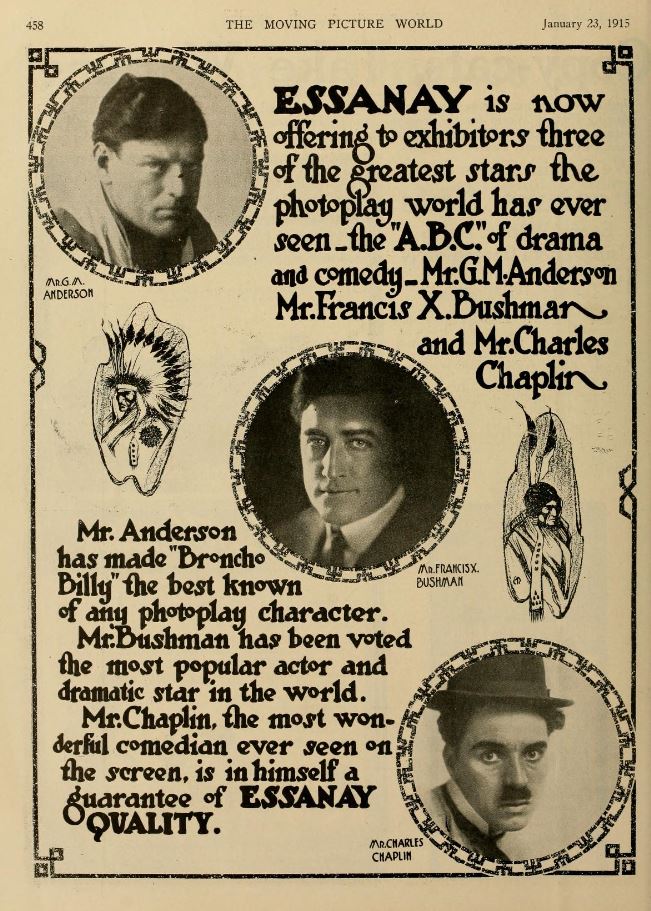
Moving Picture World, 23-January-1915
"Essanay is now offering to exhibitors three of the greatest stars the photoplay world has ever seen -- the "A.B.C." of drama and comedy -- Mr. G.M. Anderson Mr. Francis X. Bushman and Mr. Charles Chaplin." 

Moving Picture World, 23-January-1915
Broncho Billy Anderson, who got around a lot, was in New York City.  "Asked as to the acquisition by his company of Charles Chaplin, the comedian, he said that the newcomer would work in Chicago under the guidance of Director Robin.  Mr. Robin has for five years been with Mr. Anderson in the west."  I don't know who director Robin was. 

Motography, 23-January-1915

Here is Essanay's "big three," Francis X Bushman, Charles Chaplin and Broncho Billy Anderson. 

Motography, 23-January-1915
While they were in Chicago for the holidays, Broncho Billy and Charlie Chaplin danced the "Broncho Billy" waltz, while wearing their movie makeup.  "The dance was originated by Mr. Anderson and is one of the weirdest and funniest stunts on or off the stage."  I'll bet.

Moving Picture World, 30-January-1915
Essanay's list of "Greatest Screen Stars" included leading man Francis X Bushman, Wallace Beery in drag as Swedish maid "Sweedie," Broncho Billy Anderson, leading lady Beverly Bayne, Margaret Joslyn, who appeared in the Snakeville comedies and leading lady Ruth Stonehouse. 

Moving Picture World, 30-January-1915
This full-page Essanay ad says that Chaplin's first comedy for the company "His New Job" (good title) will be released February 1st.  "'It is the best I ever did,' says Chaplin." 

Motography, 30-January-1915
This item mentions that Chaplin and his comedy company left Chicago for Niles.  "It was at first planned to have the comedian work in the Chicago studio, but on account of the lack of available exterior locations the climatic conditions, it was thought best to return to the West."  It mentions that Ben Turpin and Leo White, who would become a Chaplin regular, were going along. 

Motography, 30-January-1915
Another edition of "Our Burg" says that Chaplin has shaken the dust of Chicago from this feet and headed back to sunny California. 

Wednesday, January 21, 2015

Grauman's Chinese -- Harold Lloyd -- January 21, 2015


I recently finished my series of photos taken at Grauman's Chinese. I started it on my other blog in 2009-2010, then picked it up again after a visit in 2012 (http://cablecarguy.blogspot.com/search/label/Grauman%27s%20Chinese). I moved it here when I started this blog in 2014, and finished it in September, 2014. In October, 2014, I thought I would start rerunning the series, adding photos of the people honored in the forecourt.

Sid Grauman was a San Francisco showman who came to Los Angeles and built three major houses, the Million Dollar, the Egyptian, and the Chinese. The theater has hosted many film premieres, but is most famous for the hand and footprints (and hoofprints and nose prints and other types of prints) in the forecourt.  
Harold Lloyd left his hand and footprints in the forecourt of Grauman's Chinese on 21-November-1927. I don't know what the occasion could have been -- this was between the release dates of The Kid Brother and Speedy. DSCN4138.
 
I took this on 18-July-2009.

www.listal.com

www.listal.com
 

Tuesday, January 20, 2015

The Exploits of Elaine Begins -- January 20, 2015

Moving Picture World, 02-January-1915
The Perils of Pauline was a big hit in 1914. The 20 chapter serial was not the first movie serial, but it was one of the big ones. It starred Pearl White, the first serial queen. Pathé's next serial was The Exploits of Elaine, starring Pearl White as the alliterative heroine Elaine and Arnold Daly as the scientific detective Craig Kennedy.

I like the image on the right-hand page.  Be sure to click on the images to see larger versions. 
"A Powerful and Wealthy
Capitalist Struck Down
With No One Near: A Most
Modern Safe Opened by
a New and Terrifying Force:
The Super Criminal
has Arrived!
In this Serial is Revealed
Not Merely the Science
of the Present But of
The Future as Well!"

Moving Picture World, 02-January-1915
"The stories will be published as issued in the great Hearst newspapers..." 

Omaha Daily Bee, 01-January-1915
"Begin at the beginning.  Get every word, every phrase, every thought." The Omaha Daily Bee promised its readers could follow the story in the Sunday Bee

Moving Picture World, 02-January-1915
"Following on the success of 'The Perils of Pauline," the new Pathe-Hearst Serial, "The Exploits of Elain" from the pen of Arthur B. Reeve and picturized by Chas. L. Goddard, bids fair to surpass in popularity its predecessor, judging from the briskness with which the first two-reel installment, entitled 'The Clutched Hand,' strikes the imagination."

Motography, 02-January-1915
"The exploits will give her a chance to return to the realm of acting and after weeks of being the athletic Pauline, Miss White is pleased with the change." 

Moving Picture World, 09-January-1915


Motography, 09-January-1915
"one of the greatest and most complete serials ever launched." 

Motography, 09-January-1915
Motography, 16-January-1915

"Twilight sleep" has features of truth serum. 

Motography, 30-January-1915
"The Clutching Hand examines the safe." 

High Point Review, 21-January-1915
This ad from the High Point North Carolina Review touts "The Greatest Serial Story of the Age!"  "A 25 cent subscription to the The Review will carry you thru the entire story."  A box warms people "that a notorious criminal is at large in this city." 

Motography, 23-January-1915

I wonder how much if any of this article is true. 

The Perils of Pauline was a big hit in 1914. The 20 chapter serial was not the first movie serial, but it was one of the big ones. It starred Pearl White, the first serial queen. Pathé's next serial was The Exploits of Elaine, starring Pearl White as the alliterative heroine Elaine and Arnold Daly as the scientific detective Craig Kennedy.

Moving Picture World, 23-January-1915
I like the images of the Clutching Hand and the frozen safe. 

Moving Picture World, 23-January-1915
"Too much praise cannot be given to the clean-cut methods employed, and the smoothness and consistency of the action." 

Moving Picture World, 23-January-1915
Brothers Leopold and Theodore Wharton directed Elaine

Motography, 23-January-1915
"Oxyacetylene Flame Used to Save Elaine" -- That's a great title. 

Moving Picture World, 30-January-1915

I notice that the style of the images has changed this week, from photographs to line drawings.  "Don't dally.  Don't delay." 

Motography, 30-January-1915
"Kennedy shows them the seismograph concealed in the panel is amazed to discover by its record that someone has entered his rooms."