Showing posts with label Betty Compson. Show all posts

Tuesday, July 16, 2024

Charlie Chaplin -- Keep You Cool -- July 16, 2024

Omaha Bee, 03-July-1924

This ad has a couple of interesting features. "No War Tax on Tickets" -- The entertainment tax imposed during World War One had just been repealed. "Rialto Cooling System Now in Perfect Operation." This implies to me that their air conditioning did not work properly at first. Before air conditioning, many movie theaters had to close down during the summer.

I also like the image of Charlie.

Betty Compson was a popular leading lady. Miami, directed by WW Hodkinson, is believed to be lost.

Photoplay, July, 1924

People were also anxious to see Charlie's new movie, which would be released as The Gold Rush.

Wednesday, January 3, 2024

Larry Semon in Person! Today Only! -- January 3, 2023

San Francisco Bulletin, 28-January-1924

Larry Semon appeared in person at San Francisco's California Theater, supporting his own "Lightning Love" and Woman to Woman with Berry Compson. Alfred Hitchcock was assistant director of Woman to Woman. When director Graham Cutts was away, Hitchcock directed some scenes. The American Company Famous Players-Lasky produced the film in Britain. 

Wednesday, December 27, 2023

Alfred Hitchcock -- Woman to Woman -- December 27, 2023

Film Daily, 28-December-1923

His name does not appear in the ad or in the credits, but Alfred Hitchcock was assistant director of Woman to Woman. When director Graham Cutts was away, Hitchcock directed some scenes. The American Company Famous Players-Lasky produced the film in Britain. The star was American Betty Compson. 

Saturday, March 19, 2022

Betty Compson 125, Glenn Close 75 -- March 19, 2022

Moving Picture World, 15-5eptember-1917

Actress Betty Compson was born 125 years ago today, on 19-March-1897. Al Christie gave her leading roles in many of his short comedies. She went on to star in many dramatic feature films. Her career faded after the early sound era but she continued to appear in small roles, sometimes uncredited, until the late 1940s. She was married to director James Cruze for six years.

Moving Picture World, 13-5eptember-1919

Her most famous feature was George Loane Tucker's The Miracle Man, which also starred Lon Chaney. This movie is believed to be lost.

listal.com

Actress Glenn Close was born 75 years ago today, on 19-March-1947. She has been in everything from Hamlet to 101 Dalmatians, and was good in everything I have seen.

Sunday, January 2, 2022

Larry Semon in a $50,000 Comedy -- January 2, 2022

Ogden Standard-Examiner, 28-January-1922

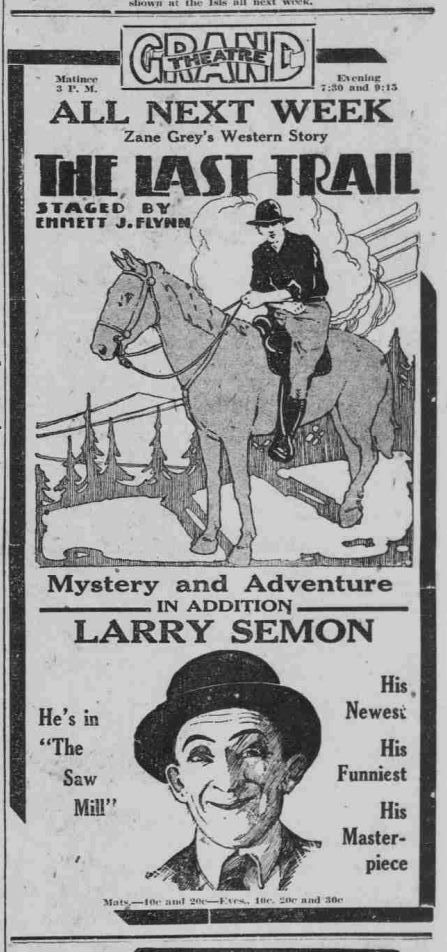
The Alhambra Theater in Ogden, Utah ran an unusual double ad for "Larry Semon in a $50,000 Comedy" with Betty Compson in Ladies Must Live and another ad for Betty Compson in Ladies Must Live and "Larry Semon in His Latest $500,000 Comedy." Interesting discrepancy.

Topeka State Journal, 28-January-1922

"His Newest"
"His Funniest"
"His Masterpiece"


Friday, September 13, 2019

Packs the Theater at $2.00 a Seat -- September 13, 2019

Moving Picture World, 13-September-1919
The Miracle Man, based on a novel by Frank L Packard and a play by George M Cohan, was the movie that made Lon Chaney a star. Here we see him with Betty Compson in a detail from a larger page.

Moving Picture World, 13-September-1919
Stars of the film are shown on the page, but it does not mention Chaney's name.  It merely identifies him as "The Contortionist."

Moving Picture World, 06-September-1919
"Find one dead expression in this group and win a prize."  I like that.

Moving Picture World, 13-September-1919
"THE POWER OF 'THE MIRACLE MAN'

"George Loane Tucker's Production of the Frank L. Packard Story for the Paramount-Artcraft Puts the Picture Among the Finest Examples of Screen Drama

By Edward Weitzel

"THERE is more than one miracle performed in George Loane Tucker's production of 'The Miracle Man,' the story as presented on the screen having the power to sway the emotions of the spectator with the compelling force of the deaf and dumb healer over the souls and bodies of those who come under his influence. Like every exceptional work of art, this Paramount-Artcraft picture made from Frank L. Packard's keenly dramatic and intensely human tale has one outstanding attribute which overtops every other quality: its power to work its will with the beholder. Neither as a piece of dramatic construction nor as a presentation of unusual phases of life that square with cold reason is it exempt from grave error, but these unfavorable conditions have little, if any, effect upon the firm hold of its emotional appeal; and it is another potent demonstration that human interest is the keystone of all forms of dramatic fiction.

"George Loane Tucker's Double Triumph.

"As the adapter of the story to the screen as well as the director of 'The Miracle Man,' George Loane Tucker has achieved a double triumph. Recognizing the rock upon which George M. Cohan wrecked his dramatic structure when he made the Packard tale into a stage play and also realizing that the scene of the miracle of the little lame boy's discarded crutches is the great dramatic moment of the entire picture in spite of the circumstances that it occurs when the action is only one-third over, scenarist Tucker has not relied upon the moral regeneration of the four criminals for the sole motive of the rest of the drama but has thrown a deeper romantic interest about the love affair between Tom Burke and Rose by using the young millionaire as Tom's rival and keeping the issue in doubt until the last moment. Several of the points in the last half of the story are overemphasized and the death scene of the healer could be shortened to advantage, but broadly considered the Tucker scenario is a work of great excellence.

"Like Drawings by Dore.

"Any attempt to set down a just appreciation of George Loane Tucker's efforts as the director of 'The Miracle Man' must concede him a full measure of praise in every detail of production and credit him with having distanced all of his previous contributions to the screen.

"Pictorially, the drama is a succession of compositions that have true artistic form. The conception and handling of the scenes in which The Frog is the central figure, the iron-nerved mendicant who preys upon the compassion of humanity, are daring and masterly. Only in the drawings of Dore for Victor Hugo's 'Hunchback of Notre Dame' can such criminal monstrosities be found. Surprise and fascinated horror grip the spectator when the crowded traffic is held up and through the rain and slime of a chill night on the grimy east side the distorted shape of a man is seen painfully dragging itself toward the gutter, the lower limbs apparently useless and their pitiable owner obliged to lie prone in the filth of the street.

"The word painting of the French novelist descriptive of the hurrying mob of crippled beggars returning to their underground haunt, and the glee with which the lame, the halt and the blind join in the wild debauch which celebrates their success at beguiling the charitable of their spare coins is equaled by the scenes in 'The Miracle Man' where The Frog appeals to the pity of the passerby and later on meets the three other members of his gang, exposes the vileness of his monstrous trickery and leads his companions in scoffing at the generosity that enables them to ply their nefarious trades.

"The Scene of the Miracle.

"The entire first third of this picture contains every possible element demanded by dramaturgic art : theme, character drawing, suspense, steady upward trend of movement and a climax that is as convincing and as inevitable as the answer to a problem in Euclid. From the time that Tom Burke confides to his pals his scheme to use the healer as the bait for their trap to catch humanity and fatten upon the suffering of the unfortunate until the supreme moment when the little cripple watches the faked miracle worked by The Frog upon himself and, upheld by the faith within his own feeble body and twisted limbs, throws away his crutches and walks tremblingly into the outstretched arms of the white haired old man at the top of the hill and The Frog and his fellow cheats realize they have seen a real miracle performed, the impulse driving the course of events forward is as resistless as the surge of the sea. It is doubtful if screen drama will ever know a more powerful moment than this climax to a bold stroke of criminal cunning — this triumph of goodness and trust over the forces of evil.

"Moral Blindness Is Overcome.

"All through the working out of the rest of the story there is a sense of diminished force, like the still reverberant but more distant peals of thunder after the height of the storm has passed. The coolness and skill with which Tom Burke accepts the demonstration of the healer's power to perform miracles, and directs the stream of banknotes and checks that flows from the grateful patients of the old man into the pockets of the crooks, are insights into the resources of the criminal that surround him with a new interest.

"Then follows the startling discovery, made by the thieves themselves, that the power of the healer has reached even them, and their moral blindness is yielding to the curative strength of the almost helpless being of those goodness and faith in humanity they had made a byword and a jest.

"This reformation of the entire gang is blended with the romantic interest previously alluded to between the girl Rose and Tom Burke and the cleverly devised element of suspense brought in with the arrival of millionaire Richard King, who sees in the girl of the underworld all that is best and fairest in womanhood and who shows her that love is a thing that protects and honors its object, not debases and destroys.

"The closing events, disclosing the death of the healer and the knowledge that Rose and Tom find the path to right living and happiness and will travel it as man and wife, bring the story to an ending that will meet with hearty approval.

"Three Star Performances.

"George Loane Tucker has evidently labored unsparingly upon every branch of production connected with 'The Miracle Man,' and nowhere is his good judgment more manifest than in his selection of the cast. Three of the performances in the picture are sufficiently meritorious to rank with any impersonation so far known to the screen. These performances are the Tom Burke of Thomas Meighan, the Rose of Betty Compson and The Frog of Lon Chaney.

"Admirable also is The Patriarch, as embodied by Joseph J. Dowling. The part as treated in the Tucker version of the story is not the positive figure the healer was in the spoken play. He is here both deaf and dumb, and failing eyesight leaves him almost totally blind before the end of the picture. He is also without any indication of mental vigor, a shadowy, mysterious figure who always remains in the background, notwithstanding his importance in the story. The subtle point made in the Cohan version, that the healer knew from the start his helpers were a gang of crooks but never let this fact be known to them, is so faintly hinted at by The Frog in the picture that the illusion is practically lost.

'But the healer still remains the mainspring of the action, a symbol of unseen power that compels belief in itself and in the humble instrument that does its bidding. It is the reaction of this power for good upon the love of Rose and Tom that puts the human touch into the story and guarantees it a warm welcome and many a word of praise."

Moving Picture World, 13-September-1919
 The Miracle Man is believed to be lost, except for an excerpt shown in a 1930s movie.

Wednesday, September 27, 2017

Personally Directed by Al E Christie -- September 27, 2017

Moving Picture World, 15-September-1917

The Christie Film Company was a major producer of short comedies from 1911 to 1933.  Al Christie was the director and Charles Christie ran the business.  The Christies featured situation comedy more than the slapstick favored by Mack Sennett and Hal Roach.  Christies frequently featured pretty girls in bathing suits. Actress Betty Compson later starred in feature films. 

Moving Picture World, 29-September-1917
 Note that the San Francisco exchange was at 100 Golden Gate Avenue.  Many film businesses were on Golden Gate.  I used to go to a lab there to get my black and white Super 8 film developed. 

Friday, March 3, 2017

Reaching the Stars by Aeroplane -- March 3, 2017

Aerial Age Weekly, 24-April-1922

ONE of the dreams of the average movie fan is to gain an interview with his or her favorite star; to sit down in a quiet little corner and ask all the intimate questions he or she has wanted to for a long time. But, to the layman, most of the screen lights are harder to reach than a bank president during a Bolshevik riot. Only in exceptional cases does the admirer of the silver sheet get a chance to get in personal contact with the luminaries of the silent drama.


One of the surest ways, figuratively speaking, of getting the ear of a star, is to mention aeroplanes. Almost the entire movie colony in Hollywood is aeroplane struck. Directors, stars, scenario writers, authors and even cameramen are aviation enthusiasts, many of them being licensed pilots.

What may come as somewhat of a surprise to many movie fans is that Mary Miles Minter, one of the youngest and best known of the ingenues on the screen today, has qualified for a license as pilot. Miss Minter successfully passed the test over a year ago but parental objection has prevented her from taking advantage of her pilot's card. She is not permitted to ascend with the controls in her own hands.


Cecil B. DeMille, director-general of the Famous Players-Lasky Corporation, is one of the pioneers of aviation in the motion picture center of the world. Mr. DeMille, for a long time, was part owner of a passenger aeroplane company which made regular trips from Hollywood to nearby cities. He is also one of the most prominent figures in aviation on the coast and often takes his "bus" out for a few dips and tail spins in order to forget the cares of his office. Mr. DeMille asserts that there is. no better tonic in the world for "that tired feeling."


Dorothy Dalton, star in Paramount Pictures, is another ardent advocate of the "travel by aeroplane" slogan. Miss Dalton's specialty is hydroplaning, for she much prefers the water route than the solid earth below.

A more recent addition to the ranks of the flying stars is Betty Compson, the girl of "The Miracle Man" fame. Although kept extremely busy out on the coast Miss Compson manages to find an occasional hour or so every few days to devote to the thrills of flying. Miss Compson has yet to win her pilot's license but hopes to secure the coveted card before she is many months older.


But perhaps the most enthusiastic, for aviation, of the movie people on the coast is Jeanie Macpherson, scenario writer for Paramount Pictures. Miss Macpherson has been flying for at least three years and is one of the most prominent aviatrices in California. She numbers among her acquaintances many of America's leading aviators, and she has participated in more "stunt" and "circus" flying than any other person connected with the motion pictures who is not paid for risking his or her neck. She has made a number of trips with Ormi Locklear, world famous "stunt" man, from whom she learned many of the finer points of the art of flying. The news of Locklear's tragic death some time ago came as a genuine shock to her. Speaking of Locklear, Miss Macpherson said, "Ormi Locklear was, to my mind, a natural flyer. His judgment in the matter of height, and in that of keeping the plane level, was uncanny. I remember one trip I took with him out on the coast in which he took me out to sea. We unexpectedly ran into a dense fog. I was frightened to death, as we could hardly see each other, but Locklear, without even bothering to consult his instruments, kept right on going, and when he thought we had gone far enough he turned his machine and headed back again.

"If I had had the machine there is no doubt that I would have been flying for Canada, Mexico or the open sea, but in a short time we were out of the mist and to my great surprise, and greater relief, found that we were headed straight for our own landing place. I believe Locklear, with that sixth sense of his, could fly his 'boat' in the dead of night, without a light to guide him, and get through safely. That's why I can't understand some of the reports which were circulated about Locklear losing control of his machine on a difficult loop."

Eddie Rickenbackcr, America's famous ace, is another close friend of Miss Macpherson's. In fact, Rickenbacker was Miss Macpherson's tutor at one time.

The writer knows of a little incident that shows Miss Macpherson's love for flying. Some time ago Miss Macpherson came East preparatory to sailing for Europe for a well deserved vacation. As is the case with all motion picture celebrities of the motion picture world, a great deal of Miss Macpherson's time during her short stay in New York City was taken up by interviewers from newspapers and magazines. One interviewer, who had been in the flying corps overseas, had been pumping Miss Macpherson on the cut and dried subject of scenario writing. The conversation was lagging when the gentleman in question suddenly looked at his watch and mentioned the fact that he would have to leave as he had an appointment with some one at the Aero Club. That proved to be the opening wedge for a conversation that lasted far beyond Miss Macpherson's dinner hour and incidentally, long past the time set for the appointment at the Aero Club. Needless to say, the subject discussed was aeroplanes and, much to the surprise of the ex-service man, Miss Macpherson spoke fluently upon the respective merits of aeroplane motors of foreign and domestic make. The writer can testify to the above fact, for he had to sit through many weary—-to him—-minutes of technical descriptions of the Hipsano Suiza, Liberty, etc. Than which, to the layman, there is nothing more complex.

Monday, February 27, 2017

Christie Comedies Are Comedies of Youth -- February 27, 2017

Moving Picture World, 03-February-1917

The Christie Film Company was a major producer of short comedies from 1911 to 1933.  Al Christie was the director and Charles Christie ran the business.  This ad says "Christie Comedies Are Comedies of Youth."  The Christies featured situation comedy more than the slapstick favored by Mack Sennett and Hal Roach.  Christies frequently featured pretty girls in bathing suits. 

www.listal.com
Actress Betty Compson later starred in feature films. 

Moving Picture World, 17-February-1917
As Hal Roach was doing with Harold Lloyd's Lonesome Luke comedies, Christie began to move from one-reel to two-reel comedies. 

Moving Picture World, 24-February-1917
Star Billie (listed as Billy in this ad) Rhodes, who was born in San Francisco, left films in 1925. 

www.listal.com