Showing posts with label Lon Chaney. Show all posts

Saturday, March 15, 2025

Lon Chaney -- A Thriller de Luxe -- March 15, 2025


Los Angeles Times, 11-March-1925

My fiancée, who is now my wife, and I used to go to San Francisco's Avenue Theater, on San Bruno Avenue, where Bob Vaughn accompanied silent movies on the Mighty Wurlitzer every Friday night.

Every year around Halloween, the Avenue showed The Phantom of the Opera with Lon Chaney. 

San Francisco Examiner, 26-October-1980

We went just about every year, so we probably attended this showing.

Indianapolis Times, 27-March-1925

Carl Laemmle, President of Universal, decided that the film should have its premiere at San Francisco's Curran Theater on Geary near Mason. The Curran now hosts mostly musical theater. I saw Pacific Overtures, Wicked and many others there.

Sunday, February 16, 2025

Lon Chaney -- The Year's Big Picture -- February 16, 2025

Selma Times-Journal, 26-February-1925

I have not written about Lon Chaney often enough. Swedish director Victor Sjöström (billed as Victor Seastrom) directed Chaney, Norma Shearer, John Gilbert and Tully Marshall in He Who Gets Slapped, based on a play by Leonid Andreyev. Chaney gave a remarkable performance as a man who acted out his humiliation every day as a clown. This was M-G-M's first production. 

Selma Times-Journal, 26-February-1925

Ottowa Citizen, 07-February-1924


Wednesday, January 15, 2025

Lon Chaney in His Greatest Role -- January 15, 2025

Tulsa Daily World, 03-January-1925

I have not written about Lon Chaney often enough. Swedish director Victor Sjöström (billed as Victor Seastrom) directed Chaney, Norma Shearer, John Gilbert and Tully Marshall in He Who Gets Slapped, based on a play by Leonid Andreyev. Chaney gave a remarkable performance as a man who acted out his humiliation every day as a clown. This M-G-M's first production. 

Winnipeg Free Press Evening Bulletin, 24-January-1925

Note "Extra! Cross-Word Puzzle Fun For the Film Fans." Crossword puzzles were a craze in 1925.

Omaha Bee, 11-January-1925

Thursday, December 19, 2024

Buster Keaton -- Sailor Lassies Help Navigator -- December 19, 2024

Photoplay, December, 1924

Buster's The Navigator was set aboard an ocean liner that was adrift on the ocean. The movie is hilarious. "...it isn't easy to be laughable for six thousand feet of film."

Moving Picture World, 20-December-1924

Metro-Goldwyn, soon to become Metro-Goldwyn-Mayer, proudly announced its current product, including The Navigator, Erich von Stroheim's Greed, Henry King's Romola, starring Lillian Gish and based on the novel by George Eliot and Victor Sjöström's He Who Gets Slapped, starring Lon Chaney.

Moving Picture World, 20-December-1924

Several theaters in the mid-west promoted The Navigator by having young ladies in sailor suits hand out rolls of Life Savers candy. 

Moving Picture World, 27-December-1924

Loew's Montreal promoted the film with a ship in the lobby and the staff dressed in naval uniforms. I like the caricature of Buster in the circles.

Moving Picture World, 20-December-1924

Meanwhile Buster was wrapping up work on his next movie, Seven Chances.

Wednesday, December 18, 2024

Believes Chaplin is Greatest Film Actor -- December 18, 2024

Moving Picture World, 06-December-1924

A Harvard professor of fine arts, Chandler R Post, gave a speech in which he said that Charlie Chaplin and Lon Chaney were the greatest film actors. He also said that "only a small percentage of the photoplays produced now really were artistic." 

Moving Picture World, 06-December-1924

We saw recently that Chaplin had gone to Mexico to marry actress Lita Grey, who was 15 and pregnant. They had two children, but the marriage was not a success.

Film Daily, 31-December-1924

The movie career of Charlie's older half-brother Sydney was on and off. He took time to handle Charlie's business matters and became an aviation entrepreneur. Syd was good at performing in drag, so Charley's Aunt was a good vehicle for him. "Enough to make a cat laugh." I don't think I have ever come across that expression. 

Film Daily, 02-December-1924

The Christie Film Company produced Charley's Aunt.

Moving Picture World, 13-December-1924

Wednesday, October 30, 2024

The Phantom of the Opera -- October 30, 2024

San Francisco Examiner, 26-October-1980

Halloween is coming.

My fiancée, who is now my wife, and I used to go to San Francisco's Avenue Theater, on San Bruno Avenue, where Bob Vaughn accompanied silent movies on the Mighty Wurlitzer every Friday night. 

Every year around Halloween, the Avenue showed The Phantom of the Opera with Lon Chaney. We went just about every year, so we probably attended this showing.

Sunday, December 31, 2023

Saturday, July 29, 2023

Hunchback Showing Soon -- July 29, 2023

Film Daily, 03-July-1923

The Hunchback of Notre Dame, starring Lon Chaney, was being prepared for release. 

Motion Picture News, 14-July-1923

"Elaborate Showings Will Exploit Feature Previous to General Release." 

Wednesday, August 17, 2022

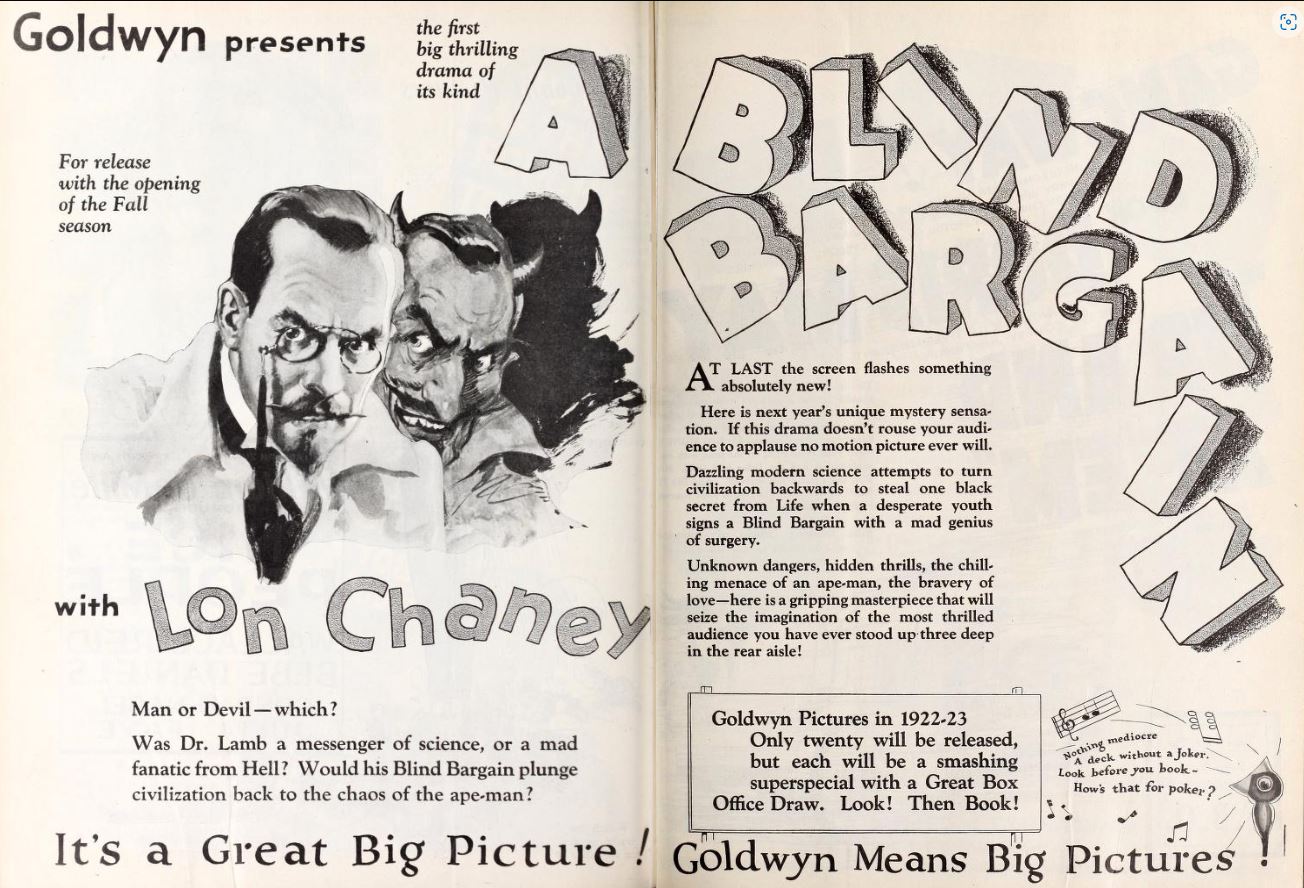
Lon Chaney -- A Desperate Youth Signs a Blind Bargain With a Mad Genius of Surgery -- August 17, 2022

Moving Picture World, 05-August-1922

I first learned about A Blind Bargain, also called The Octave of Claudius, when Famous Monsters of Filmland ran a Lon Chaney filmography. I thought both titles sounded interesting, but I couldn't find anything about the movie. Now I know that Lon Chaney played a dual role, as a mad scientist and as a hunchback created by one of the doctor's experiments. The film is probably lost.

Motion Picture News, 19-August-1922


Meanwhile Universal was preparing to release one of Chaney's most famous films, The Hunchback of Notre Dame. I remember from another Famous Monsters of Filmland that this was not the first adaption of Victor Hugo's Notre-Dame de Paris, but the fifth. One starred Theda Bara.

Saturday, March 19, 2022

Betty Compson 125, Glenn Close 75 -- March 19, 2022

Moving Picture World, 15-5eptember-1917

Actress Betty Compson was born 125 years ago today, on 19-March-1897. Al Christie gave her leading roles in many of his short comedies. She went on to star in many dramatic feature films. Her career faded after the early sound era but she continued to appear in small roles, sometimes uncredited, until the late 1940s. She was married to director James Cruze for six years.

Moving Picture World, 13-5eptember-1919

Her most famous feature was George Loane Tucker's The Miracle Man, which also starred Lon Chaney. This movie is believed to be lost.

listal.com

Actress Glenn Close was born 75 years ago today, on 19-March-1947. She has been in everything from Hamlet to 101 Dalmatians, and was good in everything I have seen.

Sunday, September 19, 2021

Horror Shockers -- Great 8MM Monster Movies! -- September 19, 2021

Vampirella 7, 1970

When I was young, I read Warren Publishing magazines like Famous Monsters of Filmland and Vampirella. The magazines always carried ads for back issues, posters and movies. I didn't have a film projector, so I read the ads with envy. Eventually, I got a Super-8 projector, but I didn't have enough money to buy any of these films. A friend had Abbott and Costello Meet Frankenstein and I was fascinated by the way it had been cut down to less than 20 minutes. 

 This ad has a great selection of horror films from the 1920s to the 1960s. I would like to see their cut-down version of The Phantom of the Opera with Lon Chaney.

Wednesday, September 30, 2020

The Penalty -- September 30, 2020


Motion Picture News, 25-September-1920

The Penalty starred Lon Chaney as a criminal who seeks revenge for the loss of his legs. It was based on a novel by Gourverneur Morris. The movie was set and partially shot in San Francisco. 

Tulsa Daily World, September 26, 1920


Saturday, July 25, 2020

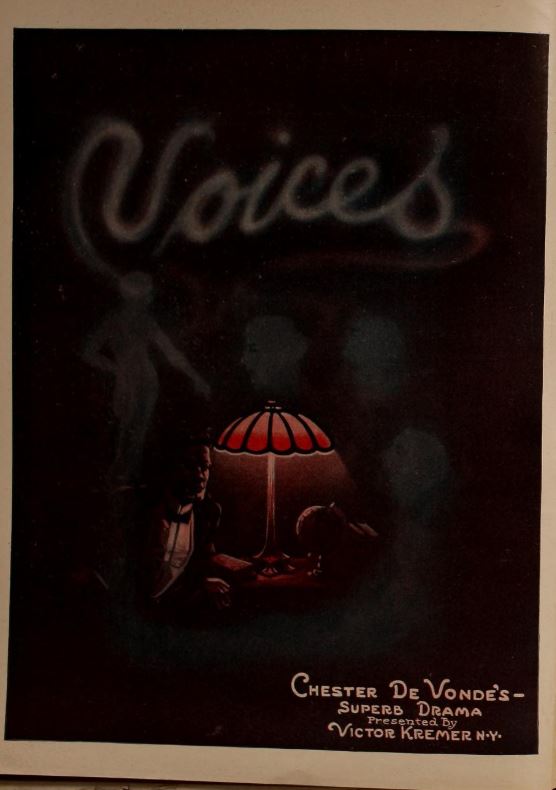
Voices -- July 25, 2020

Motion Picture News, 03-July-1920
I don't know anything about the 1920 feature Voices, but I like the trade ad.  I don't know anything about writer/director Chester De Vonde, except that he wrote the play Kongo.  Lon Chaney starred in a silent version called West of Zanzibar. Walter Huston starred in the talkie remake, Kongo.


Wednesday, January 29, 2020

Daredevil Jack -- January 29, 2020

Moving Picture World, 31-January-1920
Recently crowned heavyweight champion Jack Dempsey appeared in Daredevil Jack, a Pathé serial. The supporting cast included Lon Chaney.


Friday, September 13, 2019

Packs the Theater at $2.00 a Seat -- September 13, 2019

Moving Picture World, 13-September-1919
The Miracle Man, based on a novel by Frank L Packard and a play by George M Cohan, was the movie that made Lon Chaney a star. Here we see him with Betty Compson in a detail from a larger page.

Moving Picture World, 13-September-1919
Stars of the film are shown on the page, but it does not mention Chaney's name.  It merely identifies him as "The Contortionist."

Moving Picture World, 06-September-1919
"Find one dead expression in this group and win a prize."  I like that.

Moving Picture World, 13-September-1919
"THE POWER OF 'THE MIRACLE MAN'

"George Loane Tucker's Production of the Frank L. Packard Story for the Paramount-Artcraft Puts the Picture Among the Finest Examples of Screen Drama

By Edward Weitzel

"THERE is more than one miracle performed in George Loane Tucker's production of 'The Miracle Man,' the story as presented on the screen having the power to sway the emotions of the spectator with the compelling force of the deaf and dumb healer over the souls and bodies of those who come under his influence. Like every exceptional work of art, this Paramount-Artcraft picture made from Frank L. Packard's keenly dramatic and intensely human tale has one outstanding attribute which overtops every other quality: its power to work its will with the beholder. Neither as a piece of dramatic construction nor as a presentation of unusual phases of life that square with cold reason is it exempt from grave error, but these unfavorable conditions have little, if any, effect upon the firm hold of its emotional appeal; and it is another potent demonstration that human interest is the keystone of all forms of dramatic fiction.

"George Loane Tucker's Double Triumph.

"As the adapter of the story to the screen as well as the director of 'The Miracle Man,' George Loane Tucker has achieved a double triumph. Recognizing the rock upon which George M. Cohan wrecked his dramatic structure when he made the Packard tale into a stage play and also realizing that the scene of the miracle of the little lame boy's discarded crutches is the great dramatic moment of the entire picture in spite of the circumstances that it occurs when the action is only one-third over, scenarist Tucker has not relied upon the moral regeneration of the four criminals for the sole motive of the rest of the drama but has thrown a deeper romantic interest about the love affair between Tom Burke and Rose by using the young millionaire as Tom's rival and keeping the issue in doubt until the last moment. Several of the points in the last half of the story are overemphasized and the death scene of the healer could be shortened to advantage, but broadly considered the Tucker scenario is a work of great excellence.

"Like Drawings by Dore.

"Any attempt to set down a just appreciation of George Loane Tucker's efforts as the director of 'The Miracle Man' must concede him a full measure of praise in every detail of production and credit him with having distanced all of his previous contributions to the screen.

"Pictorially, the drama is a succession of compositions that have true artistic form. The conception and handling of the scenes in which The Frog is the central figure, the iron-nerved mendicant who preys upon the compassion of humanity, are daring and masterly. Only in the drawings of Dore for Victor Hugo's 'Hunchback of Notre Dame' can such criminal monstrosities be found. Surprise and fascinated horror grip the spectator when the crowded traffic is held up and through the rain and slime of a chill night on the grimy east side the distorted shape of a man is seen painfully dragging itself toward the gutter, the lower limbs apparently useless and their pitiable owner obliged to lie prone in the filth of the street.

"The word painting of the French novelist descriptive of the hurrying mob of crippled beggars returning to their underground haunt, and the glee with which the lame, the halt and the blind join in the wild debauch which celebrates their success at beguiling the charitable of their spare coins is equaled by the scenes in 'The Miracle Man' where The Frog appeals to the pity of the passerby and later on meets the three other members of his gang, exposes the vileness of his monstrous trickery and leads his companions in scoffing at the generosity that enables them to ply their nefarious trades.

"The Scene of the Miracle.

"The entire first third of this picture contains every possible element demanded by dramaturgic art : theme, character drawing, suspense, steady upward trend of movement and a climax that is as convincing and as inevitable as the answer to a problem in Euclid. From the time that Tom Burke confides to his pals his scheme to use the healer as the bait for their trap to catch humanity and fatten upon the suffering of the unfortunate until the supreme moment when the little cripple watches the faked miracle worked by The Frog upon himself and, upheld by the faith within his own feeble body and twisted limbs, throws away his crutches and walks tremblingly into the outstretched arms of the white haired old man at the top of the hill and The Frog and his fellow cheats realize they have seen a real miracle performed, the impulse driving the course of events forward is as resistless as the surge of the sea. It is doubtful if screen drama will ever know a more powerful moment than this climax to a bold stroke of criminal cunning — this triumph of goodness and trust over the forces of evil.

"Moral Blindness Is Overcome.

"All through the working out of the rest of the story there is a sense of diminished force, like the still reverberant but more distant peals of thunder after the height of the storm has passed. The coolness and skill with which Tom Burke accepts the demonstration of the healer's power to perform miracles, and directs the stream of banknotes and checks that flows from the grateful patients of the old man into the pockets of the crooks, are insights into the resources of the criminal that surround him with a new interest.

"Then follows the startling discovery, made by the thieves themselves, that the power of the healer has reached even them, and their moral blindness is yielding to the curative strength of the almost helpless being of those goodness and faith in humanity they had made a byword and a jest.

"This reformation of the entire gang is blended with the romantic interest previously alluded to between the girl Rose and Tom Burke and the cleverly devised element of suspense brought in with the arrival of millionaire Richard King, who sees in the girl of the underworld all that is best and fairest in womanhood and who shows her that love is a thing that protects and honors its object, not debases and destroys.

"The closing events, disclosing the death of the healer and the knowledge that Rose and Tom find the path to right living and happiness and will travel it as man and wife, bring the story to an ending that will meet with hearty approval.

"Three Star Performances.

"George Loane Tucker has evidently labored unsparingly upon every branch of production connected with 'The Miracle Man,' and nowhere is his good judgment more manifest than in his selection of the cast. Three of the performances in the picture are sufficiently meritorious to rank with any impersonation so far known to the screen. These performances are the Tom Burke of Thomas Meighan, the Rose of Betty Compson and The Frog of Lon Chaney.

"Admirable also is The Patriarch, as embodied by Joseph J. Dowling. The part as treated in the Tucker version of the story is not the positive figure the healer was in the spoken play. He is here both deaf and dumb, and failing eyesight leaves him almost totally blind before the end of the picture. He is also without any indication of mental vigor, a shadowy, mysterious figure who always remains in the background, notwithstanding his importance in the story. The subtle point made in the Cohan version, that the healer knew from the start his helpers were a gang of crooks but never let this fact be known to them, is so faintly hinted at by The Frog in the picture that the illusion is practically lost.

'But the healer still remains the mainspring of the action, a symbol of unseen power that compels belief in itself and in the humble instrument that does its bidding. It is the reaction of this power for good upon the love of Rose and Tom that puts the human touch into the story and guarantees it a warm welcome and many a word of praise."

Moving Picture World, 13-September-1919
 The Miracle Man is believed to be lost, except for an excerpt shown in a 1930s movie.

Wednesday, August 21, 2019

The Miracle Man -- August 21, 2019

Moving Picture World, 02-August-1919
The Miracle Man, based on a novel by Frank L Packard and a play by George M Cohan, was the movie that made Lon Chaney a star. Notice that his name and image do not appear in the ad. "Lon Chaney, in an exceptional characterization will be remembered forever by every one who sees this film." He played the Frog, a contortionist who served as a shill for a faith healer. Sadly, the film is lost.

Moving Picture World, 09-August-1919
"...this photoplay with an amazing soul..."

Moving Picture World, 09-August-1919
"'MIRACLE MAN' LIKED BY SING SING

"Critical Audience at New York Penitentiary

"Approved of Crook Play — Competition Announced

"A PRINT of 'The Miracle Man,' which is scheduled for Paramount-Artcraft release in September, was taken to the Sing Sing penitentiary by a representative of the Famous Players-Lasky Corporation. As it is a crook play, the manner of its reception by an audience, which naturally would be supposed to know much about crime and the ways of criminals, was the subject of considerable speculation at the office of the corporation.

"How the picture was received by this critical audience is briefly described in the Famous Players-Lasky man's written report, submitted on his return to New York. He said :

"Officials Give Praise.

"'Edward V. Brophy, warden, and John P. Joyce, superintendent of industries, told me personally that 'The Miracle Man' was the most wonderful picture they had ever seen — and they have seen many. I also received oral praise from many of the inmates themselves. Louis Jacobs said: 'The picture carries a message that reaches the men without their knowing why. It isn't crammed down their throats like a preachment. That's why it made a hit with them.' I also had to talk with — - — — (naming one of the best known newspapermen in the United States who recently was convicted of a capital crime). He had read the book and seen the play. The picture, he said, was the best he had ever seen.'

Announce Competition.

"A contest was announced to the inmates of the institution in the name of President Adolph Zukor and the Famous Players-Lasky Corporation. An offer was made of a first prize of $10, a second prize of $7 and a third prize of $5 for the three best compositions conveying the impressions made upon the writer by the picture. The judges will be George Blaisdell, editor of Moving Picture World; Joseph Dannenberg, editor of Wid's ; Lesley Mason, editor of Exhibitor's Trade Review; Robert E. Welch, managing editor of Motion Picture News, and Miss Louella O. Parsons, motion picture editor of the Sunday Telegraph.

"Sing Sing Critic Praises.

"Before the Famous Players-Lasky representative left the prison he was handed a copy of a review of "The Miracle Man," written by "F. M.":

"'So many photoplays have been called 'inspirational,' so many have had a message,' yet almost as many have failed to inspire or deliver the message. Never have we been more profoundly moved in viewing a picture or had our souls more deeply, or wholesomely, stirred than when, by a courtesy and thoughtfulness which we could not fully appreciate until after the last reel had been run, the Famous Players-Lasky Corporation permitted us to see, even before it could be seen elsewhere, this remarkable picture of George Loane Tucker's. Into it has been woven every feature that has made his other pictures the successes they were.

"'Never before have we seen a picture which we considered worthy of being compared to a great symphony, by a great composer, performed by a large and capable orchestra. In 'The Miracle Man,' as in the symphony, each tone and each accent have a definite meaning, all contributing to the final perfection of the masterpiece and all blended into one harmonious whole, no part of which would be complete without the other parts, though each part in itself may be 'a thing of beauty and a joy forever.'"

Moving Picture World, 16-August-1919
"Its fame will be spread by an endless chain."

Moving Picture World, 23-August-1919
A preview showing for the trade.

Moving Picture World, 30-August-1919
Famous Players-Lasky commissioned a song to promote The Miracle Man.