Showing posts with label kinetograph. Show all posts

Wednesday, August 31, 2022

T. A. Edison Kinetographic Camera -- August 31, 2022

Patent US589168A

125 years ago today, Thomas Edison was granted US Patent 589168, for a camera able to capture motion. Edison's research team, led by WKL Dickson did all the work. 

Friday, May 20, 2016

The Illusion of Motion -- May 20, 2016


This post is part of the Classic Movie Ice Cream Social Blogathon, hosted by Fritzi at Movies Silently (http://moviessilently.com/2016/05/20/the-classic-movie-ice-cream-social-is-here/).  Fritzi wants to focus "on classic movie-themed cheer. I’m supplying the ice cream (in digital form) and you’ll bring the cheer."

disney-pal.com
2007
When my daughter was younger, we went to Disneyland every summer.  There were two places on Main Street that we would always visit.  The Gibson Girl Ice Cream Parlour served delightful ice cream in huge waffle cones which were made on the premises.  I usually had mint chip.  Then we would go to the adjoining Penny Arcade.

2007
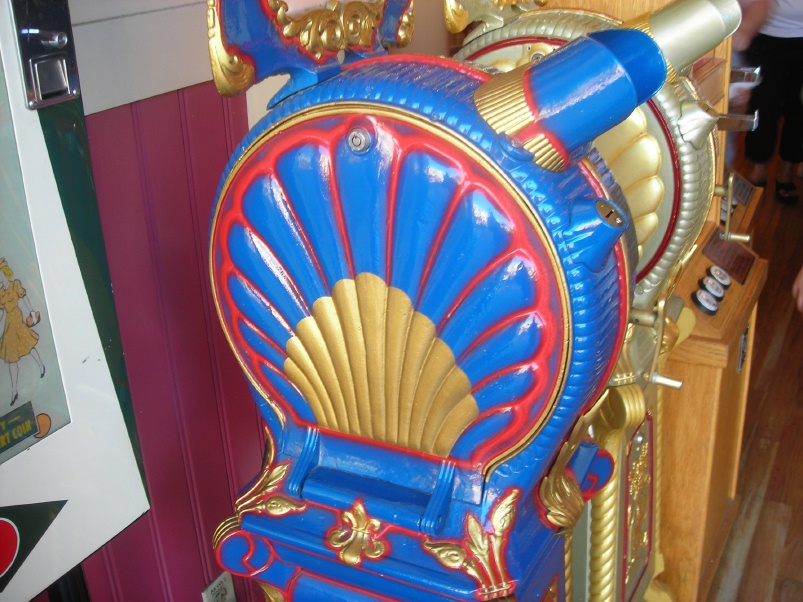
 I always had to put a penny in the delightfully painted clamshell Mutoscopes.

2007

2008

2008
2009
2009
2009
2010
2010
2012
2012
What is a Mutoscope?  Why did I have to go play with them every year?  The Mutoscope is a hand-cranked entertainment machine that works like a giant flipbook. When I was a kid, I tried to build a device like it, but always had trouble getting it to work.

2012

Each machine carries instructions and extensive patent information on a plate on the front of the machine.  The instructions are simple: "Push Penny in Slot Then Turn Crank to the Right."

2010
When you put your penny in the slot, a light comes on.  You see a photo on a card.  When you turn the crank, each photo snaps forward, revealing the next one.  The sequence of photos gives the illusion of motion.  The cool thing is, you can turn the crank as fast or as slow as you like.  You can't go backwards.  Here we see Charlie Chaplin and Mabel Normand in a scene from a Keystone comedy.  Someone with good eyes could probably tell which one.

2010
And here we see a scene from a Tom Mix western, probably one of his early Selig Polyscope productions.

Magic: Stage Illusions and Scientific Diversions, Including Trick Photography, Albert Allis Hopkins, ed.
from Magic: Stage Illusions and Scientific Diversions, Including Trick Photography, edited by Albert Allis Hopkins:
"The 'mutoscope' is compact, and the pictures are large. It is not any larger than the cover of a sewing machine. The enlarged bromide prints, measuring four by six inches, are mounted in close consecutive order around the cylinder and extend out like the leaves of a book, as shown in the illustration. In the operation of the mutoscope the spectator has the performance entirely under his own control by turning a crank which is placed conveniently at hand, and may make the operation as quick or as slow as he desires, and can stop the machine at any particular picture at will.  Each picture is momentarily held in front of the lens by the action of a slot attached to the roof of the box, which allows the pictures to slip by in much the same way as the thumb is used upon the leaves of a book."

The Mutoscope was invented by William Kennedy Laurie (WKL) Dickson, who had led the Edison team that developed the Kinetoscope and Kinetograph.   The Mutoscope and its accompanying camera, the Mutograph, were carefully designed to work around Thomas Edison's patents on motion picture devices. 

How did I get interested in the Mutoscope?  Several times when I was young I took a book out of the Anza Branch Library that explained how movies work.  I can't remember the title.  I tried to make several of the pre-cinema devices in the section on early moving picture devices. 

The Young Folk's Cyclopædia of Games and Sports by John Denison Champlin and Arthur Elmore Bostwick, 1890
The Thaumatrope (from the Greek for "wonder turner") is a card, often disk-shaped, with a string tied through a hole on each side.  On each face of the card is a part of a picture, most famously a bird on one side and a cage, upside down relative to the bird, on the other.  The person playing with the Thaumatrope takes a string in each hand and spins the card rapidly.  Persistence of vision merges the images together so the bird appears to be in the cage, or, in the example above, the rider appears to be on the horse.  This was a popular toy in the Nineteenth Century.  There is some disagreement about whether it was invented by a Frenchman or an Englishman.


I used to make Thaumatropes with my daughter. Kids enjoy them and I recommend making them as a good way to pass a rainy afternoon.

The Young Folk's Cyclopædia of Games and Sports by John Denison Champlin and Arthur Elmore Bostwick, 1890
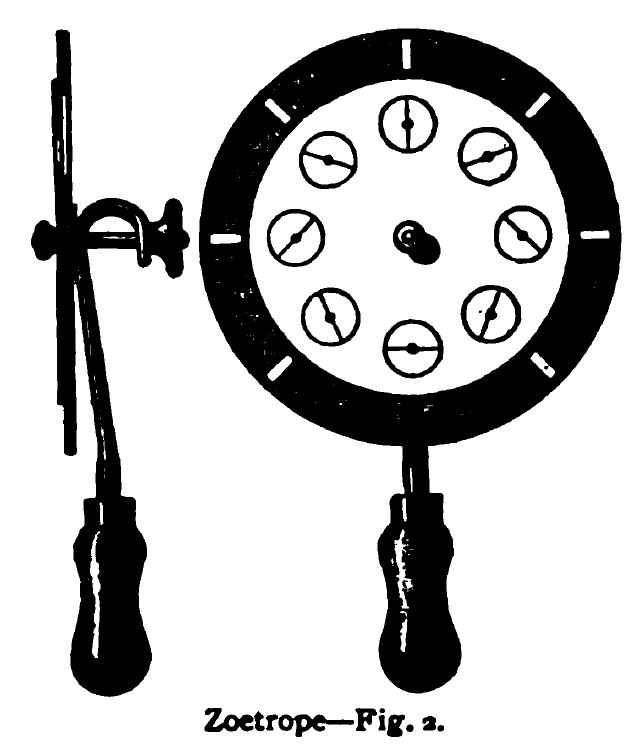
Zoetropes were harder.  There are two basic types.  Each has a series of drawings meant to represent phases of an action.

Scientific American / New Series, Volume 20, Issue 14, April 3, 1869
One type of Zoetrope has the images on the face of a disk.  The disk may have slots or notches between the images.  The disk is rotated in front of a mirror.  Looking though the slots intermittently interrupts our view of the images and persistence of vision allows us to see the images as if they are moving.

This can also be done with a second disk in front of the one with the images.  The front disk has the slots and it rotates in the opposite direction from the one with the images.  I built one of these as a project for university class.  I should have taken a photo.

The Story of the Motion Picture: 65 B.C. to 1920 A.D. By Ben Jehudah Lubschez
The other type of Zoetrope, also called a Phenakistoscope or Daedaleum (I love these names), has the images on a strip of paper lining the inside of a drum.  There is a slot toward the rim of the drum above each image.  Looking through the slots of the rotating drum also gives the illusion of motion.


When my daughter was young, I purchased a toy drum-type Zoetrope and we drew strips to view in it.  Just recently, my wife took her class to a field trip at the Disney Family Museum in San Francisco's Presidio.  They created Zoetrope strips. 

Magic: Stage Illusions and Scientific Diversions, Including Trick Photography, edited by Albert Allis Hopkins

The methods above used drawing or posed photographs to recreate motion.  In 1878, San Francisco photographer Eadweard Muybridge used a series of cameras to photograph the stages of motion as it was happening. This took place down the Peninsula from where I lived, at the Stanford Farm, the future home of Stanford University.  I found this fascinating.  I wanted to reanimate Muybridge's images and I wanted to create my own, but I could never gather enough functioning cameras.  Muybridge went on to do studies of many kinds of motion, and used a Zoetrope to present them. 


Magic: Stage Illusions and Scientific Diversions, Including Trick Photography, edited by Albert Allis Hopkins.
German inventor Ottomar Anschutz created the Electrical Tachyscope in 1887 and demonstrated it at the 1893 Columbian Exposition in Chicago.  It used an early form of strobe light to achieve intermittent motion. 

from Magic: Stage Illusions and Scientific Diversions, Including Trick Photography, edited by Albert Allis Hopkins:
"The apparatus is the invention of Ottamar Anschuetz, of Lissa, Prussia. A special camera was used, adapted to take a number of photographs in quick succession. The instrument for displaying the pictures is called the "electrical tachyscope." It consists of an iron wheel of sufficient diameter to hold an entire series of positive prints on the periphery. The wheel is arranged upon a rigid standard, and provided with a series of pins which register exactly with the picture. Upon the standard behind the wheel is located a box containing a spiral Geissler tube which is connected with the terminals of a Ruhmkorff coil. The primary coil is provided with a contact maker and breaker adapted to be operated by the pins projecting from the wheel, so that every time a picture comes before the Geissler tube it is illuminated by an electrical discharge through the tube. This discharge, being instantaneous, shows each picture in an apparently fixed position. These pictures succeed each other so rapidly that the retinal image of one picture is retained until the next is superimposed upon it, thereby giving to the observer the sense of a continuous image in constant motion."


French artist and inventor Charles-Émile Reynaud created the Praxinoscope, which improved on the Zoetrope by replacing the slots with a set of mirrors in the middle of the drum. The video was shot at the Musee Mechanique in San Francisco's Fisherman's Wharf.  The Musee Mechanique is a wonderful place to visit to play with old amusement machines. 

Magic: Stage Illusions and Scientific Diversions, Including Trick Photography, edited by Albert Allis Hopkins.
Reynaud went farther than the Praxinoscope or the Zoetrope with their simple strips of drawings.  He created the Théâtre Optique, which used a long chain of drawings on glass, along with projected backgrounds, to create beautiful animated cartoons which could be presented to large audiences.

from Magic: Stage Illusions and Scientific Diversions, Including Trick Photography, edited by Albert Allis Hopkins:
 "Up to the time of the invention of this theater, the apparatus that produced the synthesis of the successive phases of an action were limited to reproduction upon a very small scale, which can only be enjoyed by a limited group. The object of the optical theater was to provide an apparatus for the reproduction of a series of actions upon a considerable scale. The continuity of the image obtained by the praxinoscope, invented in 1877 by M. Reynaud, had not up to this time been realized by any projecting apparatus. The effect is produced by using a crystalloid band upon which the images are painted as represented at A in our engraving. The operator can revolve it in one direction or the other by means of two reels. The images pass before the lantern, B, and are projected by the aid of the objective, C, upon an inclined mirror, M, which projects them upon the transparent screen, E. Another projection lantern, B, causes the appearance on the screen of the scene, amid which appear the characters, which change their posture according as the painted band, A, is revolved by the operator."


Inspired by Reynaud, I drew a couple of animated films on strips of paper.  If they still exist, I should try to scan them and animate them.

Reynaud premiered the Théâtre Optique in 1892 to much acclaim.  In 1893, a team working for Thomas Edison demonstrated the vertical Kinetoscope, which allowed an individual to watch a movie.  In 1895, Auguste and Louis Lumière demonstrated a projector which allowed a crowd of people to watch a movie.  The Théâtre Optique was quickly forgotten,  In 1910, Reynaud threw his equipment and most of his animations into the Seine.

 Despite sad stories like Reynaud's, I get a lot of pleasure out of looking at pre-cinema, and sometimes trying to recreate it.  If you catch kids in the right mood, it can help them understand how movies work.

This post is part of the Classic Movie Ice Cream Social Blogathon, hosted by Fritzi at Movies Silently (http://moviessilently.com/2016/05/20/the-classic-movie-ice-cream-social-is-here/).  Thank you to Fritzi for all the hard work.  Thank you to everyone who visited and I encourage you to read and comment on as many posts as you can.  Bloggers love comments.  

This post is my second blogathon post of 2016 and my 42nd since 2007.  This is my 24th blogathon.    This page has a list of all my blogathon posts.  


Coincidentally, the first day of this blogathon is the 125th anniversary of the first public demonstration of the horizontal Kinetoscope by a team of Thomas Edison's workers led by WKL Dickson.  On 20-May-1891, in West Orange, New Jersey, they played this film, later called the "Dickson Greeting," to the National Federation of Women's Clubs.  The Kinetoscope required further development, which came to fruition in 1893. 

Thursday, February 5, 2015

Edison's Invention of the Kineto-Phonograph -- February 5, 2015

INTERIOR OF THE KINETOGRAPHIC THEATER, EDISON'S LABORATORY, ORANGE, N. J., SHOWING PHONOGRAPH AND KINETOGRAPH,

WKL Dickson led the Edison team that developed the kinetograph (movie camera), kinetoscope (movie viewer) and the kineto-phonograph (sound movie system).  Dickson and his wife Antonia wrote this article for the June, 1894 Century Magazine. 

Edison's Invention of the Kineto-Phonograph

From The Century; A Popular Quarterly / Volume 48, Issue 2, June 1894

The text and pictures of this article copyright, 1894, by ANTONIA & W. K. L. DICKSON.

The photographs are by Mr. Dickson.

DRAWN BY B. J. MEEKER

ACCOUNT OF THE INVENTION.

The synchronous attachment of photography with the phonograph was early contemplated by Mr. Edison, in order to record and give back the impressions to the eye as well as to the ear.

The comprehensive term for this invention is the kineto-phonograph. The dual "talking machine is the phono-kinetograph, and the reproducing-machine the phono-kinetoscope, in contradistinction to the kinetograph and the kinetoscope, which relate respectively to the taking and reproduction of movable but soundless objects.

The initial experiments took the form of microscopic pin-point photographs, placed on a cylindrical shell, corresponding in size to the ordinary phonograph cylinder. These two cylinders were then placed side by side on a shaft, and the sound record was taken as near as possible synchronously with the photographic image impressed on the sensitive surface of the shell. The photographic portion of the undertaking was seriously hampered by the defects of the materials at hand, which, however excellent in themselves, offered no substance sufficiently sensitive. How to secure clear-cut outlines, or indeed any outlines at all, together with phenomenal speed, was the problem which puzzled the experimenters. The Daguerre, albumen, and kindred processes met the first requirements,but failed when subjected to the test of speed. These methods were therefor regretfully abandoned, a certain precipitate of knowledge being retained, and a bold leap was made to the Maddox gelatine bromide of silver emulsion, with which the cylinders were coated. This process gave rise to a new and serious difficulty. The bromide of silver haloids, held in suspension with the emulsion, showed themselves in an exaggerated coarseness when it became a question of enlarging the pin-point photographs to the dignity of one eighth of an inch, projecting them upon a screen, or viewing them through a binocular microscope. Each accession of size augmented the difficulty, and it was resolved to abandon that line of experiment, and to revolutionize the whole nature of the proceedings by discarding these small photographs, and substituting a series of very much larger impressions affixed to the outer edge of a swiftly rotating wheel, or disk, and supplied with a number of pins, so arranged as to project under the center of each picture. On the rear of the disk, upon a stand, was placed a Geissler tube, connected with an induction coil, the primary wire of which, operated by the pins, produced a rupture of the primary current, which, in its turn, through the medium of the secondary current, lighted up the Geissler tube at the precise moment when a picture crossed its range of view. This electrical discharge was performed in such an inappreciable fraction of time, the succession of pictures was so rapid, and the whole mechanism so nearly perfect, that the goal of the inventor seemed almost reached.

Then followed some experiments with drums, over which sheets of sensitized celluloid film were drawn, the edges being pressed into a narrow slot in the surface, similar in construction to the old tin-foil phonograph. A starting- and stopping-device very similar to the one now in use was also applied. The pictures were then taken spirally to the number of two hundred or so, but were limited in size, owing to the rotundity of surface, which brought only the center of the picture into focus. The sheet of celluloid was then developed, fixed, etc., and placed upon a transparent drum, bristling at its outer edge with brass pins. When the drum was rapidly turned, these came in contact with the primary current of an induction coil, and each image was lighted up in the same manner as described in the previous disk experiment, with this difference only, that the inside of the drum was illuminated.

The next step was the adoption of a highly sensitized strip of celluloid half an inch wide; but this proving unsatisfactory, owing to inadequate size, one-inch pictures were substituted on a band one and a half inches wide, the additional width being required for the perforations on the outer edge. These perforations occur at close and regular intervals, in order to enable the teeth of a locking-device to hold the film steady for nine tenths of the one forty-sixth part of a second, when a shutter opens rapidly and admits a beam of light, causing an image or phase in the movement of the subject. The film is then jerked forward in the remaining one tenth of the one forty-sixth part of a second, and held at rest while the shutter has again made its round, admitting another circle of light, and so on until forty-six impressions are taken a second, or 2760 a minute. This speed yields 165,600 pictures in an hour, an amount amply sufficient for an evening's entertainment, when unreeled before the eye. By connecting the two ends of the strip, and thus forming a continuous band, the pictures can be indefinitely multiplied. In this connection it is interesting to note that were the spasmodic motions added up by themselves, exclusive of arrests, on the same principle that a train record is computed independent of stoppages, the incredible speed of twenty-six miles an hour would be shown.

The advantage of this system over a continuous band, and of a slotted shutter forging widely ahead of the film, would be this, that in that case only the fractional degree of light comprised in the 1/2720 part of a second is allowed to penetrate to the film at a complete sacrifice of all detail, whereas, in the present system of stopping and starting, each picture gets one hundredth part of a second's exposure, with a lens but slightly stopped down -- time amply sufficient, as any photographer knows, for the attainment of excellent detail even in an ordinarily good light. It must be understood that only one camera is used for taking these strips, and not a battery of cameras, as in Mr. Muybridge's photographs of The Horse in Motion. (See THE CENTURY for July, 1882.)

The next step, after making the negative band, is to form a positive or finished series of reproductions from the negative, which is passed through a machine for the purpose, in conjunction with a blank strip of film, which, after development and general treatment, is replaced in the kinetoscope or phono-kinetoscope, as the case may be. When a phonograph record has been taken simultaneously with such a strip, the two are started together by the use of a simple but effective device, and kept so all through, the phonographic record being in perfect accord with the strip. In this conjunction, the tiny holes with which the edge of the celluloid film is perforated, correspond exactly with the phonographic records, and the several devices of the camera, such as the shifting of the film and the operations of the shutter, are so regulated as to keep pace with the indentation made by the stylus upon the phonographic wax cylinder, one motor serving as a source of common energy to camera and phonograph, when they are electrically and mechanically linked together. The establishment of harmonious relations between kinetoscope and phonograph was a harrowing task, and would have broken the spirit of inventors less inured to hardship and discouragement than Edison's veterans. The experiments have borne their legitimate fruit, and the most scrupulous nicety of adjustment has been achieved, with the resultant effects of realistic life, audibly and visually expressed.

THOMAS A. EDISON, 1893.
The process of taking is variously performed: by artificial light in the photographic department, or by daylight under the improved conditions of the new theater, of which we shall speak. The actors, when more than one in number, are kept as close together as possible, and exposed either to the glare of the sun, to the blinding light of four parabolic magnesium lamps, or to the light of twenty arc-lamps, prvided with highly actinic carbons, supplied with powerful reflectors equal to about 50,000 candle-power. This radiance is concentrated upon the performers while the kinetograph and phonograph are hard at work storing up records and impressions for future reproduction.

A popular and inexpensive adaptation of kinetoscopic methods is in the form of the well-known nickel-in-the-slot, a machine consisting of a cabinet containing an electrical motor and batteries for operating the mechanism which acts as the impelling power to the film. The film is in the shape of an endless band fifty feet in length, which is passed through the field of a magnifying-glass perpendicularly placed. The photographic impressions pass before the eye at the rate of forty-six per second, through the medium of a rotating, slotted disk, the slot exposing a picture at each revolution, and separating the fractional gradations of pose. Projected against a screen, or viewed through a magnifying-glass, the pictures are eminently lifelike, for the reason that the enlargement need not be more than ten times the original size. On exhibition evenings the projecting-room, which is situated in the upper story of the photographic department, is hung with black, in order to prevent any reflection from the circle of light emanating from the screen at the other end, the projector being placed behind a curtain, also of black, and provided with a single peep-hole for the accommodation of the lens. The effect of these somber draperies, and the weird accompanying monotone of the electric motor attached to the projector, are horribly impressive, and one's sense of the supernatural is heightened when a figure suddenly springs into his patb, acting and talking with a vigor which leaves him totally unprepared for its mysterious vanishing. Projected stereoscopically, the results are even more realistic, as those acquainted with that class of phenomena may imagine, and a pleasing rotundity is apparent, which, in ordinary photographic displays, is conspicuous by its absence.

THE FENCERS. TWO SECTIONS OF THE KINETOSCOPIC BAND, SHOWING MINUTE GRADATIONS IN POSE.
HEAR ME, NORMA. KINETOSCOPIC VIEWS, SHOWING FIVE SECTIONS OF THE STRIP.
Nothing more vivid or more natural could be imagined than these breathing, audible forms, with their tricks of familiar gesture and speech. The inconceivable swiftness of the photographic successions, and the exquisite synchronism of the phonographic attachment, have removed the last trace of automatic action, and the illusion is complete. The organ-grinder's monkey jumps upon his shoulder to the accompaniment of a strain from Norma. The rich strains of a tenor or soprano are heard, set in their appropriate dramatic action; the blacksmith is seen swinging his ponderous hammer, exactly as in life, and the clang of the anvil keeps pace with his symmetrical movements; along with the rhythmical measures of the dancer go her soft-sounding footfalls; the wrestlers and fencers ply their intricate game, guarding, parrying, attacking, thrusting, and throwing, while the quick flash of the eye, the tension of the mouth, the dilated nostrils, and the strong, deep breathing give evidence of the potentialities within.

The photographic rooms, with their singular completeness of appointment, have been the birthplace and nursery of this invention; and the more important processes connected with the preparation and development of the film, together with other mechanical and scientific devices, are still carried on in this department. The exigencies of natural lighting incident to the better taking of the subjects, and the lack of a suitable theatrical stage, however, necessitated the construction of a special building, which stands in the center of that cluster of auxiliary houses which forms the suburbs of the laboratory, and which is of so peculiar an appearance as to challenge the attention of the most superficial observer. It obeys no architectural rules, embraces no conventional materials, and follows no accepted scheme of color. Its shape is an irregular oblong, rising abruptly in the center, at which point a movable roof is attached, which is easily raised or lowered at the will of a single manipulator. Its color is a grim and forbidding black, enlivened by the dull luster of many hundred metallic points; its material is paper, covered with pitch and profusely studded with tin nails. With its flapping sail-like roof and ebon hue, it has a weird and semi-nautical appearance, and the uncanny effect is not lessened when, at an imperceptible signal, the great building swings slowly around upon a graphited center, presenting any given angle to the rays of the sun, and rendering the operators independent of diurnal variations. The movable principle of this building is identical with that of our river swinging-bridges, the ends being suspended by iron rods from raised center-posts. This building is known as the Kinetographic Theater, otherwise the "Black Maria". Entering, we are confronted by a system of lights and shades so sharply differentiated as to pain the eye, accustomed to the uniform radiance of the outer air. Later we find that the contrasts are effected by the total exclusion of light from the lower end of the hall, heightened by draperies of impenetrable black, against which stands out in sharp relief the central stage, on which are placed the kinetographic subjects, bathed in the full power of the solar rays pouring down from the movable roof. This distribution of light and shade is productive of the happiest effects in the films, as the different figures are thrown into the broadest relief against the black background, and a distinctness of outline is achieved that would be impossible under ordinary conditions.

At the other end of the hall is a cell, indicated by an ordinary door and an extraordinary window, glazed in panes of a lurid hue, which gives the finishing touch to the Rembrandtesque character of the picture. The compartment is devoted to the purpose of changing the film from the dark box to the kinetographic camera, being provided with a special track, running from the mysterious recesses at the back of the stage to its own special precincts, where fresh films are substituted for the ones already employed. the processes of development, etc., are performed in the main photographic building.

The dramatis personae of this stage are recruited from every characteristic section of social, artistic, and industrial life, and from many a phase of animal existence. One day chronicled the engagement of a troupe of trained bears and their Hungarian leaders. The bears were divided between surly discontent and a comfortable desire to follow the bent of their own inclinations. It was only after much persuasion that they could be induced to subserve the interests of science. One furry monster waddled up a telegraph-pole, to the soliloquy of his own indignant growls; another settled himself comfortably in a deep arm-chair, with the air of a postgraduate in social science; a third rose solemnly on his hind legs and described the measures of some dance, to the weird strains of his keepers music. Another licked his master's swarthy face, another accepted his keepers challenge, and engaged with him in a wrestling-match, struggling, hugging, and rolling on the ground.

Of human subjects we have a superfluity, although the utmost discrimination is essential in the selection of themes. the records embrace pugilistic encounters, trapeze and cane exercises, (lancing, wrestling, fencing, singing, the playing of instruments, speech-making, the motions involved in the different crafts, horseshoeing, equestrianism, gardening, and many others.

THE BARBER SHOP.
We have yet to speak of the microscopic subjects, a class of especial interest, as lying outside of the unaided vision of man. In the treatment of these infinitesimal types, much difficulty was experienced in obtaining a perfect adjustment so as to reproduce the breathing of insects, the circulation of blood in a frog's leg, and other similar processes of nature. The enlargement of animalcule in a drop of stagnant water proved a most exacting task, but by the aid of a powerful lime-light, concentrated on the water, by the interposition of alum cells for the interception of most of the heat rays, and by the use of a quick shutter and kindred contrivances, the obstacles were overcome, and the final results were such as fully to compensate for the expenditure of time and trouble. We will suppose that the operator has at last been successful in imprisoning the tricksy water-goblins on the sensitive film, in developing the positive strip, and placing it in the projector. A series of inch-large shapes then springs into view, magnified stereoptically to nearly three feet each, gruesome beyond power of expression, and exhibiting an indescribable celerity and rage. Monsters close upon one another in a blind and indiscriminate attack, limbs are dismembered, gory globules are tapped, whole battalions disappear from view. Before the ruthless completeness of these martial tactics the Kilkenny cats fade into insignificance. A curious feature of the performance is the passing of these creatures in and out of focus, appearing sometimes as huge and distorted shadows, then springing into the reality of their own size and proportions.

Hitherto we have limited ourselves to the delineation of detached subjects, but we shall now touch very briefly upon one of our most ambitious schemes, of which these scattered impersonations are but the heralds. Preparations have long been on foot to extend the number of the actors and to increase the stage facilities, with a view to the presentation of an entire play, set in its appropriate frame.

This line of thought may be indefinitely pursued, with application to any given phase of outdoor or indoor life which it is desired to reproduce. Our methods point to ultimate success, and every day adds to the security and the celerity of the undertaking. No scene, however animated and extensive, but will eventually be within reproductive power. Martial evolutions, naval exercises, processions, and countless kindred exhibitions will be recorded for the leisurely gratification of those who are debarred from attendance, or who desire to recall them. The invalid, the isolated country recluse, and the harassed business man can indulge in needed recreation, without undue expenditure, without fear of weather, and without the sacrifice of health or important engagements. Not only our own resources but those of the entire world will be at our command. The advantages to students and historians will be immeasurable. Instead of dry and misleading accounts, tinged with the exaggerations of the chroniclers minds, our archives will be enriched by the vitalized pictures of great national scenes, instinct with all the glowing personalities which characterized them.

Antonia and W K L. Dickson.

DRAWN BY E. J. MEEKER./EXTERIOR OF EDISON'S KINETOGRAPHIC THEATER, ORANGE, N. J.

Tuesday, January 6, 2015

Edison's Kinetoscope -- January 6, 2015


The earliest version of the Kinetograph/Kinetoscope used tiny images on a cylinder rather than on film.  The article is from Manufacturer and Builder, November, 1894. The image is from "The Edison Kinetoscope," The Electrical Engineer, 07-November-1894.

Edison's Kinetoscope


From Manufacturer and Builder / Volume 26, Issue 11, November 1894

The initial idea of Edison's kinetoscope, relating to the production of motion, is based upon the familiar toy known as the zoetrope, or wheel of life. This rude prototype contains a cylinder 10 inches in width and open at the top, around the lower half of whose interior a series of pictures is placed, representing any sequence of motion it may be desired to portray, such, for instance, as wrestling, jumping, or the swift progress of animals. These movements are seen through the narrow vertical slits in the cylinder during the rapid revolution of the little machine, and are designed to blend into one continuous impression. In the zoetrope, however, the pictures are wood cuts of rude execution, and the limited speed obtainable in the production of these militate against the lifelike effect, producing a series of jerks instead of the desired continuity of motion. When instantaneous photography, as evolved by Maddox and others, was utilized superior results were attained, but it seemed impossible to take pictures at sufficiently short intervals to secure the absolute blending of outline essential to a faithful portrayal of life. In Edison's latest form of kinetoscope the photographic film is in the shape of an endless band from 50 to 150 feet in length, which is passed through the field of the magnifying glass perpendicularly placed, and the photographic impressions pass before the eyes at the rate of 46 per second. Projected against a screen, or viewed through the magnifying glass, the pictures are eminently lifelike.  Antonio (Antonia? - JT) and W. K. L. Dickson in Cassier's Magazine.

Thursday, December 4, 2014

Edison's Kinetoscope -- December 4, 2014


The article is from Manufacturer and Builder, July, 1894. The image is from "The Edison Kinetoscope," The Electrical Engineer, 07-November-1894.

Just what the kinetograph and the kinetoscope really will accomplish is known to few people, because of a lack of any authentic and authorized description of the instruments. The comprehensive term for this invention is the kineto - phonograph. The "dual talking machine" is the phono - kinetograph, and the reproducing machine the phono - kinetoscope, in contradistinction to the kinetograph and the kinetoscope, which relate respectively to the taking and reproduction of movable but soundless objects.

The initial experiments took the form of microscopic, pin - point photographs, placed on a cylindrical shell, corresponding in size to the ordinary phonograph cylinder. These two cylinders were then placed side by side on a shaft, and the sound record was taken as near as possible synchronously with the photographic image impressed on the sensitive surface of the shell.

The photographic portion of the work presented many difficulties, and the writers describe at length the efforts that were made to get a film sufficiently sensitive to take the impression in the brief time possible for exposure, and that would give such detail as to bear enlargement. This was finally accomplished, however, and a shutter was invented which gave an exposure of 1/2720th part of a second. The next step, and one which sorely tried the patience and ingenuity of the inventors, was to connect the camera and the photograph (phonograph - JT) so that the action and the accompanying sound should both be recorded exactly simultaneously. The pictures were taken in a specially devised theater, which is described.

The actors, when more than one in number, are kept as close together as possible, and exposed either to the glare of the sun, to the blinding magnesium lamps, or to the light of twenty arc lamps, provided with highly actinic carbons, supplied with powerful reflectors equal to about 50,000 candle-power. This radiance is concentrated upon the performers while the kinetograph and phonograph are hard at work storing up records and impressions for future reproduction.

A popular and inexpensive adaptation of kinetoscopic methods is in the form of the well-known nickel-in-the-slot, a machine consisting of a cabinet containing an electrical motor and batteries for operating the mechanism which acts as the impelling power to the film. The film is in the shape of an endless band fifty feet in length, which is passed through the field of a magnifying glass perpendicularly placed. The photographic impressions pass before the eye at the rate of forty-six per second, through the medium of a rotating, slotted disk, the slot exposing a picture at each revolution, and separating the fractional graudations of pose. Projected against a screen, or viewed through a magnifying glass, the pictures are eminently lifelike, for the reason that the enlargement need not be more than ten times the original size. On exhibition evenings the projecting-room, which is situated in the upper story of the photographic department, is hung with black in order to prevent any reflection from the circle of light emanating from the screen at the other end, the projector being placed behind a curtain also of black, and provided with a single peep-hole for the accommodation of the lens. The effect of these somber draperies, and the weird accompanying monotone of the electric motor attached to the projector, are horribly impressive, and one's sense of the supernatural is hightened when a figure suddenly springs into its path, acting and talking with a vigor which leaves him totally unprepared for its mysterious vanishing. Projected stereocoscopically, the results are even more realistic, as those acquainted with that class of phenomena may imagine, and a pleasing rotundity is apparent, which, in ordinary photographic displays, is conspicuous by its absence.

-- Photo-American.

Monday, October 6, 2014

Edison's Kinetograph -- October 6, 2014


The image is from "The Kineto-Phonograph," an article in the 29-June-1894 edition of The Electrical Review.  The article is from the June, 1891 Manufacturer and Builder. 

Edison's Kinetograph


From Manufacturer and Builder / Volume 23, Issue 6, June 1891

The latest invention of Mr. Edison, which the newspapers of late have been dicusing is sufficiently ingenious to be worthy of the fame of the "wizard". As presented originally in the form of an interview with a reporter of the New York Sun, the subject was dished up with a garnishing of sensational comment evidently designed to make the most of the opportunity from the standpoint of newspaper enterprise. Of this nature is the introduction to the article in question, wherein is a prediction of Mr. Edison that he would produce a machine that would record and reproduce motion as the phonograph records and reproduces sound -- once declared by would-be wizards to be ridiculous; whereat the real wizard gets mad and registers a vow, etc.,etc.  What Mr. Edison has in mind to accomplish, may best be stated in his own words, as reported in the aforesaid interview.  Recently he (Mr. Edison) went to Chicago. While there, some one who was interested in the World's Fair asked him if he was going to get up some electric novelty to place on exhibition at the big exposition. "I have a machine projected", replied Edison, "but the details are not perfected yet. My intention is to have such a happy combination of electricity and photography that a man can sit in his own parlor and see reproduced on a screen the forms of the players in an opera produced on a distant stnge, and, as he sees their movements, he will hear the sound of their voices as they talk or sing or laugh. When the machine is perfected, which it will be long before it can be exhibited at the fair, each little muscle of the singer's face will be seen to work, his facial expression with its every change will be exactly reproduced, and the stride and positions will be natural, and will vary as do those of the person himself. That is only one part of what the machine will do. To the sporting fraternity, I can say that before long it will be possible to apply this system to prize fights and boxing exhibitions. The whole scene, with the comments of the spectators, the talk of the seconds, the noise of the blows, and so on, will be faithfully transferred."  It appears that Mr. Edison has been at work seeking to perfect the mechanical details of this ingenious idea, and that he has made considerable progress. What must be accomplished in order to make a practically operative invention, is to to combine and actuate the two elements of the combination, that they shall work together in perfect synchronism -- that is to say, the phonograph that emits the sounds must be made to operate simultaneously with the photographic apparatus, so that sounds that shall be emitted to the ear will be fitted exactly to the pictures that are to be projected upon a large screen. Furthermore, it must be borne in mind that the pictures are not of the immovable kind that we are familiar with in stereopticon exhibitions. They are taken in such rapid succession (146 to the second), that, when caused to move rapidily in front of the lens of a projecting lantern, they will faithfully reproduce on the screen the appearance of being in motion. The zeotope (zoetrope? - JT), an ingenious optical toy with which all of our readers will be familiar, gives this illusion very well, and many who have had the opportunity of witnessing the admirable projection pictures of animals in motion made from the instantaneous pictures of E. Muybridge, need not be told that this part of Mr. Edisons scheme has already been worked out practically to perfection. Reference to this point is made in the Sun's article, and Mr. Edison is made to say that the trouble with all attempts heretofore made to reproduce action and motion by photographs, was that the photographs could not be taken in series with sufficient rapidity to catch accurately the motion it was desired to reproduce. If Mr. Edison is correctly reported, he exhilbits in this statement an unaccountable ignorance of Mr. Muybridge's wonderful work in this direction, with which the entire scientific world is quite familiar. The adaptation of Mr. Muybridge's series of pictures to the projecting lantern have been shown in nearly every large city in this country as well as in Europe, and so admirably reproduce the movements of men and animals, executing all sorts ("of" omitted - JT) actions, that they appear to be perfectly lifelike.  Mr. Edison's idea of combining the sound record with that of the photograph, so as to reproduce a scene at the theater, the lecture hall, or the arena, to eye as well as to ear, is worthy of his best efforts, and will demand an amount of mechanical ingenuity to overcome its practical difficulties that can hardly be overestimated. It will be apparent, however, to those who have read this summary of the siubject intelligently, that the problem he is seeking to solve is simply a mechanical one -- that it involves no original discovery. We say this with no design to depreciate Mr. Edison's efforts, but simply to state the truth of the case, which has been greatly distorted by the extravagant utterances of a newspaper scribe.