Showing posts with label Bessie Love. Show all posts

Tuesday, February 25, 2025

The Lost World -- February 25, 2025


Moving Picture World, 14-February-1925

This subject of this huge trade ad was the movie based on Arthur Conan Doyle's The Lost World, which included object animation created by Willis O'Brien, was a big hit. I starred Bessie Love. 

Monday, January 27, 2025

Bessie Love -- The Little Brown Wren -- January 27, 2025


Photoplay, January, 1925

I have always been fascinated by the career of actress Bessie Love. She was born in Texas. Her name was Juanita Horton. Her family moved to Los Angeles and she went to Los Angeles High School. Looking for work, she met director DW Griffith and got a small part in Intolerance. She appeared in movies with William S Hart and Douglas Fairbanks. She was a 1922 WAMPAS (Western Association of Motion Picture Advertisers) Baby Star. She played many leading roles, most famously in The Lost World, but never broke through until the talkies came, when she starred in The Broadway Melody. Her career was hot again for a few years but then tailed off. She continued to appear in small parts in movies until the early 1980s.


The Little
Brown Wren

Bessie Love has developed
a personality
that is delightful and unique

By Ivan St. Johns

OUTSIDE, the wind whined along the range and then came sweeping down upon the little brown tent with one of those full-throated shrieks that make you believe in ghosts. It blew the thickly falling snowflakes in whirlpools of white, and smashed them high and hard upon the endless piles of packed and glittering snow-banks. When it died down for a moment, there was the distant, hair-raising note of a coyote's howl in the vastness.

The Texas range on a very bad winter night.

Inside the little tent, the fire burned bravely in the drum stove and fought back the creeping, bitter cold. The kerosene lanterns sputtered and gave out a sickly light and a sicklier smell.

There were eight or ten of us in that tent and we were none of as very happy. Two or three newspapermen, a big executive of First National, the director and cameraman, Charlie Murray, a couple of cowboys in off the range, a middle-aged woman dozing over a week-old newspaper and -- the girl.

A slender, brown wren of a girl, in the ordinary and rather awkward khaki riding habit of the district. A mouse-like lit tie person. Brown hair, sleek and smooth about her small head. Brown eyes, peering out from a smoothly brown face, clear but colorless. A sweet, humorous, timid mouth. Nobody was paying much attention to her.

You see. we had all ridden miles in an automobile in the face of that snowstorm, to get to the "Sundown" location, seventy miles north of El Paso. We were, with the exception of the cowboys, city-bred, and used to our comforts. We were not habituated to roughing it. It was very cold and dismal, and the endless, uninhabited prairie outside depressed us.

And then the girl, sort of casually, picked up her ukulele -- dread instrument of torture as a rule -- and holding it cockily under her left arm. began to sing. I am not poetic as a rule, being a very average, ordinary sort of citizen, but the thought that came to me then and still comes to my memory of that evening, is "A brown wren turned into a nightingale."

And so she did.

Bessie Love sang for us -- all sorts of songs, funny little character songs that she had picked up. heaven alone knows where! -- jazzy, daring, tantalizing little songs; tender, crooning things that have outlived the centuries -- and we forgot the snow outside, and the penetrating cold, and the wind itself paused to listen, and the tent became a happy, congenial, friendly place where a man would rather be than almost any place else he could think of.

It takes personality to "put over" a song across the footlights. It takes more to put over a song in a drawing room. But it takes personality plus to put over a song in a tent surrounded by snow and wind and filled with hungry, cold and slightly disgruntled men.

I REMEMBER one night at a party given by Marshall and Blanche Sweet Neilan. Alan Hale was there, and though he is more often villainous upon the screen than anything else, off the screen he is the most sparkling of humorists and the most entertaining of companions. He is also by way of being one of the best trick dancers I have ever seen. On the night of this party he had a lot of new steps, and needed a partner to do them with. Now there were at the party, though I will mention no names, two or three screen stars who are famous for their dancing. At least one of them is more famous for it than for anything else. Two of them had been great stage dancers, musical comedy and Follies favorites. They all fell down on the job, though they tried hard enough.

And then the first thing you know, while Max Fisher's orchestra played seductively, there was little Bessie Love, quietly and unpretentiously, following Alan through all the mazes, light as a feather and graceful as a flower in a summer breeze. She never made a mistake nor a misstep, and she gained suddenly as she danced a pert little personality, an impudent little boyishness that is one of her chief attractions.

It is the same way on the screen. Though she was a failure as a star, and though often her role is not a featured one in big productions, Hollywood has a tradition that Bessie Love will steal any picture she is in; that she has, in fact, stolen more pictures from the people supposed to be starred in them than anyone else on the screen. It isn't quite fair to enumerate them, but if you will stop and think I'm sure you will remember half a dozen pictures from which you took away most poignantly the memory of something Bessie Love did.

She was born in Texas but went to Los Angeles when she was only a baby. She went to public school there and to Los Angeles High School. She was training herself to be a school teacher, as her mother had been before her, when pictures crept upon her horizon. She was still in high school when D. W. Griffith picked her from a mob of applicants to play a part in "Intolerance."

He was so sure of her ability that he gave her a five-year contract, and she did some pictures with Bill Hart and was leading lady for Douglas Fairbanks.

After that, for almost three years, she was practically an outcast. She couldn't get a job. She had made a mistaken starring venture, had failed, and it seemed as though her picture career might end with that. She fought against it, and finally decided to come back to the screen in any sort of parts, even "kid stuff," which she hoped she had abandoned forever. Her first picture was "Forget-Me-Not" -- a child role.

But the breaks began to come her way after that and today she works in as many as three pictures at once.

And during those three years she seems to have distilled the sweetness within her, so that she can project it upon the screen. She seems to have developed a new and very telling personality. There is a measure of understanding and of depth to her that I, personally, find in no other screen actress. And then, she's such a little thing. And so bright and sweet and kindly.

So far she's never been married.

Photoplay, January, 1925

This movie based on Arthur Conan Doyle's The Lost World, which included object animation created by Willis O'Brien, was a big hit.

Photoplay, January, 1925


Tuesday, August 27, 2024

Bessie Love is a Veteran Trouper -- August 27, 2024

Picture Play, August, 1924

I have always been fascinated by the career of actress Bessie Love. She was born in Texas. Her name was Juanita Horton. Her family moved to Los Angeles and she went to Los Angeles High School. Looking for work, she met director DW Griffith and got a small part in Intolerance. She appeared in movies with William S Hart and Douglas Fairbanks. She was a 1922 WAMPAS (Western Association of Motion Picture Advertisers) Baby Star. She played many leading roles, most famously in The Lost World, but never broke through until the talkies came, when she starred in The Broadway Melody. Her career was hot again for a few years, but then tailed off. She continued to appear in small parts in movies until the early 1980s.

Exhibitors Herald, 30-August-1924

Bessie Love starred in Sundown, a western story mostly shot in Texas. Laurence Trimble and Harry O Hoyt directed.

Picture Play, August, 1924

Bessie Love sits at her typewriter.

Exhibitors Herald, 23-August-1924

Harry O Hoyt also directed The Lost World, an adaption of Arthur Conan Doyle's The Lost World. Willis O'Brien used stop-motion animation to bring the dinosaurs and other prehistoric beasts to life.

Picture Play, August, 1924

Bessie Love "on location for 'All Day.'" I guess this is an alternative title for Dynamite Smith, which was set in Alaska. 

Exhibitors Herald, 23-August-1924

"The real thing!"

Saturday, July 27, 2024

The Ardor of Bessie Love -- July 27, 2024

Exhibitors Herald, 05-July-1924

I have always been fascinated by the career of actress Bessie Love. She was born in Texas. Her name was Juanita Horton. Her family moved to Los Angeles and she went to Los Angeles High School. Looking for work, she met director DW Griffith and got a small part in Intolerance. She appeared in movies with William S Hart and Douglas Fairbanks. She was a 1922 WAMPAS (Western Association of Motion Picture Advertisers) Baby Star. She played many leading roles, most famously in The Lost World, but never broke through until the talkies came, when she starred in The Broadway Melody. Her career was hot again for a few years, but then tailed off. She continued to appear in small parts in movies until the early 1980s.

Bessie and the calf are both cute. 

Thursday, June 29, 2023

Fox Film Corporation -- 20 Years of Progress (Part One) -- June 29, 2023

Motion Picture News, 30-June-1923

100 years ago this month, the Fox Film Corporation celebrated "20 Years of Progress." 
Fox paid for a gaudy color section to promote its wares. 

William Fox purchased his first nickelodeon in 1904. He went on to develop a nationwide chain of movie theaters and to found one of the major production companies on the film industry. He overexpanded and lost everything in the Great Depression.

Motion Picture News, 30-June-1923

Motion Picture News, 30-June-1923

Motion Picture News, 30-June-1923

"The Motion Picture Version/Mightier Than the Book."

Motion Picture News, 30-June-1923

The Governor's Lady was based on a novel by Alice Bradley and a play produced by David Belasco. Belasco, a native of San Francisco, liked naturalism. For The Governor's Lady, he built a Child's Restaurant onstage and the actors prepared food in the kitchen. 

Motion Picture News, 30-June-1923

Great image. Notice that Bela Lugosi played a supporting role. 

Motion Picture News, 30-June-1923

John Ford directed Tom Mix in North of Hudson Bay. Dig that sweater. 

Motion Picture News, 30-June-1923

Gentle Julia starring Bessie Love, was based on a novel by Booth Tarkington.
 
Motion Picture News, 30-June-1923

"Mr Gallagher and Mr Shean -- First Appearance in Pictures." Ed Gallagher and Al Shean were a vaudeville comedy team. Al Shean was the Marx Brothers' uncle. Their mother Minnie was his sister.

Motion Picture News, 30-June-1923

"Old King Tut would marvel at The Shepherd King. Egyptian subjects were very popular because of the recent discovery of Tutankhamun's tomb.

Motion Picture News, 30-June-1923

The Shadow of the East was based on a novel by EM Hull, the man who wrote The Sheik.

Motion Picture News, 30-June-1923

Six Cylinder Love was based on a play by William Anthony McGuire. Ernest Truex starred in the play on Broadway and then in the movie.

Motion Picture News, 30-June-1923

The Temple of Venus shot partially in Santa Cruz, California, was to star Jean Arthur (very young) and Phyllis Havers. Jean Arthur was replaced by Mary Philbin early in the shooting.

Wednesday, September 15, 2021

Tom Mix -- The Night Horsemen -- September 15, 2021

Omaha Bee, 25-September-1921

I like the design of this ad for The Night Horsemen, which apparently survives in an archive. It is based on a novel by Max Brand (Frederick Schiller Faust), who wrote lots of Westerns.

Moving Picture World, 31-January-1920

Exhibitors Herald, 17-September-1921

Exhibitors Herald, 03-September-1921

Tom Mix and Fox's number two western star, Buck Jones talked about touring the rodeo circuit together.

Moving Picture World, 24-September-1921

Tom Mix was invited to visit the Pendleton Round-Up, a major rodeo.

East Oregonian, 10-September-1921

Unfortunately, his schedule did not permit him to go. 

Exhibitors Herald, 17-September-1921

Buck Jones serenades his leading lady, Helen Ferguson, in To A Finish. I find the title interesting because usually we would say "To The Finish."

Exhibitors Herald, 17-September-1921

listal.com

Moving Picture Weekly, 03-September-1921

"Let your crowd go wild with excitement when the fearless king of cowboys fights the skull-faced demons." Sounds like an exciting serial. Art Acord was another contemporary of Mix and Jones, who appeared in many silent films, but did not make the transition to talkies.

Moving Picture Weekly, 11-September-1921

Frank Mayo had a long career but never became a star. John Ford directed him in Hitchin' Posts.

Moving Picture Weekly, 11-September-1921

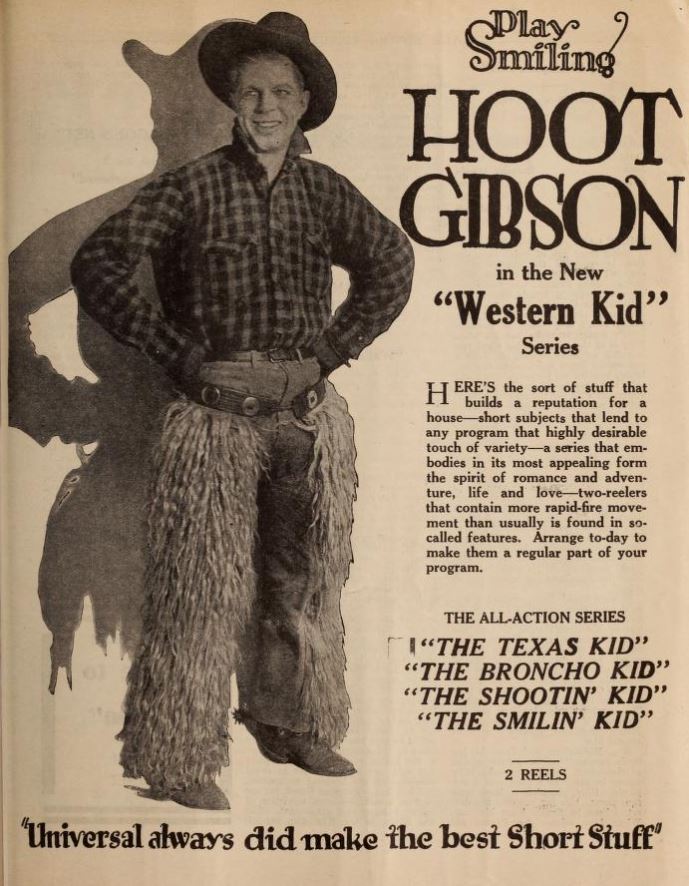
Moving Picture Weekly, 03-September-1921

Hoot Gibson was a contemporary of Tom Mix and Buck Jones. His movies tended to emphasize humor. How about those sheepskin chaps?

Moving Picture Weekly, 25-September-1921

"Universal's first Americanism Film"!?

Moving Picture World, 03-September-1921

Lester Cuneo had worked with Tom Mix at the Selig Polyscope Company and then served in the army during World War One. Cuneo died by his own hand in 1925. 

Moving Picture World, 17-September-1921

Tom Santschi (hard name to spell) had a long career, but mostly worked in small character parts after the mid-1920s. The Secret of Butte Ridge was directed by Bob Bradbury.

Moving Picture World, 24-September-1921

Santschi's leading lady in The Honor of Ramirez was Bessie Love.