Showing posts with label Lillian Gish. Show all posts

Thursday, December 19, 2024

Buster Keaton -- Sailor Lassies Help Navigator -- December 19, 2024

Photoplay, December, 1924

Buster's The Navigator was set aboard an ocean liner that was adrift on the ocean. The movie is hilarious. "...it isn't easy to be laughable for six thousand feet of film."

Moving Picture World, 20-December-1924

Metro-Goldwyn, soon to become Metro-Goldwyn-Mayer, proudly announced its current product, including The Navigator, Erich von Stroheim's Greed, Henry King's Romola, starring Lillian Gish and based on the novel by George Eliot and Victor Sjöström's He Who Gets Slapped, starring Lon Chaney.

Moving Picture World, 20-December-1924

Several theaters in the mid-west promoted The Navigator by having young ladies in sailor suits hand out rolls of Life Savers candy. 

Moving Picture World, 27-December-1924

Loew's Montreal promoted the film with a ship in the lobby and the staff dressed in naval uniforms. I like the caricature of Buster in the circles.

Moving Picture World, 20-December-1924

Meanwhile Buster was wrapping up work on his next movie, Seven Chances.

Tuesday, January 30, 2024

Lillian Gish -- Not a Movie -- A Work of Art! -- January 30, 2024


Motion Picture News, 12-January-1924

The White Sister was based on the play by F Marion Crawford and Walter C Hackett, and the novel by Crawford. The film, shot in Rome and Naples, starred Lillian Gish and Ronald Colman. Henry King directed. Lillian Gish became entangled romantically and legally with Charles Duell, president of Inspiration Pictures, Inc. "Not a Movie -- A Work of Art!"


Motion Picture News, 26-January-1924


Friday, September 9, 2022

DW Griffith -- A Film Every Person in Any City Will Want to See -- September 9, 2022

Bemidji Daily Pioneer, 30-September-1922

Orphans of the Storm was adapted from an 1874 French melodrama, The Two Orphans, by Adolphe d'Ennery and Eugène Cormon. Griffith changed the title so people could not rerelease older versions of the story, such the one with Theda Bara.

Chicasha Daily Express, 20-September-1922

Birmingham Age-Herald, 10-September-1922

Lillian Gish and John Gilbert were both big stars in the early 1920s. Distributors looking to scam some money from customers took a 1915 Mutual four-reeler called Enoch Arden, based on the poem by Alfred, Lord Tennyson and they renamed it The Fatal Marriage. DW Griffith had supervised the movie and Christy Cabanne directed. Notice that Cabanne's name did not appear in the ad.

Brookings Register, 21-September-1922

"A fine new print" of The Birth of the Nation. That movie would not go away. 

Friday, July 8, 2022

DW Griffith -- The Fatal Marriage -- July 8, 2022


Bemidji Daily Pioneer, 29-July-1922

I thought this was an interesting case. Lillian Gish and John Gilbert were both big stars in the early 1920s. Distributors looking to scam some money from customers took a 1915 Mutual four-reeler called Enoch Arden, based on the poem by Alfred, Lord Tennyson and they renamed it The Fatal Marriage. DW Griffith had supervised the movie and Christy Cabanne directed. Notice that Cabanne's name did not appear in the ad.
     
Motion Picture News, 01-July-1922

Portland, Oregon's Peoples' Theater advertised DW Griffith's epic Orphans of the Storm with this lobby display.

Tuesday, June 7, 2022

It Is DW Griffith in His Best Stride! -- June 7, 2022

Kansas City Star, 18-June-1922

Orphans of the Storm was adapted from an 1874 French melodrama, The Two Orphans, by Adolphe d'Ennery and Eugène Cormon. Griffith changed the title so people could not rerelease older versions of the story, such the one with Theda Bara. I like the illustration in this item.

Moving Picture World, 24-June-1922

Film Daily, 02-June-1922

I think At the Grange was released as One Exciting Night. Irene Sinclair was a pen name of DW Griffith.

Wednesday, April 6, 2022

DW Griffith -- Here's the Show You've Been Waiting For -- April 6, 2022

Rock Island Argus, 29-April-1922

Orphans of the Storm was adapted from an 1874 French melodrama, The Two Orphans, by Adolphe d'Ennery and Eugène Cormon. Griffith changed the title so people could not rerelease older versions of the story, such the one with Theda Bara. I like the illustration in this ad.

Butler County Ohio Press, 21-April-1922

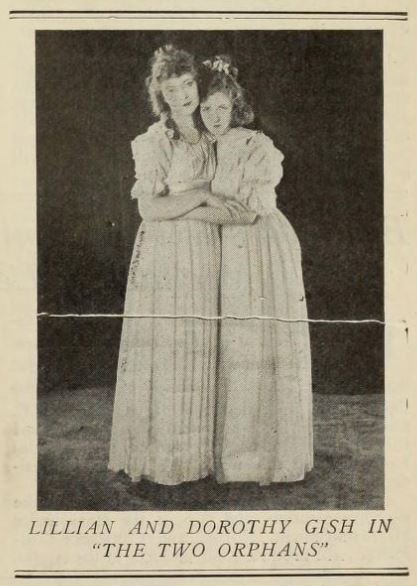
I like the two views of Lillian Gish and her sister Dorothy.

Moving Picture World, 01-April-1922

Way Down East, released in 1920, was still touring the country, doing big business. I like the image in this trade ad.

Newark Delaware Post, 03-April-1922

I guess the new theater in Newark, Delaware was named the New Theater. 

Bemidji Daily Pioneer, 21-April-1922


Dream Street was not so successul.

Thursday, March 10, 2022

DW Griffith -- A Return Engagement by Special Request -- March 10, 2022

Evening Capital and Maryland Gazette, 22-March-1922

Way Down East, released in 1920, was still touring the country, doing big business.

Alexandria Gazette, 13-March-1922

Caldwell Tribune, 21-March-1922

Meanwhile Griffith's 1915 epic The Birth of a Nation was still in release, giving aid and comfort to the second Ku Klux Klan.

Sunday, January 9, 2022

D. W. Griffith's Greatest Sensation -- January 9, 2022

Ogden Standard-Examiner, 01-January-1922

The Greatest Question was a 1919 movie, one of DW Griffith's Let's-Beat-the-Crap-Out-of-Lillian-Gish productions. Leading man Bobby Harron had died in 1920. The movie had something to do with spiritualism.

Ogden Standard-Examiner, 01-January-1922

After the carnage of World War One, spiritualism became a popular topic, as it had been after the US Civil War. 

Punta Gorda Herald, 13-January-1922


The Fall of Babylon was reedited from Griffith's 1916 epic Intolerance. "To produce 'The Fall of Babylon' required the services of 125,000 people and 7,500 horses. Biggest picutre ever shown in Punta Gorda."

Richmond Palladium and Sun-Telegram, 03-January-1922


Way Down East, released in 1920, was still touring the country, doing land office business. I like the price correction in this ad.

Wednesday, December 8, 2021

DW Griffith -- His Sixth Big Production -- December 8, 2021

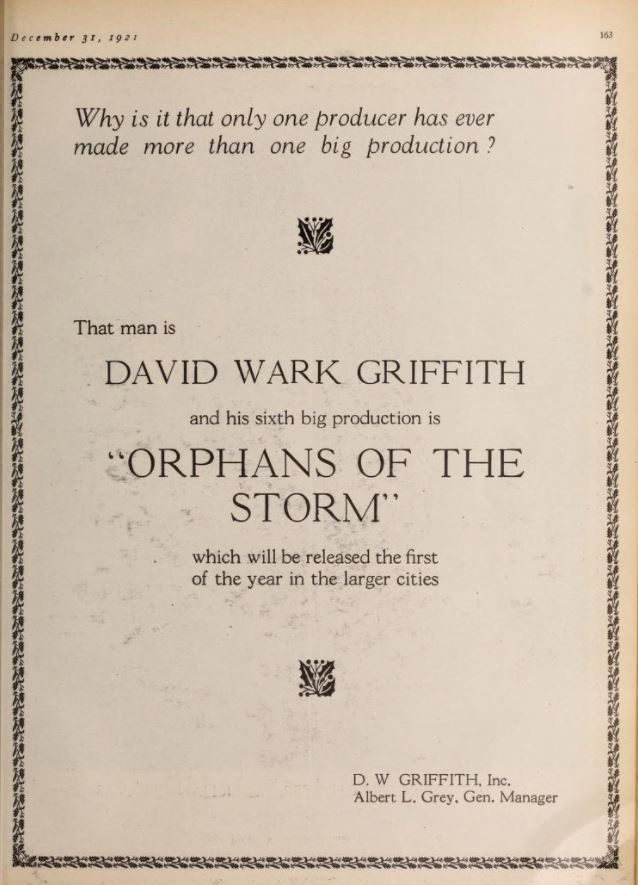
Motion Picture News, 31-December-1921

"Why Is It Only One Producer Has Ever Made More Than One Big Production?" DW Griffith's last movie with Dorothy and Lillian Gish was Orphans of the Storm, which was adapted from an 1874 French melodrama, The Two Orphans, by Adolphe d'Ennery and Eugène Cormon.

Bridgeport Times and Evening Farmer, 03-December-1921

The Park Theater in Bridgeport, Connecticut hosted a preview of The Two Orphans on 04-December-1921. "MR. D. W. GRIFFITH, THE PRODUCER; MISS LILLIAN GISH, MISS DOROTHY GISH AND OTHER MEMBERS OF THE CAST WILL BE PRESENT IN PERSON." The title change came later.

Richmond Palladium and Sun-Telegram, 12-December-1921

Dream Street was not a hit. Many people have said mean things about the leading lady, Griffith's protégée, Carol Dempster.

Free Trader Journal and Ottowa Fair Dealer, 23-December-1921

Way Down East, released in 1920, was still touring the country, doing land office business.

Conway, Arkansas Log Cabin Democrat, 14-December-1921

Pueblo Chieftan, 12-December-1921

Birth of a Nation was still in release, giving aid and comfort to the second Ku Klux Klan.

Monday, November 8, 2021

DW Griffith -- Romance From Moth-Balls -- November 8, 2021

Photoplay, November, 1921.

DW Griffith's last movie with Dorothy and Lillian Gish was Orphans of the Storm, which was adapted from an 1874 French melodrama, The Two Orphans, by Adolphe d'Ennery and Eugène Cormon.

Photoplay, December, 1921.

Photoplay, March, 1922.

Orphans of the Storm got a rave review from Photoplay.  "Don't miss this."

Moving Picture World, 26-November-1921

Moving Picture World, 26-November-1921

Moving Picture World, 26-November-1921

Motion Picture News, 04-September-1915

Theda Bara appeared in an adaption of The Two Orphans in 1915. Herbert Brenon directed. Like most of Theda Bara's Fox features, it is presumed to be lost. 

Albuquerque Evening Herald, 02-November-1921

Dream Street and Orphans of the Storm were the only features that Griffith released in 1921. Dream Street was not a hit. Many people have said mean things about the leading lady, Griffith's protégée, Carol Dempster.

Albuquerque Evening Herald, 03-November-1921

Screen Snapshots was a series of short films produced by C.B.C. Film Sales Corp and its successor, Columbia Pictures, from 1920 to 1958.

Bemidji Daily Pioneer, 05-November-1921

Way Down East, released in 1920, was still touring the country, doing land office business.


Amarillo Daily News, 20-November-1921

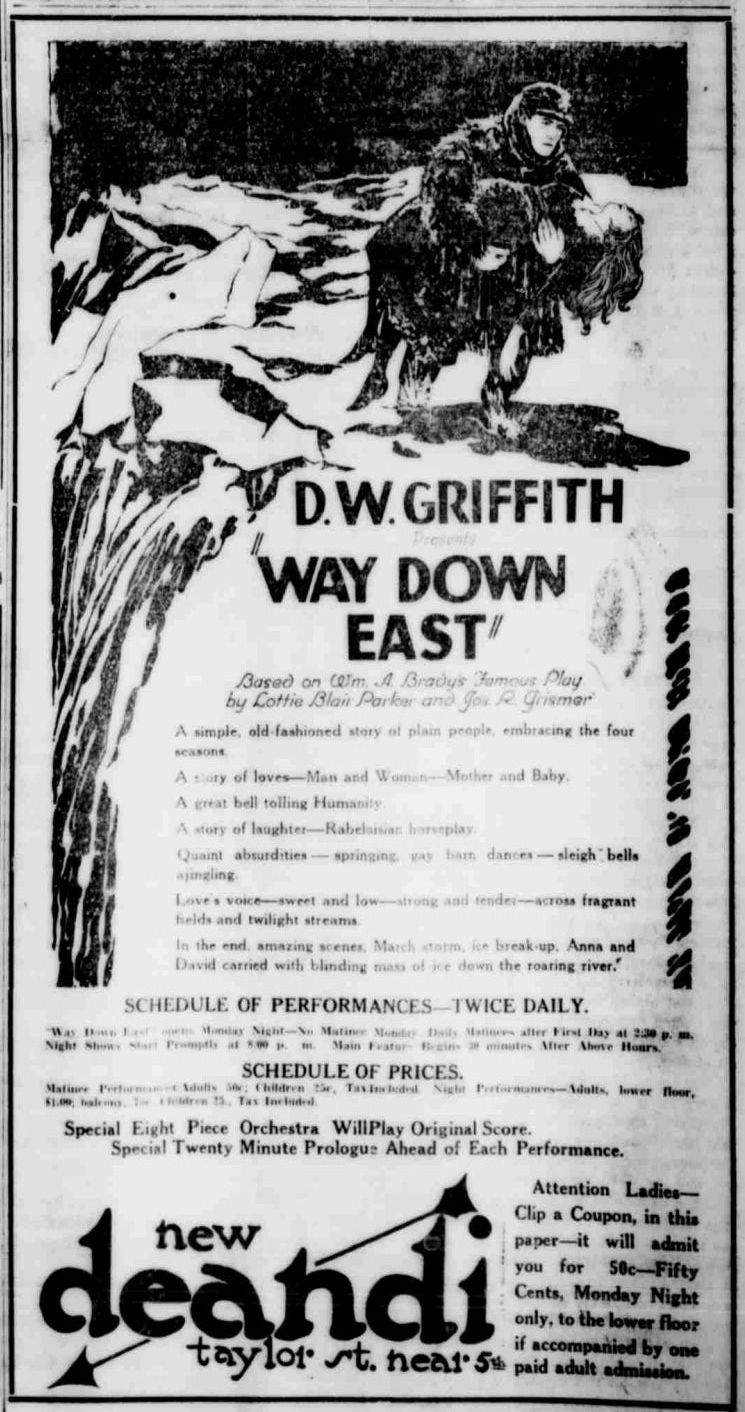
All of these items, a still from the icy river scene, an ad for the showing at the New Diandi Theater and a collection of quotes from eminent people like actor John Barrymore and artists Howard Chandler Christy and Charles Dana Gibson. Way Down East, like many of Griffith's big productions, was shown in a roadshow format, with higher ticket prices, a special orchestra and a limited number of showings daily, as opposed to the continuous programs shown by most theaters. 

Conway, Arkansas Log Cabin Democrat, 11-November-1921

Washington Evening Star, 27-November-1921

Note that many ads for Way Down East featured a large black circle, just like ads for Griffith's Birth of a Nation

Rockingham Post Dispatch, 12-November-1921

Birth of a Nation was still in release, giving aid and comfort to the second Ku Klux Klan. 

Moscow, Idaho Daily Star-Mirror, 12-November-1921

Griffith's war film, Hearts of the World, was shown to raise money for the American Legion. 

Amarillo Daily News, 20-November-1921

While Way Down East was playing at Amarillo's New Diandi Theater, the Olympic advertised a 1915 feature film, Martyrs of the Alamo, "Personally Directed by D. W. Griffith." Griffith produced the movie and Christy Cabanne directed. Producers were often called supervisors then.