|
| www.listal.com |
This post is part of the Early Women Filmmakers Blogathon, hosted by Fritzi at Movies Silently (http://moviessilently.com/2017/03/27/the-early-women-filmmakers-blogathon-is-here/). Fritzi says that "It’s time to give these talented women their moment in the sun and the
Early Women Filmmakers Blogathon aims to do just that. This is a topic
that is dear to my heart and I am just tickled pink to be hosting!"
 |
| www.lucywho.com |
There was a time when a married lady did not have her own name. Some readers have heard of Princess Michael of Kent. I used to think her first name was Michael. When Baroness Marie Christine von Reibnitz married Queen Elizabeth II's first cousin Prince Michael of Kent, she became Princess Michael of Kent. If she had been of royal instead of merely aristocratic birth, she would have been Princess Marie Christine.
 |
| www.listal.com |
British actress Beatrice Tanner was billed as Mrs Patrick Campbell for her entire career, which went on for forty years after her husband died in 1900. She was the first person to play Eliza Doolittle in George Bernard Shaw's
Pygmallion.
I remember when my mother's credit cards and checks were labelled
"Mrs (my father's name)." Those of us who are not royalty have largely
abandoned that practice, except for the occasional wedding invitation
addressed to "Mr and Mrs (man's name)."
Actress, screenwriter, producer and director Dorothy Davenport was usually billed as Mrs Wallace Reid after her husband died at a tragically young age in 1923. This probably helped to sell the movies she directed, but I will try to avoid calling her Mrs Wallace Reid. Dorothy Davenport deserves her own name.
 |
| Edward Loomis Davenport: A Biography, edited by Edwin Francis Edgett, 1901 |
Dorothy Davenport was born into a theatrical family. Her paternal grandparents were Edward Loomis Davenport, who had appeared on stage with Junius Brutus Booth, father of the coward who murdered President Lincoln, and Fanny Vining, a British-born actress. EL died in 1877. Fanny Vining died in 1891. When I went to look up Fanny Vining in
Edward Loomis Davenport: A Biography, edited by Edwin Francis Edgett, I found this in the index:
 |
| Shakespeare's Heroines on the Stage, By Charles Edgar Lewis Wingate, 1895 |
Their daughter, Fanny Davenport, was a popular leading lady. Here she is costumed to play Cleopatra in the first American production of Victorien Sardou's play, which had been written for Sarah Bernhardt. She died in 1898.
 |
| www.listal.com |
Classic film fans will recognize EL and Fanny's son, Harry Davenport, who spent the late 1930s and the 1940s playing old men, right up to his death in 1949. He played the King of France in the Charles Laughton
Hunchback of Notre Dame, Grandpa in
Meet Me in Saint Louis, the judge in
The Story of Alexander Graham Bell, and father of Nick Charles in
The Thin Man Goes Home. His theatrical career began in the Nineteenth Century. He made his first movies during the silent era and also directed. Harry Davenport was the father of Dorothy Davenport.
 |
| www.listal.com |
Dorothy's mother, Alice Shepphard Davenport, who was Harry's first wife, appeared in many Keystone comedies including "Making a Living," Charlie Chaplin's first film. She played the mother.
 |
| Moving Picture Magazine, November, 1914 |
Dorothy (Dot) Davenport was born in 1895. Her parents divorced the next year. I haven't found much about her life until she started playing small parts in Biograph films. Her first movie listed in the Internet Movie Database was "A Mohawk's Way," directed by DW Griffith and released in 1910.
 |
| Variety, 07-January-1911 |
By January, 1911, 17 year old (? - born 1895) Dorothy Davenport was working for the Reliance company. Fanny Davenport was her aunt.
 |
| Moving Picture News, 07-October-1911 |
By October, 1911, Dorothy Davenport was with the Nestor Film Company. "Miss Davenport, though still in her teens, is known throughout the theatrical and film world as one of its brightest stars. She belongs to the famous Davenport family, her father being the favorite actor, Harry Davenport; her aunt was the gifted actress Fanny Davenport; and her grandfather was the renowned tragedian, E. L. Davenport."
 |
| Moving Picture News, 28-October-1911 |
"Alice Davenport, the well-known actress and sketch writer, has been engaged by the Nestor Film Co. to do character parts, and she and her daughter, Dorothy Davenport, leading lady with one of the Nestor companies, are now speeding in the direction of Lower California with fifty more Nestor players."
 |
| Moving Picture News, 06-April-1912 |
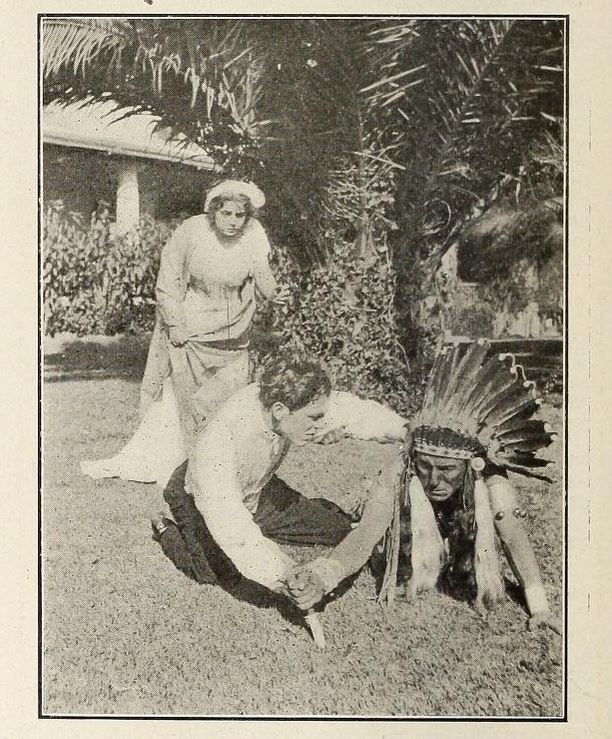
Dorothy appeared in "Her Indian Hero" for Nestor. I will not attempt to explain what is going on in this scene, but it is a little less racist than it appears.
 |
| Moving Picture World, 16-March-1912 |
Dorothy seemed to move around from studio to studio.
 |
| Moving Picture World, 27-July-1912 |
Dorothy was back with Nestor by July. "She is much liked by her fellow actors." Harry Edwards later became a director.
Someone cleverly cut out a piece of the 31-August-1912
Moving Picture World which explains that the Nestor lot had become part the Hollywood branch of Universal and that Dorothy was playing leads for a company directed by Milton H. Fahrney. I would like to meet this person and let her or him (probably him) know how grateful I am. Dorothy made many action films where she got to display her ability on horseback.
 |
| Motography, 04-October-1913 |
 |
| www.listal.com |
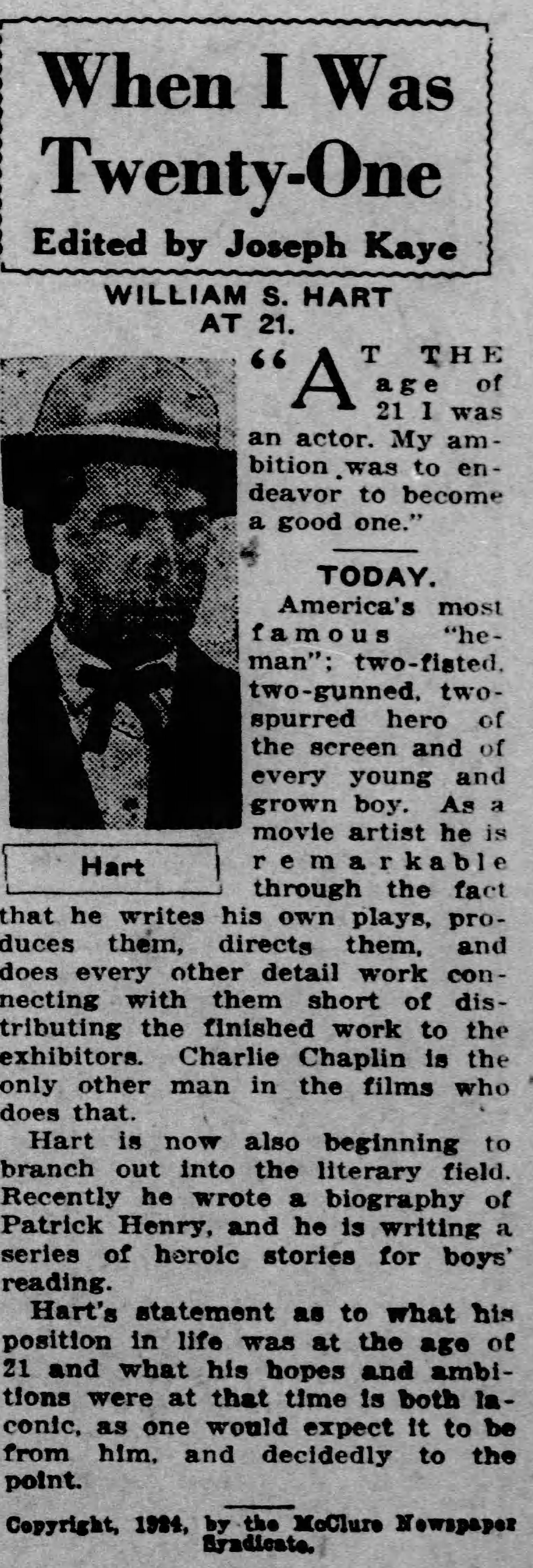
While working at Universal, Dorothy met Wallace Reid. Wally was born in 1891, the son of two actors. His father was also a playwright. When his father Hal moved to the movie industry as an actor, writer and director, Wally went along with him. Wally wanted to be a producer, writer or director, but movie studios wanted to take advantage of his good looks and his athleticism and pushed him to act.
 |
| Motography, 01-November-1913 |
 |
| Motion Picture Story Magazine, January, 1914 |
 |
| Variety, 31-October-1913 |
 |
| Motion Picture News, 08-November-1913 |
When Dot met Wally, she was impressed by his looks and his ability to ride a horse. They married in 1913.
 |
| Variety, 26-March-1914 |
Dorothy took some time off from the movies. Their first child wasn't born until 1917, so it wasn't because of that.
 |
| Reel Life, 23-January-1915 |
Dot and Wally shared in the social life of the film community. Dancing was very popular.
 |
| Moving Picture World, 24-June-1916 |
Dorothy's Saint Bernard puppy got killed by a careless truck driver
 |
| Moving Picture News, 08-July-1916 |
In light of the Reid family's later issues, I thought this Universal two-reeler sounded interesting. "No. 16 Martin St. combines two significant phases of modern life; one is the rise of the science of criminology, and the other the prevalence of a new vice, the 'dope' evil ... Cleo (Dorothy Davenport) returns for the second show, and finding Audrey alone, pretends that she is a cocaine fiend and begs Audrey to get her some coke."
 |
| Moving Picture News, 05-August-1916 |
"she frankly admits that her home means more to her than the studio."
 |
| Moving Picture News, 11-November-1916 |
Red Feather Photo-Plays had ads with nice designs. I wonder what their
movies were like. Dorothy Davenport got top billing for this one.
 |
| Moving Picture News, 09-December-1916 |
 |
| Moving Picture News, 27-January-1917 |
Despite the loss of her Saint Bernard puppy, Dot had a fine menagerie of "Spitz dogs and Persian cats," who all got along.
 |
| Moving Picture News, 01-January-1917 |
In late 1916, Universal had Dorothy in short subjects that premiered on November 30, December 10 and December 21.
 |
| Moving Picture News, 24-February-1917 |
Another nice Red Feather Photo-Plays ad. The movie got a poor review.
 |
| Photoplay, August, 1917 |
Things seemed good at the Reid family home. Wally was said to have a drinking problem, but it didn't interfere with his heavy work schedule.
Wallace Reid, Jr was born on 18-June-1917. "The proud father states that indications point to a career in the vocal rather than the silent drama for the youngster." His adopted sister Betty was born in 1919.
 |
| Photoplay, March, 1919 |
"He plays those with too many millions who always, always get the Girl." You can see why they always got the Girl.
 |
| Photoplay, March, 1919 |
"Dorothy Davenport is too busy taking care of her frisky young son, William Wallace Reid, Jr., to devote any attention to the screen as far as personal appearances are concerned. Hope she'll come back some time, though."
 |
| Arizona Republican, 06-December-1919 |
In 1919, Wally was riding a Southern Pacific train to Oregon to work on
The Valley of the Giants, based on a Peter B Kyne story about lumberjacks. I have not been able to find any contemporary accounts, but sources say that the train had an accident and Wally injured his head. A doctor had to sew his scalp shut. Paramount wanted the movie to stay on schedule, so Wally received morphine to help him deal with the pain.
 |
| Arizona Republican, 15-August-1920 |
Wally appeared in eight features in 1919, seven in 1920 and 1921 and eight in 1922. To keep up the grueling pace, studio doctors kept administering larger and larger doses of morphine. Among his most popular films were auto racing comedies like
Excuse My Dust.
 |
| Photoplay, January, 1921 |
Photoplay Magazine had a page titled "Why-Do-They-Do-It?" "Wallace Reid, in 'What's Your Hurry," gets out of his racing car after driving something like one hundred miles in a race and leans against the exhaust pipe. The exhaust pipe is sure to be extremely warm after such a drive, yet Wally doesn't seem to notice it."
 |
| Motion Picture News, 27-January-1923 |
Wallace Reid entered a sanitarium in an attempt to kick his drug habit. He died there on 18-January-1923.
 |
| Photoplay, April, 1923 |
Dorothy Davenport was left with two small children and a pile of debts. She quickly made plans to do something about it. Dorothy was a friend of producer, director and writer Thomas Ince's wife Elinor. Dorothy and Elinor persuaded Thomas Ince to back an anti-drug movie.
 |
| www.wikipedia.org |
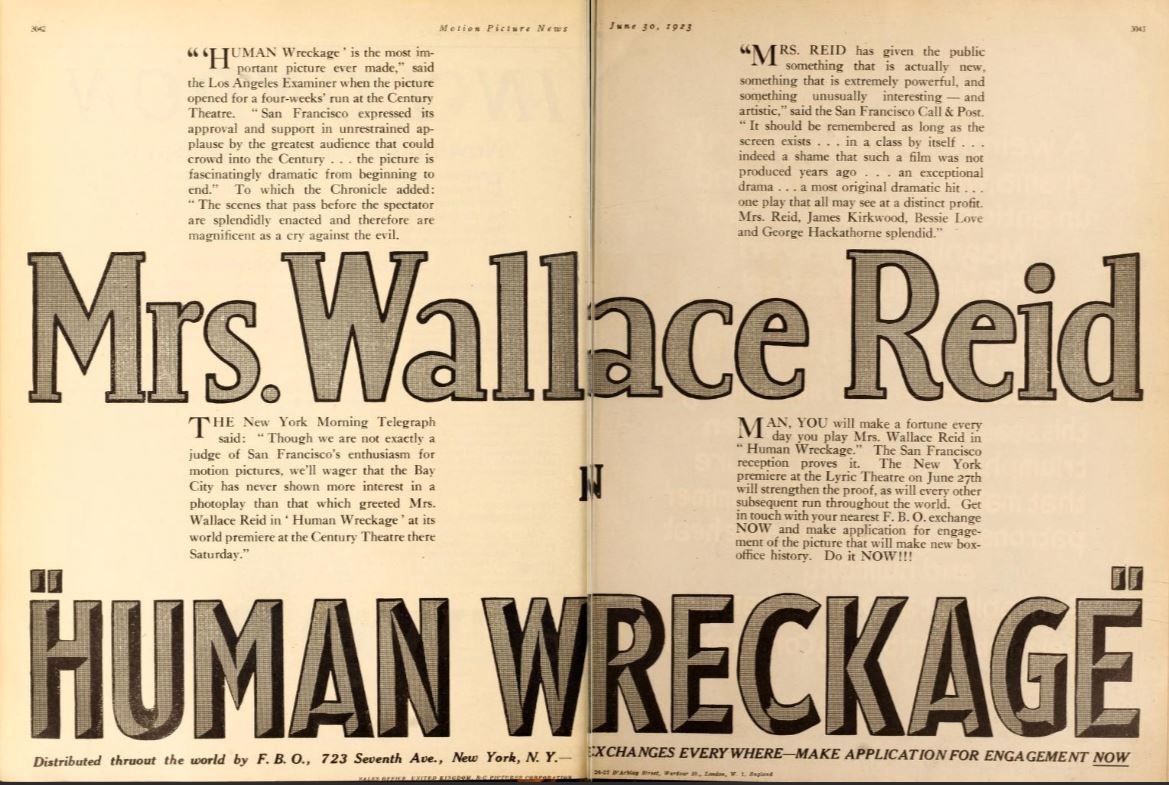
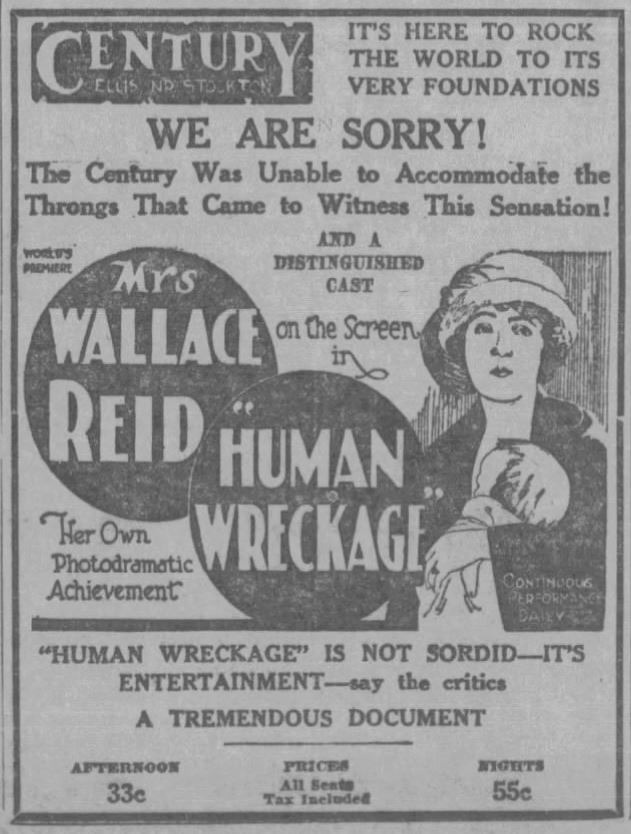
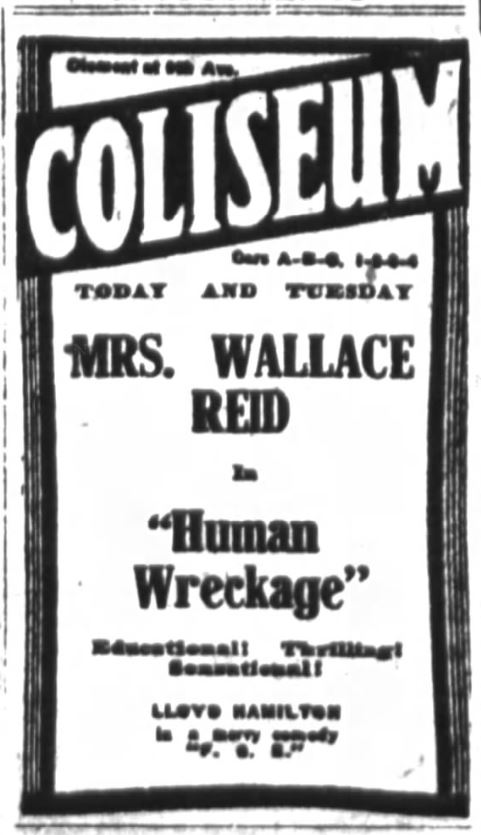
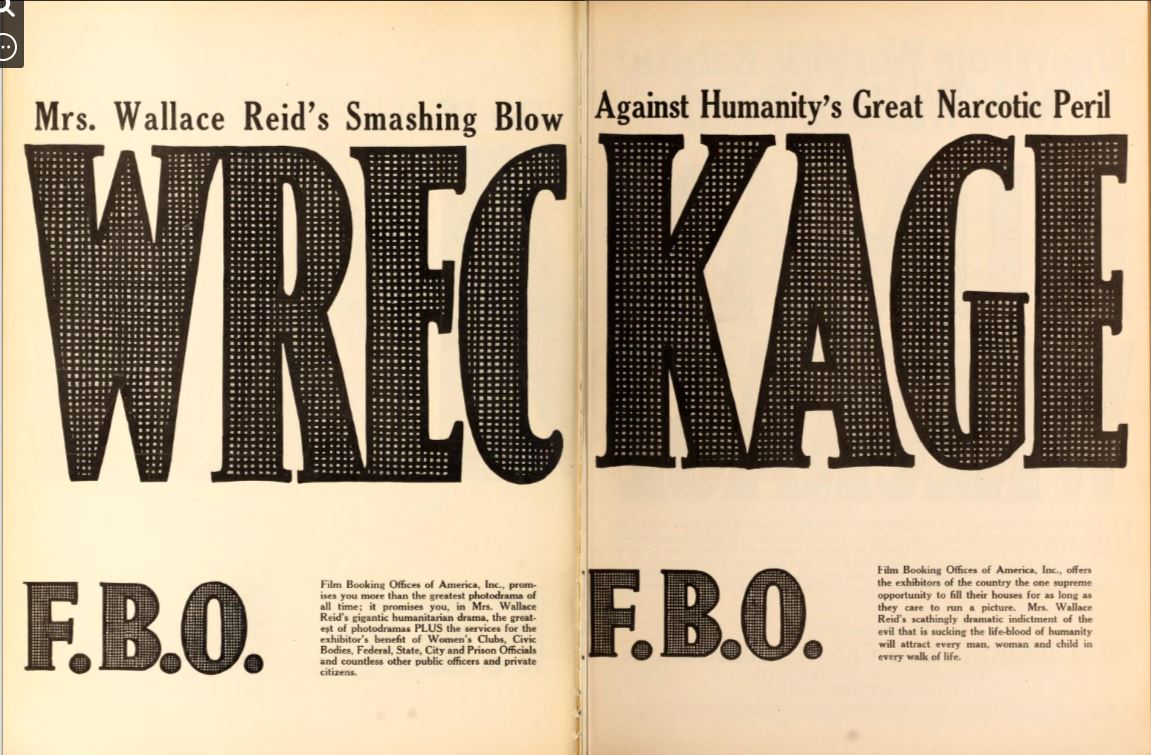
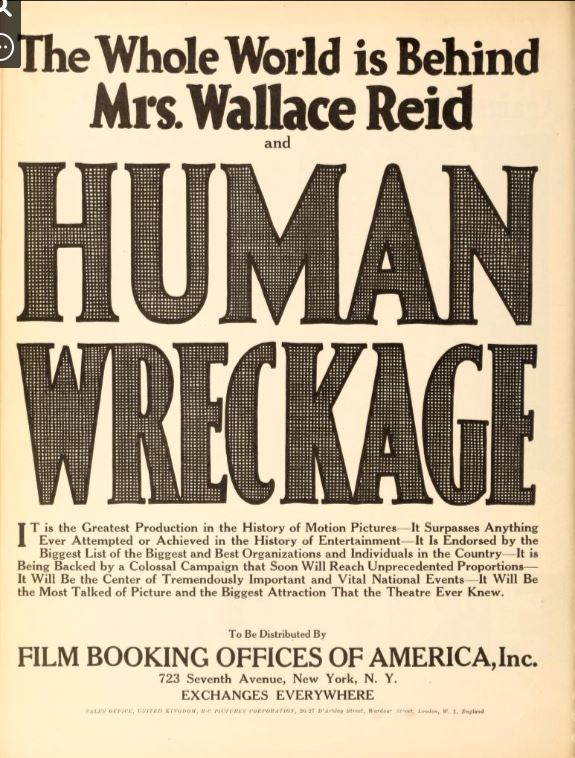
Dorothy, billed as Mrs Wallace Reid, acted in and co-produced
Human Wreckage. She also co-wrote and co-directed it, but was not billed. The film is believed to be lost.
 |
| Photoplay, June, 1923 |
I found it interesting that people didn't want a "dope" hospital named after Wallace Reid, but then I remembered that there was some controversy about the naming of the Betty Ford Clinic. I agree with the
Photoplay writer: "If Wallace Reid's name could lend any aid to a hospital for drug addicts it would be a noble use. Nothing on earth is finer than an institution which heals." However, this is not what Dorothy had in mind: "She is simply appearing in a picture which treats of an enemy of life."
 |
| Educational Screen, September, 1923 |
"Mrs. Wallace Reid's anti-narcotic propaganda picture at least indicates sincerity of purpose." "(Strictly adult)"
 |
| Motion Picture Magazine, October, 1923 |
I added the bold formatting.
"When Mrs. Wallace Reid was in New York for the premiere of her 'Human Wreckage,' we were particularly interested in talking to her. That she is clear in her own mind about her course of action against the traffic of drugs, there can be no slight doubt. And, personally, we feel an admiration for anyone who carries on in the way Mrs. Reid has done.
"At a luncheon at which she spoke, she asked people to consider those menaced by drugs in a different light than we have heretofore considered them.
She said to try not to think of them as strange and curious beings but as sick people who can undoubtedly be helped. And she urged that we stop referring to them by such vernacular names as 'dope-fiend,' 'hop-head,' etc.
"She spoke of 'Wally' only once, when she explained that her help to the cause must always be a personal one ; whereupon she went on to explain that ignorance of drug conditions was the real menace and that if she had known a year ago what she knows today her history might have been very different. And surely, if Wally's passing and Mrs. Reid's subsequent anti-narcotic work, including 'Human Wreckage,' lessens the toll of drugs then he continues to serve humanity well, even in death."
 |
| Educational Screen, September, 1925 |
Dorothy's next social conscience film was
Broken Laws, which was about the bad effects of overindulging children. The film may exist in a Belgian archive.
 |
| Film Daily Yearbook, 1925 |
Mrs Wallace Reid Productions advertised in the 1925
Film Daily Yearbook.
 |
| Picture-Play Magazine, February, 1926 |
This photo of Dorothy and the kids accompanied the article "Memories of Wallace Reid." "I am working, for one must occupy one's time, and I have the children's future to think of. My aim is to produce films. I never considered myself a good actress, and I detest using make-up. So in 'The Red Kimona,' though I codirect, I appear only in the prologue."
 |
| www.wikipedia.org |
Dorothy Davenport's next production was her first credited directorial effort,
The Red Kimona (Sometimes spelled
The Red Kimono -- spelling of Japanese names in the US was not standardized until World War Two). This social conscience story was about sex trafficking, then called white slavery. Dorothy used the real name of the woman whose story she told. The woman sued and won. This movie is available from Kino.
Dorothy's social conscience films established her as a producer/director of sensational subjects.
 |
| Motion Picture Magazine, July, 1926 |
I don't know much about Dorothy's next production,
The Earth Woman. It was directed by Walter Lang. The reviewer found it depressing but truthful, except for "a box-office ending."
I can't find much about her next production,
The Satin Woman, also directed by Walter Lang, but it is preserved in an archive.
 |
| Photoplay, May, 1928 |
Dorothy Davenport's next directorial effort was The Road to Ruin, which sounds pretty sordid. Apparently this one was sponsored by the juvenile courts.
 |
| Photoplay, February, 1929 |
Linda, the story of a girl who married too young, was a silent issued with synchronized music and sound effects.
 |
| www.listal.com |
Dorothy Davenport's next film,
Sucker Money, the story of a fake spiritualist, was her first talkie. She was billed as Dorothy Reid. She co-directed with Melville Shyer.
 |
| Film Daily, 01-March-1933 |
"Entertaining program melodrama exposing spiritualistic racket. Has excellent exploitation possibilities."
 |
| www.listal.com |
Dorothy Davenport remade
The Road to Ruin as a talkie. She was billed as Mrs Wallace Reid. She co-directed with Melville Shyer.
 |
| Motion Picture Herald, 24-February-1934 |
"Once again the screen takes it upon itself to indicate to young people the dangers that lurk in the path of young girls, and to point out to parents the necessity of telling their growing daughters the facts of life."
 |
| www.listal.com |
Dorothy Davenport directed her last movie in 1934.
 |
| Photoplay, March, 1934 | | |
 |
| Film Daily Yearbook, 1940 |
Her career continued, writing and producing movies and then television shows until the late 1950s. She was mostly billed as Dorothy Reid. She died in 1977. I am sad to say that I don't remember reading her obituary, if there was one in the
San Francisco Chronicle.
 |
| Film Daily Yearbook, 1934 |
Dorothy acted in
Man Hunt. William Wallace Reid, Jr performed as a baby in a few of his father's films. He continued acting until the early 1940s. I remember reading his obituary in 1990 when he died in an airplane crash. His mother wrote
The Racing Strain.
This post is part of the Early Women Filmmakers Blogathon, hosted by Fritzi at Movies Silently (http://moviessilently.com/2017/03/27/the-early-women-filmmakers-blogathon-is-here/). Thank you to Fritzi for all the hard work. Thank you
to everyone who visited and I encourage you to read as many posts as
you can, and leave comments. Bloggers love comments.
This post is my second blogathon post of 2017 and my 47th since 2007. This is my 30th blogathon. This page has a list of all my blogathon posts.