|
| Motion Picture Herald, 20-July-1940 |
Many cities and states, fearing racial unrest, banned films of the 04-July-1910 fight between heavyweight champ Jack Johnson, who was African-American and former champ James Jeffries, who was white. In 1912, Congress banned interstate transportation of fight films. The ban remained in place until 1940.
U. S. PRIZE FIGHT BAN OFF, RKO TAKES OVER
RKO Will Distribute Jenkins-Armstrong Bout Pictures for Pathe; First Since July, 1912
National distribution of prize fight films, outlawed by Federal legislation for 28 years, was to resume as a legitimate practice this week with Pathe News filming and RKO Radio Pictures handling the pictures of the bout of Lew Jenkins, world's lightweight champion, vs. Henry Armstrong, world's welterweight champion, scheduled for Wednesday night at the Polo Grounds in New York City.
Banned in 1912
From July 31, 1912 when the Sims act forbidding interstate commerce in fight films was passed until July 1, 1940 when it was repealed through the efforts of Senator William Warren Barbour, the regular motion picture industry had no interstate distribution of such films and during the 28 years the so-called "sports crowd" had a monopoly on the business, despite the law.
In the early days of the industry prize fight films contributed to the development of new picture making techniques in addition to being popular screen entertainment. In July, 1894 the first prize fight films were made at Edison's "Black Maria" studio in West Orange, N. J. The principals were Michael Leonard, "Beau Brummel of the prize ring" and Jack Cushing, contender for the lightweight crown. Six of the ten rounds were recorded by the Kinetograph and nearly 1,000 feet of film was used, a record.
James Corbett, heavyweight titleholder was signed in August, 1894, to the first exclusive star contract in film history, Corbett fought six one-minute rounds for the camera and gave the pre-arranged knock-out blow at the end of the sixth. The Corbett-Fitzsimmon fight in Carson City was filmed there and faked in Philadelphia and both versions did good business. Biograph introduced photography under lights at the Jeffries-Sharkey fight in 1899. The fight film business continued until adverse reaction followed the Jack Johnson-Jim Jeffries fight at Reno on July 4, 1910.
The Johnson-Jeffries film grossed, according to reports, $300,000 for the old General Film Company. But in some places exhibition of the film occasioned race-riots and Johnson's activities after the fight were not such to quiet public protest. On July 31, 1912 Congress passed the Sims bill which made interstate traffic in fight films unlawful.
A negro and a white man were the contenders in the last legal fight for film purposes in 1912 and in the first since the law was repealed this year.
RKO promised prints for the metropolitan New York area the day following the Jenkins-Armstrong fight and on the second day for theatres throughout the country. Exclusive film rights to fight were obtained in a deal with the Madison Square Garden Corporation and Mike Jacobs, fight promoter and head of the Twentieth Century Sporting Club. Stanton Griffis, chairman of the executive committee of Paramount, is chairman of the board of directors of Madison Square Garden. Ned E. Depinet, vice-president, concluded the arrangement for RKO.
During the 28 years that the law against the interstate traffic in prize fight films was on the books it was openly violated, in many instances. When independent distributors were caught crossing state lines with fight films they were often compelled to pay a $1,000 fine but usually went right on with the distribution of the picture.
The "sports crowd" which controlled the fight films made' during the 28 years of the Sims act sold some pictures widely but complete national distribution was not possible. Many exhibitors did not wish to violate the law ; others became discouraged when motion picture practices were violated, as when prints were sold simultaneously to competing theatres.
Major distributors were never barred from handling fight pictures in other countries. Universal handled the distribution of the Joe Louis-Arturo Godoy fight of February IS, 1940 for all foreign countries except possessions
of the U. S. The promoter of that film was Jack Dietz' Sports Attractions which specialized in the filming of such events. The film rights were bought from Mr. Jacobs.
The future of the fight film business is uncertain at present. The fact that RKO Pathe obtained the films rights to the first big bout after the Sims law was repealed indicated, it was said, that a major picture company is willing to pay more than formerly paid by the "sports crowd" for such rights. It was reported that RKO and Paramount might bid for the film rights to the next big fight ; a joint distribution set-up was said to be possible.
RKO expects that the Jenkins-Armstrong films will be widely received because there is no longer the legal difficulty for exhibitors out of the state and because a regular production crew might be expected to obtain better films and better sound than in former fight pictures. It was said that the rentals would probably be about the same.
 |
| Motion Picture Daily, 15-July-1940 |
On 17-July-1940, Lightweight champ Lew Jenkins and Welterweight champ Henry Armstrong fought at the Polo Grounds in New York. Neither man's title was at stake. Armstrong won by TKO in the 6th round.
 |
| www.listal.com |
Henry Armstrong is regarded as one of the best fighters of all time. He won the Featherweight, Lightweight, Welterweight and Middleweight titles. Armstrong was the first man to hold three titles (Featherweight, Lightweight and Welterweight) at the same time.
"MILLIONAIRE KID'S" FIGHT FILM REPEALER
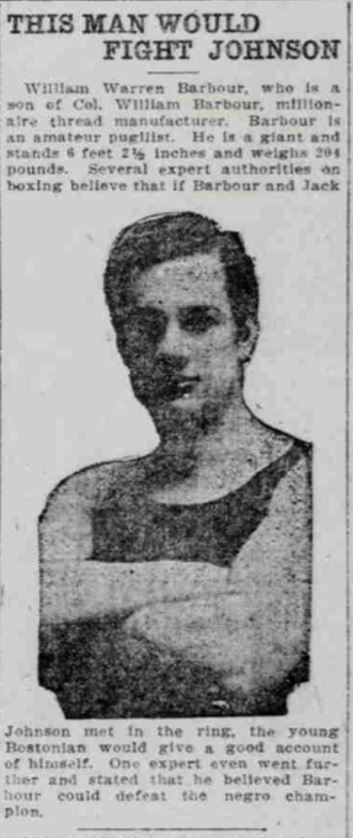
Senator William Warren Barbour's (Rep., N. J.) interest in sponsoring the Congressional repeal of the Federal ban on interstate transportation of fight films, enacted over the last weekend in June with almost unprecedented
lack of opposition and attention, goes back some 29 years, when the Senator was then reigning national amateur heavyweight boxing champion.
Warren Barbour, billed as "The Millionaire Kid," was generally conceded to be the chief "white hope" to end the conquests of big, black Champion Jack Johnson. Boxer Barbour, son of a wealthy Jersey manufacturer, was all for the match, but his parents were adverse to his turning professional. He took his gloves off for his parents.
Shortly afterward, the Federal fight film ban was enacted, in 1912, because of Johnson's mauling of white fighters and because of some spectacular personal behaviour in Chicago.
Senator Barbour, in Congress, long felt that the ban was an archaic handicap to the sport, got his friend, Jack Dempsey, to so testify before a Congressional committee. The repeal resulted.
 |
| El Paso Herald, 12-July-1910 |