|
| Moving Picture World, 02-September-1922 |
San Francisco's historic Castro Theater has been in the news lately. Another Planet Entertainment (APE) wants to tear out all the seats in the orchestra level and install a flat floor with four terraces. They want to make the theater more suitable for music shows. The city will hold at least two hearings in October.
 |
| Moving Picture World, 02-September-1922 |
The New Castro of San Francisco
Has a Unique Decorative Scheme
SAN FRANCISCO has many notable residential district moving picture houses, but
none have attracted more attention than the New Castro Theater, opened on the
evening of June 22.
This house, which covers a lot one hundred by one hundred and fifty feet in size, is located
on Castro street near Market, near the eastern portal of the Twin Peaks tunnel, the longest
municipal tunnel in the world, and one which taps a splendid new residential section. The
theater has a seating capacity of 2,000 and is owned and operated by Nasser Brothers, and
represents an investment of about $300,000. Timothy L. Pflueger was the architect.
Nasser Brothers have been associated continuously with moving picture enterprises in the
Eureka Valley district since 1907, and six of them have an interest in the new house.
William, Elias and George Nasser are actively identified with the theater, the latter acting as
resident manager. The Liberty was their first theater in the district and later this year was
supplanted by the older Castro, which in turn, has been succeeded by the new house.
Designed on Daring Lines
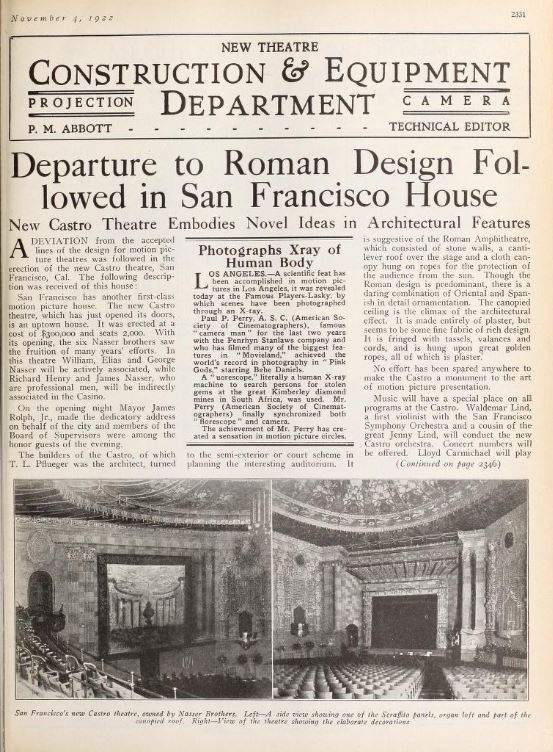
The New Castro Theater has been designed along rather daring lines, and it is this unusual
feature that is one of its greatest charms. Influences of the Orient and Occident have been
combined, with features of Spanish and Italian origin, resulting in a theater entirely different
from the usual run of moving picture houses.
The structure is of strictly fire-proof construction, being built largely of reinforced concrete,
and presents a pleasing appearance. It is the interior which offers such an unusual feast
for the eye. The theater proper is suggestive of a Roman amphitheater with stone walls, a
canopied ceiling suspended from ropes and cantilever roof of wood over the stage.
The culminating feature of the decoration is the canopy of plaster, which imitates a richly
decorated fabric hung on ropes of gold. From the center of the ceiling hangs a Moorish
lantern, with shades of colored parchment and fringed with tassels and valences, which produces
an effect of Oriental splendor.
Scraffito Panels
For the first time, it is believed, in theater construction in this county, use has been made
of Scraffito work, an old Italian art, two large panels, twenty-six by twenty-nine feet in size
being on either side of the auditorium. This work, by the Faggioni Company Studios, has
attracted much attention from interior decorators. The process employed is a combination of
carving and etching in plaster. Layers of differently colored plasters are applied in thin
coats and the design later etched, revealing the desired colors beneath.
The balcony of the Castro projects but a few feet over the rear of the orchestra section and
all patrons are enabled to enjoy a view of the ceiling and the splendid side walls. It is reached
by short inclines from the mezzanine lounge, which extends the full width of the building.
During matinee hours this floor is available to ladies for bridge, tea or club parties, without
any expense in addition to the usual admission prices, and has become quite popular.
The projection room is located at the top of the balcony in the center of the house and is
equipped with two Simplex projectors, spotlights and a stereopticon. This room is quite
large, and its appointments are of a high order.
Ample Ventilation Facilities
The heating and ventilating system was installed by James Nelson, the equipment having
a capactity for a larger house than the Castro, thus insuring an abundance of fresh air of the
desired temperature at all times. The location of the house in the warm belt of the Mission
also simplifies the heating problem.
Music has a prominent place on the program and is furnished by a Robert Morgan organ,
presided over by Lloyd Carmichael, and an orchestra led by Frank Siegrist, a noted
cornetist. A grand piano is a part of the musical equipment.
Special attention has been paid to the seating, all equipment of this type having been furnished
and supplied by C. F. Weber and Company.
The publicity work is handled by W. Harold Wilson, who is making a specialty of such work
for district theaters, and patrons are being attracted from all parts of the city.
Ladies' rest rooms are to be found on both the ground floor and on the mezzanine, with a
maid in attendance, and a men's smoking room is located downstairs.
The matinees are from 1:30 to 5 o'clock p. m. and the evening performances from 6:15
to 11:00 p. m., with the exception of Sundays and holidays, when the house is opened earlier
and the show is continuous.
The prices are 15 cents for the entire house at matinees, except Sundays and holidays, and
25 cents evenings, Sundays and holidays, with five cents extra for the loge seats. The war
tax is extra. Admission for children is 10 cents at all times.