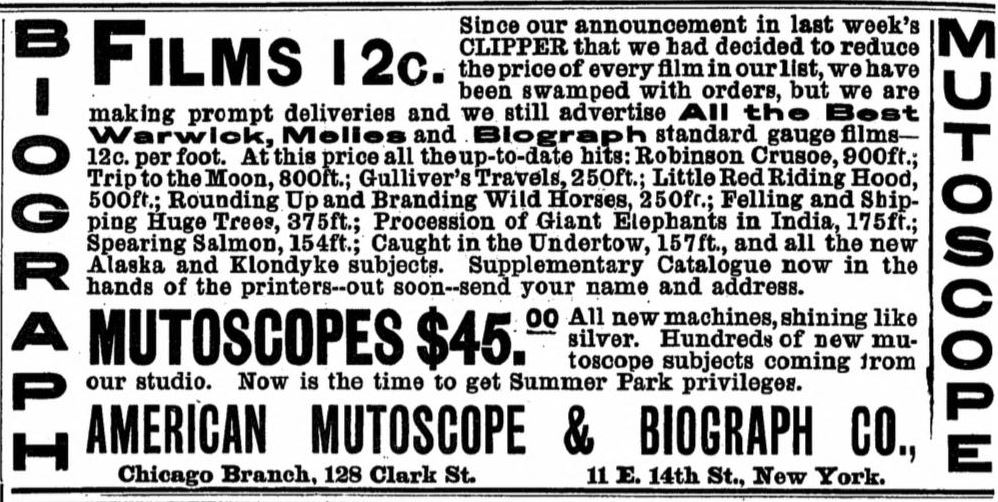
The American Mutoscope and Biograph Company was an early American producer and manufacturer. You could by a new Mutoscope, a coin-in-the-slot machine, for $45, "new machines, shining like silver."
Biograph offered its own productions, many made at the famous studio at 11 East 14th Street in Manhattan. They also carried Star Films produced by Georges Méliès in France and British films made by Charles Urban's Warwick Trading Company.
The American Mutoscope and Biograph Company released "Robinson Crusoe," Star Film's production number 430–443. This was made by French producer, director, writer, set designer and actor, Georges Méliès. I do not know if Biograph held rights to the movie, or they were engaging in piracy.
The American Mutoscope and Biograph Company released "Robinson Crusoe," Star Film's production number 430–443. This was one of French producer, director, writer, set designer and actor, Georges Méliès. I do not know if Biograph held rights to the movie, or they were engaging in piracy.
The Vitagraph Company of America, an important early film studio, advertised a wide selection of films. "The Life of an American Fireman" may be a pirated copy or an unofficial remake of the 1903 Edison film. I assume "Robinson Crusoe" is the 1903 Georges Méliès version. "Sleeping Beauty" was a Pathé Frères production. Shamrock III was the third in a series of five yachts that Thomas Lipton built to try to take the America's Cup.
"Le Royaume des fées" ("The Kingdom of the Fairies") was a popular films produced by Georges Méliès' Star Films in 1903. His brother Gaston ran the US office. "A tremendous spectacle in 35 tableaux."
Brothers Auguste and Louis Lumière grew up in Lyon. Their father operated a small factory which made photographic plates and generated losses. Both brothers went to technical school. After they graduated, they ran the factory. They automated the process of making plates and money. Both brothers were inventors who made many improvements to the dry plate process and later developed the first commercial color photography process.
Their father retired in 1892 and they began to work on making moving pictures. By 1895, they had created the Cinematographe, a device which could shoot movies, make prints and project them.
On 22-March-1895 they had a private screening at the Society for the Development of the National Industry in Paris.
125 years ago today, on 28-December-1895, they showed their films to a paying audience in Paris. This is generally considered to be the beginning of commercial cinema.
"The Lumière Cinematograph," Journal of the Society of Motion Picture Engineers, December, 1936
The brothers sent cameramen around the world to film many famous places and people. They soon lost interest in movies and concentrated on color photography. When magician Georges Méliès, who was to become a pioneering filmmaker, wanted to buy a camera, they told him that film was just a novelty. They would not sell him a camera.
Among the subjects on the original program were these (some of these may be remakes, made when the negatives wore out):
This post is part of the Springtime Silent Movie Challenge: In the Beginning..., hosted by Fritzi at Movies Silently. "Here’s the challenge. Before June 21, 2018, you will:
"Watch 5 movies made between 1906 and 1914
"Watch 5 movies made in 1905 or before
"Share your experience on your blog, on social media or here in the comments (I will set up a special post for the purpose to publish on June 21)"
For my five 1905 or before movies, I thought I would look at some pioneering efforts.
My fifth film has been called the first film to bear a trademark. In the early days of the movie industry, prints were often duplicated ("duped") and sold by unscrupulous dealers. Having a trademark embedded in the film helped to protect the producer.
When I first started watching movies from the late 19th and early 20th Centuries, I noticed that many of them had logos painted on or otherwise included in their sets.
In this shot from William S Porter's 1903 "Life of an American Fireman," a Thomas Edison sign hangs to the right of the window in the burning room.
In this shot from Essanay's 1909 "Mr Flip," Essanay's Indian head logo is at the bottom of the doorframe.
La Revue du cinéma, 15-October-1929
Georges Méliès, seen here in a study that he drew for his 1901 film "L'Homme à la tête en caoutchouc" ("The Man With the India Rubber Head"), was a magician who quickly saw the possibilities of the moving pictures. His Star Film Company produced hundreds of films between 1896 and 1912. Number 112 in the Star Film catalog is "Entre Calais et Douvres" ("Between Calais and Dover"), produced in 1897.
The film is set on a packet boat which carried passengers across the English Channel, a body of water known for violent seas.
Here is an 1874 view of the packet boat Castalia enjoying the balmy weather on the Channel.
"Between Calais and Dover" uses a moving platform, designed by Méliès, to simulate the rocking of a boat. The captain on the bridge stands firmly while the passengers get tossed all about. The man who can't get his table and chair to stand up is Georges Méliès.
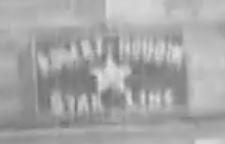
Below the captain, on the front of the bridge, is a sign that says "Robert Houdin Star Line." Georges Méliès operated the Théâtre Robert-Houdin. I had always assumed that this was the logo, but sources say that somewhere in the scene are the initials "M. R." for Méliès and Lucien Reulos, who was his partner. I have never been able to find them.
This post is part of the Springtime Silent Movie Challenge: In the Beginning..., hosted by Fritzi at Movies Silently. "Here’s the challenge. Before June 21, 2018, you will:
"Watch 5 movies made between 1906 and 1914
"Watch 5 movies made in 1905 or before
"Share your experience on your blog, on social media or here in the comments (I will set up a special post for the purpose to publish on June 21)"
For my five 1905 or before movies, I thought I would look at some pioneering efforts.
My third film is one of the first films to be projected before a paying audience.
When I was in grammar school, I read several books about film comedy. At least one them called "L'Arroseur Arrosé" ("The Sprinkler Sprinkled" or more commonly "Watering the Waterer" in English) the first movie comedy. I think they were correct.
The film begins with a man watering a flowers in a garden. He wears clogs, a long apron and a straw hat. A boy enters the frame and stands on the hose. The water stops spraying from the hose. The gardener looks at the hose and the boy lifts this foot. The gardener gets sprayed in the face and his hat flies off. The kid runs and the gardener catches him and pulls him back to the center of the frame by his ear. The gardener spanks the kid. When the gardener is done, the kid walks briskly off the screen and the gardener resumes watering.
This is still funny 123 years later.
Brothers Auguste and Louis Lumière grew up in Lyon. Their father operated a small factory which made photographic plates and generated losses. Both brothers went to technical school. After they graduated, they ran the factory. They automated the process of making plates and money. Both brothers were inventors who made many improvements to the dry plate process and later developed the first commercial color film process.
Their father retired in 1892 and they began to work on making moving pictures. By 1895, they had created the Cinematographe, a device which could shoot movies, make prints and project them. On 22-March-1895 they had a private screening at the Society for the Development of the National Industry in Paris. On 28-December-1895, they showed their films to a paying audience in Paris. This is generally considered to be the beginning of commercial cinema.
"L'Arroseur Arrosé" was the second film on the program.
"The Lumière Cinematograph," Journal of the Society of Motion Picture Engineers, December, 1936
The brothers sent cameramen around the world to film many famous places and people. They soon lost interest in movies and concentrated on color photography. When magician Georges Méliès, who was to become a pioneering filmmaker, wanted to buy a camera, they told him that film was just a novelty. They would not sell him a camera.
Next Saturday:A film by the first women director, who was one of the first directors of either gender.
Yesterday we saw the first nationwide solar eclipse since 1979. It was foggy in Pacifica, but I found a nice video. The sky did get darker around the totality. I had the nationwide coverage from CBS on the television while I worked.
The obvious one is that a movie distributor is trying to deceive the public. WAR is "We Are Ready to help you get the money". "THOUSANDS VOLUNTEER expressions of satisfaction." "ONE OF THE GREATEST BATTLES of wits ever presented to the public."
The other thing is that this is an ad for Melies Films. By 1914, pioneer Georges Méliès and his useless brother Gaston Méliès had stopped making movies. I see a "G" for Gaumont logo in the middle. I'm not sure what that is all about.