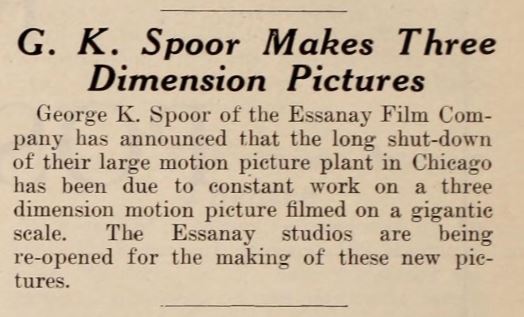
George K Spoor who had founded the Essanay Company with Broncho Billy Anderson, announced that he was reopening the company's Chicago studio to produce "a three dimension motion picture on a gigantic scale. I wonder if "gigantic scale" referred to the 65mm Natural Vision process.
Motion Picture News, 22-September-1923
The Lee-Bradford Corporation announced it would distribute a series of color cartoons made by Frank Nankivell. I do not know what color process he used. The films were called the Red Head Comedies.
In honor of the Lunar New Year, the Year of the Rabbit, here is the most famous rabbit of all, Bugs Bunny.
The San Francisco Chinese New Year Parade is tonight. The parade has taken place since the 1860s.
27-July-1940 saw the debut of the Buck-Toothed Barrymore, the Hardest Working Hare in Show Business, the Chairman of the Carrot Patch, Bugs Bunny. There is some controversy over the identity of the first Bugs Bunny cartoon. Some people favor "Porky's Hare Hunt" from 1938. Some people like other movies, but the rabbit's official debut was in "A Wild Hare," which was released on 27-July-1940. Tex Avery directed it. Bugs said "What's up, Doc?" for the first time. Warner Brothers received an Academy Award for Best Animated Short Subject.
Brothers Max and Dave Fleischer founded Out of the Inkwell Studios in 1921.
Moving Picture World, 29-October-1921
Rialto Productions released Winsor McKay's animated "The Dreams of a Rarebit Fiend," and the disturbing Funny Face Comedies, which appeared to feature either marionettes or animated dolls.
Exhibitors Herald, 22-October-1921
Pioneering animator Paul Terry produced Aesop's Fables from 1921 to 1933.
Animator Ray Harryhausen was born 100 years ago today, on 29-June-1920. I remember seeing The Mysterious Island on television when I was very young. I later read in Famous Monsters of Filmland, I think, that Harryhausen and his wife went out to dinner and he brought home the crab shell to use in the movie.
I loved Mighty Joe Young. I liked It Came From Beneath the Sea with its 8-legged octopus and scenes shot in San Francisco. I saw Clash of the Titans and some of the Sinbad movies in the theater. When I got a Super 8 camera, I tried to do some object animation. It only showed me how difficult it is to do what Ray Harryhausen did.
In honor of the Lunar New Year, the Year of the Pig, here is Porky Pig, a star of Warner Brothers' animated cartoons. Porky went through many design changes over the years. Here he shares a page of a Warner Brothers' with some guy named Paul Muni.
This post is part of the Springtime Silent Movie Challenge: In the Beginning..., hosted by Fritzi at Movies Silently. "Here’s the challenge. Before June 21, 2018, you will:
"Watch 5 movies made between 1906 and 1914
"Watch 5 movies made in 1905 or before
"Share your experience on your blog, on social media or here in the comments (I will set up a special post for the purpose to publish on June 21)"
For my five movies made between 1906 and 1914, I thought I would continue to look at some pioneering efforts.
My eighth film, my third from 1906-1914, may be the first fully hand-drawn animated movie.
www.listal.com
Émile Cohl made "Fantasmagorie" in 1908 when he was 51 years old. Cohl had already lived an exciting life as a caricaturist and a professional stamp collector. Cohl had been a disciple of André Gill, who had once gone to prison for drawing a picture of a pumpkin. Gill and Cohl were members of les Hydropathes, a group of artists who liked to shock people. The Hydropathes disbanded and Cohl became one of the Incoherents. Their art prefigured Dada and Surrealism.
A caricature of author Émile Zola by Cohl. Zola and Cohl were on opposite sides of the Dreyfus affair.
In 1907, Cohl joined the Gaumont studio and learned the art of the motion picture.
According to one source, "Fantasmagorie" required 400 drawings, each of which was shot twice. Like J Stuart Blackton's "Humorous Phases of Funny Faces," it was drawn with black ink on white paper, but printed as a negative, to resemble chalk drawings. Much of the movie consists of a rapid series of transformations which make sense in a surrealistic way.
First we see a hand, presumably Cohl's, draw a little clown who hangs by his arms from a trapeze.
The clown pulls the trapeze bar down. As it wipes across, the clown is replaced by a portly man with a hat and an umbrella.
The scene becomes a movie theater. The man sits in a seat. The clown rises from the floor and bothers him. Then a spider drops the ceiling and transforms into the clown. A woman enters the theater and sits in front of the man. She wears a hat with huge plumes, which block his view. He plucks out each feather and throws it aside. Each feather transforms into something else.
The lady's hat turns into a bubble containing the clown. The bubble turns into a balloon. The clown goes into a box. The man throws his luggage on top.
The clown pops out of the box and pokes the man with his pointy hat. Through a hard-to-explain series of transformations, the clown's head winds up as the cork on a champagne bottle.
Then the champagne bottle turns into a cannon and shoots its cork at the clown. The bottle walks forward and swallows the clown. The bottle transforms into a flower with the clown standing in its middle. Then comes my favorite part of the movie: the stem of the flower becomes the trunk of an elephant and the clown takes a ride on it.
The elephant transforms into a police station and the clown goes in the door. A cop locks it behind him, but the clown climbs out the second-story window.
The clown falls and his head comes off. The hands appear again and glue his head back in place.
The clown gets up, drinks from a jug, inflates like a balloon, and lands on the back of a horse. The clown waves goodbye and the movie ends.
If you have never seen "Fantasmagorie" before, watch it. It is charming. If you have seen it before, watch it again.
This post is part of the Springtime Silent Movie Challenge: In the Beginning..., hosted by Fritzi at Movies Silently. "Here’s the challenge. Before June 21, 2018, you will:
"Watch 5 movies made between 1906 and 1914
"Watch 5 movies made in 1905 or before
"Share your experience on your blog, on social media or here in the comments (I will set up a special post for the purpose to publish on June 21)"
For my five movies made between 1906 and 1914, I thought I would continue to look at some pioneering efforts.
My sixth film, my first from 1906-1914, may be the first animated movie shot on motion picture film, and it is one of the earliest to feature animation using drawings.
Paramount Press Book Collection, February-March, 1918
"Humorous Phases of Funny Faces" was made by J Stuart Blackton, who was one of the founders of the Vitagraph Company, an important early film studio. Blackton had been an artist for the New York World. He also appeared onstage with conjuror Albert Smith. Blackton and Smith, along with William "Pop" Rock founded Vitagraph in 1897.
San Francisco Dramatic Review, 30-September-1899
Many vaudeville bills included a "lightning sketch artist." The lightning sketch artist had a large easel with a chalk board or sheets of paper on the stage. He (usually he) would rapidly draw caricatures of famous people or other funny images. Some of the lightning sketch artists were famous newspaper cartoonists.
Blackton worked as a lightning sketch artist, and appeared in an early Edison film making a lightning sketch. I think "Humorous Phases of Funny Faces" was influenced by Blackton's work as a lightning sketch artist.
Please excuse the music. You might want to mute it.
"Humorous Phases of Funny Faces" begins with a title which we see being assembled using stop motion.
We see a hand with a piece of chalk draw a man's head, as Blackton did in his lightning sketch artist act. The shot was probably undercranked to make it run faster. When the man's head is done, we see a woman's head drawn without the hand or the chalk being visible except when Blackton accidentally exposed a frame with them in the shot. This happened to me many times when I did object animation.
The man's eyes roll around and look at the woman. She winks at him and he smiles. His hair begins to grow wildly and she stops smiling. A large cigar springs up in his mouth and he begins blowing smoke, which envelops her in a cloud. She looks shocked just before she disappears and a top hat appears on his head. All of this is animated smoothly. A hand with an eraser erases the blackboard.
Then a portly man with an umbrella and a derby hat is drawn in animation. He flips his umbrella and doffs his hat. Suddenly he is replaced by an abstract spiral. The spiral winds away and a picture of a woman and an ugly man facing each other gradually becomes clear. Then they gradually get erased.
The scene changes to a show a clown. When his arms start to move, we can see that they are jointed cut-outs. He does tricks with his hat and then with a small dog. The hand appears again and erases the dog and half of the clown. The clown moves a little bit more, and then the hand erases the rest. The hand draws patterns in the cloud of erased chalk, and then the movie ends abruptly.
New York Clipper, 07-April-1906
This ad from the 07-April-1906 New York Clipper says "Originality. That's the secret of our success. Here's another original novelty. HUMOROUS PHASES OF FUNNY FACES. Absolutely different from any film ever made. Comical sketches drawn by an invisible pencil. Drawings actually executed but the artist is nowhere in sight. FUNNY, MYSTERIOUS, CLEVER. After each drawing completes itself it moves, laughs, winks, weeps, dances, juggles and performs many surprising feats. Then an eraser wipes out the drawings showing that after all they are only the products of an artist's brush." I'd like to see "Sherlock Holmes, or Held for Ransom."
International Projectionist, November, 1933
Here are some illustrations from "The History of the Animated Film Cartoons" by Earl Theisen (International Projectionist, November, 1933). "Figs. 3 to 6. Copies from specimens of cartoon films made by Blackton in 1906 (Fig. 3, picture of Blackton doing a chalk talk in his 1906 cartoon)." Note that Figures 4 and 5 are both reversed from their appearance in the movie and are drawn in black on white. The chalkboard effect must have come from printing from a positive to a negative.
If you are interested in the beginnings of animation, "Humorous Phases of Funny Faces" is worth viewing. It is rough, but it is fun to watch.
100 years ago this month, in October, 1917,. Paramount released "The Aeroplane Machine Gun," which described the interrupter gear which allowed a machine gun to fire through the arc of an airplane's propeller. Animation pioneer John R Bray produced the film and JF Leventhal was the animator. Note that the airplane in the illustration has a machine gun mounted on the top wing.
I was sad to learn of the passing of voice artist June Foray. There goes a large chunk of my childhood. She started out in radio. She did countless voices on Warner Brothers cartoons, although only Mel Blanc got credit. She was Rocky and Natasha on Rocky and Bullwinkle.
I particularly liked her work on The Stan Freeburg Show.
I have not been able to find out much about the Peter Pan Film
Corporation and its Mo-Toy Comedies, but the movies appear to use object
animation. I was never very good at drawing, so I have always been
partial to object animation.
I have not been able to find out much about the Peter Pan Film Corporation and its Mo-Toy Comedies, but the movies appear to use object animation. I was never very good at drawing, so I have always been partial to object animation.
Moving Picture World, 24-February-1917
Two months earlier, the producer is identified as Toyland Films, Inc.
Moving Picture World, 24-February-1917
They are certainly the same movies. "In the Jungle" is listed in the April ad. A scene in the February ad must be from "Jimmy Gets the Pennant."
75 years ago today, on 13-November-1940, Walt Disney released his unique animated feature Fantasia. I first saw it on a rerelease at the Ghiradelli Cinema in Ghiradelli Square. A little kid in front of us kept asking his parents when the cartoon was going to start.
27-July-1940 saw the debut of the Buck-Toothed Barrymore, the Hardest Working Hare in Show Business, the Chairman of the Carrot Patch, Bugs Bunny. There is some controversy over the identity of the first Bugs Bunny cartoon. Some people favor "Porky's Hare Hunt" from 1938. Some people like other movies, but the rabbit's official debut was in "A Wild Hare," which was released on 27-July-1940. Tex Avery directed it. Bugs said "What's up, Doc?" for the first time. Warner Brothers received an Academy Award for Best Animated Short Subject.
In honor of the Lunar New Year, the Year of the Goat, here is "Goofy Goat Antics," a 1931 cartoon directed by Ted Eshbaugh for the Van Beuren Studios. It was a color cartoon, but only monochrome prints survive. This may be a rerelease title. The original title was "Goofy Goat." When my daughter was young, I told her about Goofy Goat; she thought I was kidding.
The San Francisco Chinese New Year Parade is tonight.
Comic actor Eddie Bracken was born 100 years ago today, on 07-February-1915. He was a member of director Preston Sturges' stock company, appearing in The Miracle of Morgan Creek and Hail the Conquering Hero. I remember being surprised to see him in Baby's Day Out in 1994.
75 years ago today, Walt Disney released his second animated feature, loosely based on Carlo Collodi's Pinocchio. Notice that the poster mentions the Multiplane, developed at the Disney studios.
Artist and inventor Charles-Émile Reynaud created the Praxinoscope and later in 1888 the Théâtre Optique, which presented hand-drawn moving pictures using perforated film. This item from Magic: Stage Illusions and Scientific Diversions, Including Trick Photography, edited by Albert Allis Hopkins, describes the Théâtre Optique.After movies came to dominate the world of entertainment, Reynaud, in despair, threw most of his equipment and movies into the Seine.
REYNAUD'S OPTICAL THEATER.
Up to the time of the invention of this theater, the apparatus that produced the synthesis of the successive phases of an action were limited to reproduction upon a very small scale, which can only be enjoyed by a limited group. The object of the optical theater was to provide an apparatus for the reproduction of a series of actions upon a considerable scale. The continuity of the image obtained by the praxiuoscope, invented in 1877 by M. Reynaud, had not up to this time been realized by any projecting apparatus. The effect is produced by using a crystalloid band upon which the images are painted as represented at A in our engraving. The operator can revolve it in one direction or the other by means of two reels. The images pass before the lantern, B, and are projected by the aid of the objective, C, upon an inclined mirror, M, which projects them upon the transparent screen, E. Another projection lantern, B, causes the appearance on the screen of the scene, amid which appear the characters, which change their posture according as the painted band, A, is revolved by the operator.