Showing posts with label Mickey Neilan. Show all posts

Thursday, December 14, 2023

Chaplin -- Laugh? They'll Just Pass Out Completely -- December 14, 2023

Motion Picture News, 22-December-1923

"Charles Chaplin and Douglas Fairbanks pay respects to John Barrymore as he is making "Beau Brummel" at Warner's Studio." At first, I thought this must have been an old photo from the set of Dr Jekyll and Mr Hyde. Chaplin's hat resembles the one the bad guy wore in Dr Jekyll and Mr Hyde but then I remembered that Barrymore's Beau Brummel wound up old and decrepit. Douglas has his hair curled for The Thief of Bagdad

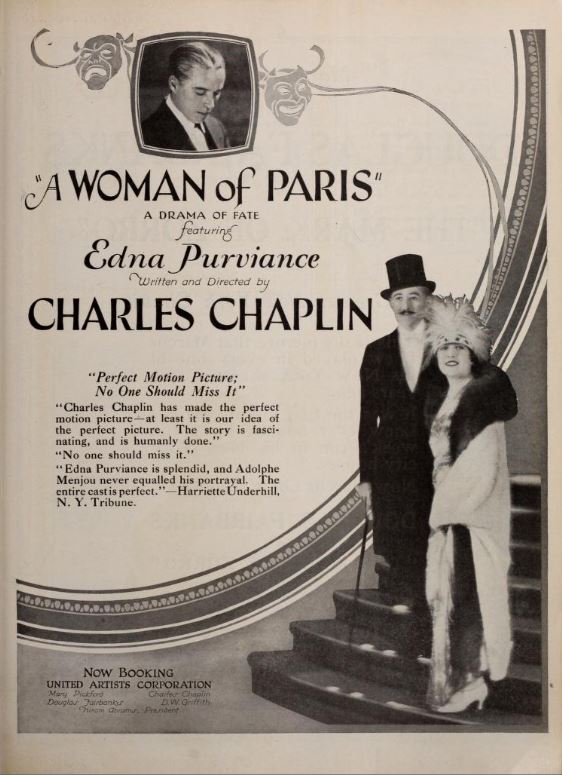
Motion Picture News, 01-December-1923

"Perfect Motion Picture: No One Should Miss It." Chaplin's feature A Woman of Paris was doing good business, even though he made only a cameo appearance. United Artists advertised it heavily.

Motion Picture News, 08-December-1923

"Grips Without a Lariat; Holds Without Extra Mob." They are trying to say that it is a good movie without having huge numbers of extras.

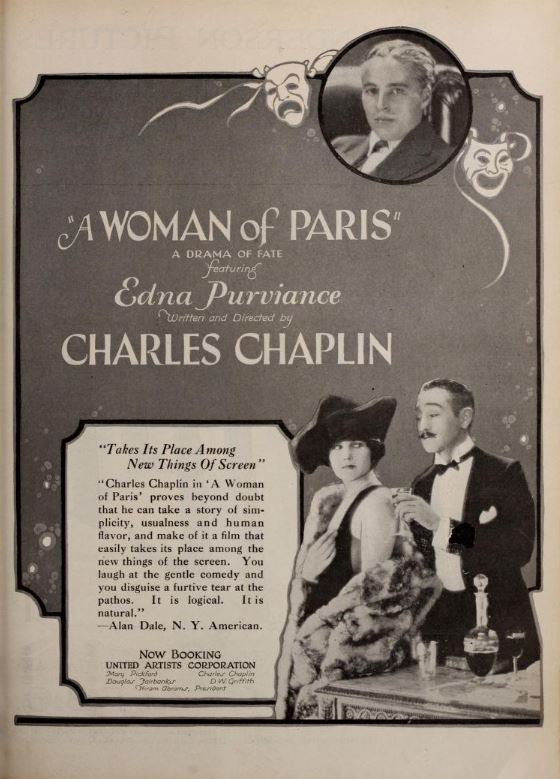
Motion Picture News, 22-December-1923

"Takes Its Place Among New Things of Screen."

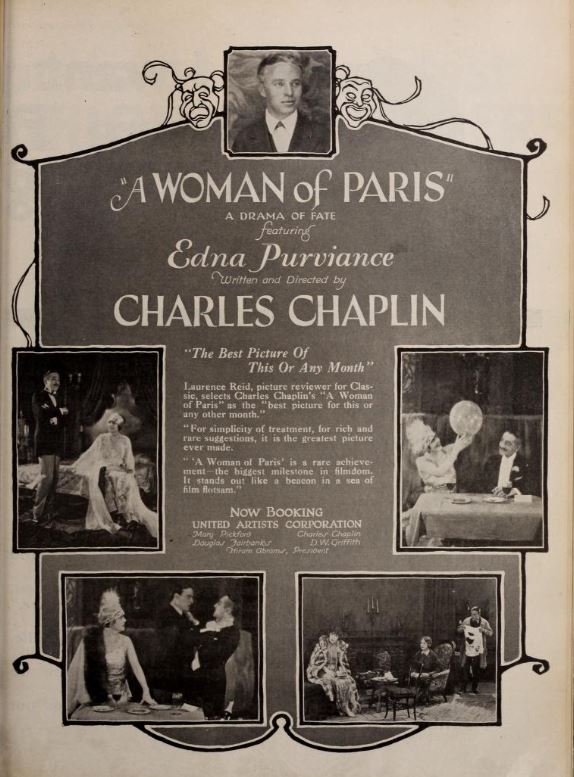
Motion Picture News, 29-December-1923

"The Best Picture of This or Any Month." 

Motion Picture News, 08-December-1923

Chaplin was at work on his "first comedy release for United Artists Corporation," The Gold Rush

Film Daily, 16-December-1923

The movie career of Charlie's older half-brother Sydney was on and off. He took time to handle Charlie's business matters and became an aviation entrepreneur. Syd appeared in a group of films produced by Thomas Ince and Mickey Neilan.

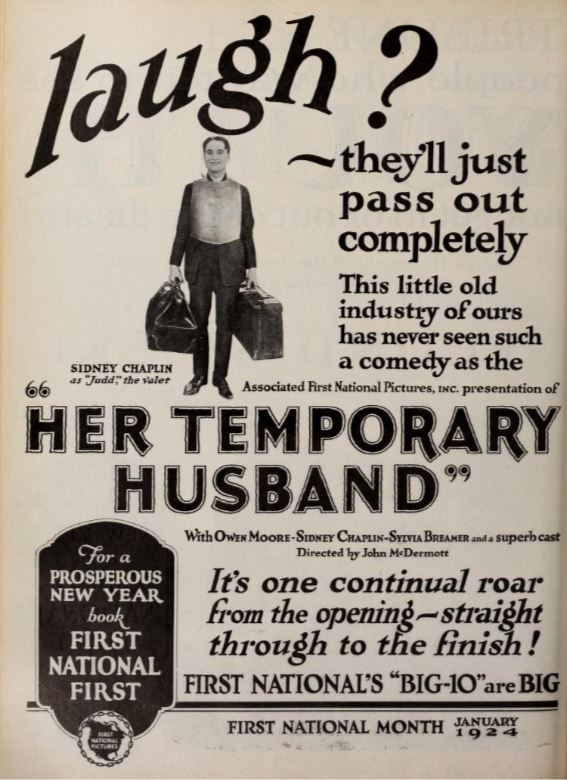
Motion Picture News, 08-December-1923

"Laugh? they'll just pass out completely..." Great slogan.

Motion Picture News, 15-December-1923

Laugh? Why they'll d--- near pass out laughing at this one..."

Monday, August 28, 2023

One Big Picture a Week -- August 28, 2023

Motion Picture News, 04-August-1923

Hearst's Cosmopolitan Productions and Goldwyn Pictures joined forces to form Goldwyn-Cosmopolitan. Distinctive Pictures was a company that produced films with George Arliss and others. Goldwyn-Cosmopolitan used this large and expensive trade ad to promote its upcoming series of big pictures, to be released one a week. 

Motion Picture News, 04-August-1923

King Vidor directed Three Wise Fools. I like the armored car. The Spoilers was based on a novel by Rex Beach. It was set during the Alaska Gold Rush. It was filmed many times, and the highlight was always knock-down drag-out fight between Glennister and McNamara.

Motion Picture News, 04-August-1923
I don't know a thing about Enemies of Women except that it was based on a novel by Vicente Blasco Ibáñez, directed by Alan Crosland and starred Lionel Barrymore.  6 Days was based on another smutty book by Elinor Glyn. Someday I will write about a joke people made about her titles. 

Motion Picture News, 04-August-1923

The casually racist Green Goddess was based upon a stage play that George Arliss had played in for years. It was later remade as a talkie. It was a Distinctive Pictures production. The Eternal 3 was directed by Mickey Neilan. 

Motion Picture News, 04-August-1923

Clarence Badger was a short-legged omnivore with an incredibly strong bite. He directed Marie Prevost in Red Lights, a railroad story. The Steadfast Heart was a Distinctive Pictures production. 

Motion Picture News, 04-August-1923

The Magic Skin was based on a story by Honoré de Balzac. The Day of Faith was directed by Tod Browning.

Motion Picture News, 04-August-1923

In the Palace of the King was a melodrama. 

Motion Picture News, 04-August-1923


Sunday, March 27, 2022

They Went Wild Over Baby Peggy -- March 27, 2022

Moving Picture Weekly, 11-March-1922

Baby Peggy had grown to become Century's biggest comedy star, even surpassing her old comrade Brownie the Century Wonder Dog. This ad touts her role in a feature film, an adaption of Booth Tarkington's book Penrod. Wesley Barry played Penrod and Baby Peggy, billed as Peggy Jane, played Peggy Rensdale.

Motion Picture News, 21-January-1922

Baby Peggy and Wesley "Freckles" Barry in the feature film Penrod, directed by Mickey Neilan.

Exhibitors Herald, 25-March-1922

"Century Comedies Rock the Earth With Laughter." Century Comedies' four series starred Lee Moran, Harry Sweet, Baby Peggy and Brownie the Century Wonder-Dog.

Moving Picture World, 04-March-1922

Century President Julius Stern, Carl Laemmle's brother-in-law, returned from a trip to the East to find everyone hard at work under the supervision of his brother, Abe Stern.

Moving Picture World, 04-March-1922

Meanwhile Moran's erstwhile parter Eddie Lyons was making comedies for Arrow.


Moving Picture World, 25-March-1922

This ad for Educational Pictures Week featured a list of 43 Christie Comedies and a large photo of producer Al Christie.

Moving Picture World, 25-March-1922

"All Christie Comedies Available" for Educational Pictures Week.

Moving Picture World, 25-March-1922

Neal Burns was one of Christie's comic leading men.

Moving Picture World, 25-March-1922

Bobby Vernon started as a juvenile comedian at Keystone, where he starred in several popular comedies with Gloria Swanson. "The dog's name is Blanco because there is a blank space where his brains ought to be. That is harsh.

Exhibitors Herald, 04-March-1922

Al Christie had a company up in the Sierras, in Truckee. They reported that several film crews were at work in the area. 

Moving Picture World, 04-March-1922

Educational, which specialized in short subjects, released several series of comedies: "Lloyd Hamilton in Mermaid Comedies," "Bobby Vernon in Christie Comedies," "Johnny Hines in Torchy Comedies," and "Neal Burns in Christie Comedies." This ad also mentions "The Battle of Jutland" and a new series of "Wilderness Tales."


Lloyd Hamilton, who had been the Ham of Ham and Bud, starred in a series of Mermaid Comedies distributed by Educational Comedies. Most of them were destroyed in a vault fire.

Exhibitors Herald, 04-March-1922

Exhibitors Herald, 04-March-1922

Exhibitors Herald, 11-March-1922

Exhibitors Herald, 18-March-1922

Harry Cohn, his brother Jack and Joe Brandt provided the initials for C.B.C. Film Sales Corp. The Hallroom Boys Comedies were a long running series of short comedies, based on a comic strip by Harold MacGill.

Moving Picture World, 18-March-1922

Mario Bianchi was born in Cesena in Italy's Emilia-Romagna region. He emigrated to the US in 1914. He adopted the name Monty Banks and appeared in many short comedies. He later appeared in features known for daring stunt work.

Moving Picture World, 25-March-1922

Uncle Dan Mason, who played the Skipper in a series of short comedies based on Fontaine Fox's comic panel The Toonerville Trolley That Meets All the Trains, met Sunny Jim Rolph, the mayor of San Francisco. Some of the movies were shot down the Peninsula in San Mateo.


Thursday, September 17, 2020

A Riot of Romance and Realism -- September 17, 2020


Washburn, Wisconsin Times, 16-September-1920

Director Marshall (Mickey) Neilan made Go and Get It, a horror comedy featuring a gorilla with a human brain. The movie may still exist. In 1941, Paramount remade the story as The Monster and the Girl.

Tuesday, August 11, 2020

Go and Get It -- August 11, 2020


Motion Picture News, 24-July-1920

Director Marshall (Mickey) Neilan made Go and Get It, a horror comedy featuring a gorilla with a human brain. The movie may still exist. In 1941, Paramount remade the story as The Monster and the Girl

www.listal.com

Thursday, May 23, 2019

The Comedy of the Talking Feet -- May 23, 2019

Moving Picture World, May 24, 1919
100 years ago this month, in May, 1919, Mary Pickford's Daddy Long Legs was ready to be released. Daddy-Long-Legs was a 1912 novel by Jean Webster.  It has been filmed many times, even though some people find the subject a bit problematic.


Moving Picture World, May 24, 1919
"MARY AND HER 'DADDY LONG LEGS'


"First National's Initial Pickford Release Is by Far the Best Picture the Star Has Had for Many a Moon and Is Made Eloquent by Mary's Talking Feet
"By Edward Weitzel

"EVERYONE has seen conversation carried on through using the hands. In "Daddy Long Legs" Mary Pickford talks with her feet. At first glance this may look like carrying atmosphere, local color, mood and all that to extremes, but the way it is done in the final scene is one of the delightful moments of the picture — and 'Daddy Long Legs' is full of them. To put it concisely: First National's initial Pickford release is by far the best picture Mary has had for many a moon. Showmanship is mixed with every stage of its making and crops out in every detail connected with the transference of Jean Webster's celebrated story and play to the screen. Not one of the thousands of readers of the book or spectators of the stage version are going to be disappointed at the story in its new form. Agnes C. Johnson's scenario and the direction by Marshall Neilan have furnished Mary Pickford with every possible aid to the display of her talents, and she dominates the picture at all times without leaving the impression that this artistic necessity is in the least overdone.

"The Comedy Is All Sure-Fire.

There is never a dull moment in 'Daddy Long Legs.' It has just enough sentiment of the right sort to balance the comedy, which is of a thoroughly entertaining character. Nothing has been left to chance in respect to the laugh getting element of the picture. The comedy is all sure-fire, but handled with such nice discrimination and fitting so neatly to the occasion that it has the effect of novelty, and is an object lesson to the tiresome person who keeps insisting that every author should put nothing but original comic situations and bits of business in his pictures. Bless the tiresome person's innocent soul, the man or woman who could do this has never been born and never will be born. A combination of story, scenario, director and star that can create the waves of laughter which swept over the Strand Theatre at the opening performance of 'Daddy Long Legs' is the best evidence that knowing how to do the trick is what screen comedy most needs.

"An Ash Can for a Crib.

"Judy Abbott, the lovable little orphan of Jean Webster's book, who begins life with a roll of newspapers for her first garments, and an ash can for a crib, and whose early years are spent in the John Greer orphanage, is well-known to the reading public of all ages. All that is required is the assurance that the spirit and charm of the original are to be found in the picture to send Judy's friends trooping to the nearest theatre where the screen version is being shown.

"For those who are not acquainted with Judy's history, the following facts will show the desirability of being among those present when Mary and her 'Daddy Long Legs' come to town:

"From Station House to Orphanage.

"Just who put Judy in that ash can and then ran off and left her is never found out. It is better to have this point settled on the start, because the end is much nicer than having her turn out to be the daughter of one of the characters in the story who showers her with money, which is the usual ending for fiction of this class. From the ash can Judy is escorted to the station house by a policeman, and then taken to the orphanage. When she is next seen she has grown into a wistful-eyed girl of twelve, whose love of fun cannot be subdued even by the systematic cruelty of the matron, Mrs. Semple. Her side partner and companion in all her defying of rules and attempts at overreaching the common enemy, the matron, is a snub-nosed boy who has more freckles to the square inch than any youngster who has so far aspired to be a movie actor.

"The Great Prune Strike.

"There is a series of comic incidents that begin with a prune strike, incited by Judy, and lead to the agitator and her faithful lieutenant being given the hunger treatment. While seated on a bench in the yard and praying for something to still the gnawing in their tummies, a box of lunch and a jug of cider are thrown over the wall. The children partake innocently but copiously of the juice of the apple when it stingeth like many swallows of fire water. Wild hilarity follows. A well, the meanest orphan of the bunch, a dog which laps up enough of the cider to send him reeling on his way, and the efforts of Judy and her chum to get the full benefit of their joyous state of mind, all take part. The skill used in its handling makes it one of the funniest comedy scenes of the screen.

"Mary Pickford's Finest Acting.

"Serious interest is put into the story when Judy is sent to college by a mysterious trustee of the orphanage whom the girl has never seen and who never lays eyes on the object of his bounty, until she has changed into a beautiful and accomplished young woman. His name is Jarvis Pendleton; but Judy, who caught sight of his shadow, calls him "Daddy Long Legs," and writes to him by the name she invented for him. As in all well-made plots, after the correct number of misunderstandings and attempts of another chap to take the heroine away from the man she loves but will not marry for fear he will not relish the facts about her birth, the two most interesting characters in the story find the right answer to their romance.

"It is in this scene that Mary Pickford does some of the finest acting of her career. It is also where she talks with her feet. She has come to Pendleton's house to explain matters. He is seated in a high-backed chair, which is turned from the spectator. When Judy discovers that Jarvis and her "Daddy Long Legs" are one and the same person, and that her secret is known to him, she attempts to leave the room, but is detained by Jarvis. Her play of mixed emotions is beautifully done.

"The Comedy of the Talking Feet

"Then comes the comedy of the talking feet. Jarvis draws her into his lap over the arm of the chair until only the heroine's slim ankles and well-shod extremities are to be seen. At first they register great indignation, then indecision, then passive consent, and as the story ends, they are moving like a pair of particularly active semaphores and telling of Judy's complete surrender. This situation brings the picture to an absolute climax which is refreshingly new, and holds the attention of the entire body of spectators to the very end.

"The growth of Judy's character as her skirts are gradually made longer is denoted by the star with uniform expertness, and at Commencement Day, when all the other girls rush to show their friends and relatives their diplomas, and poor Judy has not one friendly face in the crowd, her pathos touches the right chord.

"Marshall A. Neilan's Expert Direction.

Moving Picture World, May 17, 1919
"Marshall A. Neilan has never surpassed his direction of this picture. There are added bits of pleasantry such as the scenes in Cupid's Court and the intoxicated dog, that are made to fit into the story by force of their cleverness of conception and skill in accomplishment. The atmosphere of the different social grades is always correct, and several exterior scenes are gems.

"The cast could hardly be bettered. Mahlon Hamilton as Jarvis Pendleton, Milla Davenport as Mrs. Lippert, Percy Haswell as Miss Prichard, Fay Lemport and Angelina Wyckoff. Director Neilan as Jimmie McBride, and Wesley Barry as Judy's side partner, are the leading members of the support.

"'Daddy Long Legs' is in for a long run of popularity."

Moving Picture World, May 17, 1919
This ad renders scenes from the movie in cartoon form.

Moving Picture World, May 3, 1919
There's that finger again.  I would still like to know why there were not accepting any bookings.


Wednesday, March 14, 2018

Booth Tarkington 150 -- March 14, 2018

Time, 31-December-1929
Indiana author Booth Tarkington was born 150 years ago, on 14-March-2018.  I don't think people read his stories and novels much today.  When I was a kid, the only thing I knew about him was that he wrote the novel that Orson Welles used as the basis for The Magnificent Ambersons.  I was already in college when I learned that F Scott Fitzgerald was a great admirer of Tarkington.  Inspired by this, I went to the Anza Branch Library and took out Penrod: His Complete Story, a collection of stories about a boy who grows up.

Seattle Star, 23-January-1915
Booth Tarkington and Harry Leon Wilson wrote a play called Cameo Kirby.  It has been filmed several times.  Dustin Farnum, who had played the role on stage, starred in the 1914 version.  John Gilbert played the part in a 1923 version directed by John Ford.  Irving Cummings directed a 1930 version which starred J Harold Murray.  I have never heard of him, either.


Motion Picture Magazine, February, 1922
As far as I can tell, 1922's Penrod, starring Wesley Barry and directed by Mickey Neilan, was the first movie based on a Penrod story.  Ben Alexander played Penrod in a 1923 adaption of Penrod and Sam, also directed by Mickey Neilan.  Ben Alexander played Jack Webb's first partner on the television version of Dragnet.

Billy Mauch played Penrod in three talkies, Penrod and Sam (1937), Penrod and His Twin Brother and Penrod's Double Trouble, both in 1938.

www.listal.com
Monsieur Beaucaire was a play by by Booth Tarkington and Evelyn Greenleaf Sutherland.  Rudolph Valentino and Bebe Daniels starred in a 1924 version.  Bob Hope and Joan Caulfield appeared in a 1946 adaption.

www.listal.com
In 1942 Orson Welles based his second feature film on The Magnificent Ambersons, but the movie got butchered by the studio after he left for another project.  There was also a television adaption in 2002.

Wednesday, November 12, 2014

The Cream of Mirth Provokers -- November 12, 2014

Moving Picture News, 14-November-1914
In his wonderful book The Silent Clowns, Walter Kerr suggested that Lloyd Hamilton was one of the great silent comics whose reputation has diminished. This is because many of the solo movies Hamilton made for Educational during the 1920s are lost. Perhaps this is also because he was not able to succeed as a star in feature films.

This ad for his earlier movies with Kalem promises that their comedies would be without vulgarity.  Hamilton's Ham and Bud comedies, with Bud Dancan were actually very rough and very vulgar. 

Marshall "Mickey" Neilan, who had been an actor, became a director at Kalem.  By the later teens, he was considered an important director.