Showing posts with label Phantoscope. Show all posts

Tuesday, April 23, 2024

Says Movies of Future Will Reproduce Sound and Color -- April 23, 2024

Motion Picture News, 26-April-1924

"...Leon Bakst, famous Russian scenic artist, predicts that the motion picture of tomorrow will be in natural colors and reproduce sound by means of radio." 

Motion Picture News, 19-April-1924

The weekly Pathé Review included a section in Pathécolor, which was a stencil process.

Film Daily, 09-April-1924

Film Daily, 16-April-1924

Film Daily, 24-April-1924

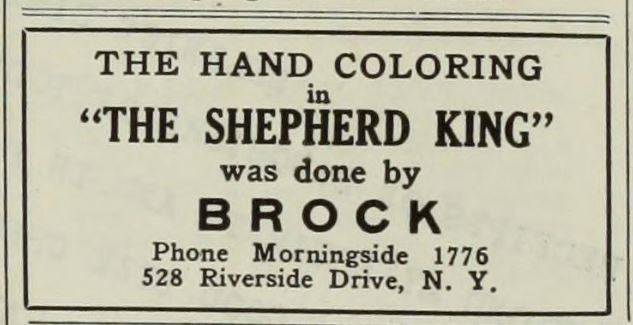
The Brock Company, which I know nothing about, appears to have kept busy applying hand coloring to sequences in feature films. 

Motion Picture News, 26-April-1924

This item is a bit confusing. Where most Phonofilms were single shots showing vaudeville act, De Forest said his new film would be shot with exteriors and a cast of twenty. I can't find a film like that in the Phonofilm filmography. J Searle Dawley (great name) did direct some Phonofilms, and De Forest supplied the soundtrack for a 1925 Fleischer Brothers cartoon called "East Side, West Side." I will have to dig around. 

Motion Picture News, 12-April-1924

"...there has been much widespread comment and query as to whether or not the talking motion picture has a real future, or whether this is only another novelty." 

Film Daily, 24-April-1924

De Forest planned to donate prints of his Phonofilms to the Smithsonian Institution "for the permanent use of that establishment." 

Motion Picture News, 26-April-1924

The reader will notice that WE Waddell is said to be the person who wrote the story for the ambitious Phonofilm "East Side, West Side." 


"Does the Public Want Talking Pictures?
"By W. E. Waddell

"There has been much discussion recently as to whether or not there is a demand for other than pantomime motion pictures. In the opinion of many the silent drama fills every requirement.

"The old-timer is wont to say, 'O, yes, I've seen talking pictures and they are no good — the people don't want them.' He is guessing when he says the people do not want them, for no one in the history of amusements has yet been able to successfully guess what the public wants, and when he refers to talking pictures he has seen in the past he is thinking of various combinations of phonograph and motion picture machines. By this method there has been no illusion, no perfect tone production.

"In addition there are still more vital reasons why this method is doomed to failure. A phonograph record is limited to time of running, and no change of scene can take place. The motion picture of today consists of many quick changes of scene and settings.

"Many of the 'shots' are not over ten feet (ten seconds) in length. Therefore a picture that talks cannot successfully compete with its silent brother if it be limited to a single set.

"What happens when the film breaks with the phonograph-motion picture combination? There is only one answer to that. Burn it up, and get another print, for synchronism has been permanently destroyed.

"But a new talking picture has arrived in the remarkable adaptation of radio to motion pictures, invented by Dr. Lee DeForest, who calls it the Phonofilm. There is no phonograph used in connection with the Phonofilm. The film itself literally talks and reproduces music. The actor performs exactly as he does upon the speaking stage. While the camera lens is catching every movement of his lips a tiny gas-filled tube by its side is faithfully catching every sound he utters.

"By the Phonofilm method pictures may be made with all the latitude of the silent drama except that the director must discard his megaphone.

"Long shots, close-ups, interior and exterior scenes may be made without regard to continuity. Then they are assembled in the usual way, with perfect synchronization.

"What happens when the film breaks? Nothing. Simply patch it together and a fraction of a word with its accompanying action is missing as in a regular motion picture; but synchronization is not disturbed.

"Many stage successes are useless for the reason that their charm lies in clever repartee. Therefore a world of splendid material is available for the talking picture that has been considered useless for the silent drama. In addition, musical comedies, light and grand operas, great orchestra concerts, may be reproduced."

Motion Picture News, 12-April-1924

Meanwhile, inventors on both sides of the Atlantic Ocean were working to develop mechanical television systems. C Francis Jenkins was working in the US. This item mentions that he had developed an early motion picture projector, the Phantoscope. 

Film Daily, 14-April-1924

John Logie Baird was working on his own system in the UK.

Tuesday, January 30, 2018

Recent Scientific Discoveries -- January 30, 2018

San Francisco Call, 08-May-1900
RECENT SCIENTIFIC DISCOVERIES.
Copyright, 1900, by Seymour Eaton.

Note— These papers on Practical Science have been prepared for The Call's Home Study Circle by Professor William J. Hopkins of Drexel Institute.

VI. MOVING PICTURES.

If we look at one of the conventional pictures of a running horse— a picture twenty years old, preferably— and compare it with some of the more recent pictures of the same subject we may see a marked difference. In the older picture the horse is stretched out in an attitude which, to the eye not specially trained, suggests speed. In the more recent one he may perhaps be seen standing like an awkward statue on one leg, with no visible means of support for the rest of him. And yet this is. in a sense, true to life, for it represents accurately the position of the horse at one instant. Except to the technically trained eye it conveys no impression of rapid motion, for the eye does not see things that way.

Persistence of Vision.

The response of the optic nerve and its connections to any action which produces the sensation of light Is not instantaneous nor does the sensation cease at once with the cessation of the cause. It persists for an appreciable time, varying from about one-thirtieth to one-tenth of a second, according to the intensity of the light. In the case of the running horse, therefore, the rapidly changing positions blend into an impression which is pretty well represented by the kind of picture that was customary before the days of instantaneous photography.

Muybridge's Pictures.

It would never have occurred to any one before Muybridge had come to this country and had shown his instantaneous pictures of moving horses that any horse ever assumed such attitudes. Even with the evidence before their eyes the first sensation of the majority his hearers was one of amusement and incredulity. His photographs were obtained by using a series of cameras so placed that the horse came before each one in succession and caused the exposure to be made at the right instant by the breaking of a thread. With the cameras at the right intervals there was thus obtained a series of pictures which showed successive instantaneous attitudes of the horse, with brief breaks between. If these pictures could be presented before the eye, one at a time, in order and rapidly enough, the impression of one would persist until the next appeared and the horse would be seen running, trotting or cantering naturally. Such an instrument, very crude and simple, existed at that time and had been in use for many years as a scientific toy. It was the zoetrope, the forerunner of the kinetoscope and all its kin.

The Zoetrope.

The zoetrope consists of an open cylinder, usually of cardboard, so mounted that it can be whirled on a vertical axis. In the upper half of this cylinder are cut equidistant vertical slits. The pictures in order showing the successive instantaneous positions In the motion to be represented are placed inside the cylinder, against the lower half, so that one picture is opposite each slit. On whirling the cylinder, therefore, keeping the eye at the row of silts, the pictures follow each other in rapid succession, only one being seen at a time. The sensation of each lasts until its image is replaced by that of the next, and the impression is that of the action of which the individual pictures show different stages.


Moving Picture Machines.

All machines for showing moving pictures by whatever name they may be called are nothing more than improvements and elaborations on the optical principle of the zoetrope. There are but few essential things which a successful machine of this sort must accomplish, but their accomplishment is not in every case altogether easy. The pictures must be presented so rapidly that there is no appreciable break between, either in light or in positions of the moving figures. The light must be admitted exactly as the picture is in place and must be cut off just before the picture Is changed. The different pictures must be shown in exact register or there will be a shifting or dancing effect which is not intended and is unpleasant.

Instead of a number of separate cameras to take the pictures, a single instrument is used, so arranged that the shutter is in practically continuous vibration at the rate of thirty or more exposures a second. In its proper place behind the shutter and lens a continuous strip of film is run in time with the shutter. Its motion is necessarily jerky, for it must be at rest for the exposure, while the shutter is open, and move ahead one space while the shutter is closed. By the development of this long strip of film there is obtained a series of negatives, from which positives are printed, in similar long strips, and these positive strips are used in the viewing or projecting instrument. If the positives are examined separately it will usually be difficult. If not impossible, to detect any difference in positions of the figures in pictures which lie near together in the strip, and when these pictures are passed through the projecting instrument at the same rate as that of the taking camera the movements of the figures upon the screen appear natural and lifelike.

The projecting instrument for moving pictures is a regular projecting lantern, with the addition of mechanism, attached to the objective, for keeping the shutter and the pictures in motion. This motion is kept up by a motor or by a hand-wheel, and the shutter or fan is run by the same mechanism that moves the film. A picture is held against the opening while the lens is uncovered, then released as the vane covers the lens, and the next one takes Its place, to be shown, in turn, the instant the vane has passed.

Practical Uses.

The chief use to which moving pictures have' been applied thus far is that of entertainment, and unfortunately the subjects which have aroused the most interest have been prize-fights. There are, however, many directions in which this instrument may prove of great value. It is proposed to make use of it in war and how far such an idea can be carried out we shall perhaps know better after the close of the present war in Africa. There are certain practical difficulties in having a kinetoscope camera at the front always ready for service, even If its use were permitted.

The value of a series of instantaneous photographs taken at short intervals in analyzing rapid motion is sufficiently obvious. By passing the pictures through the viewing instrument at a reduced speed the motion may be made as slow as we wish and its nature clearly seen. Another application of this principle which has recently been proposed is less obvious. It is proposed to take photographs at long intervals of movements which are very slow. Then, passing the series of_ pictures from these negatives through the viewing instrument at the usual speed the slow motion becomes rapid. Suppose, for example, that a photograph is taken every few hours of a sprouting seed and growing plant. When shown by the viewing or projecting instrument the sprout may be seen breaking through the ground, gaining in height and size, putting forth leaves, buds and branches and reaching its maturity, all in a few minutes. The same method may be applied to many things other than plants. To this modification of the principle of moving pictures it has been considered necessary to give a new name -- the "phantoscope."