Showing posts with label First National. Show all posts

Thursday, July 9, 2026

Geprge Arliss Day -- July 9, 2026

listal.com

Since I got out of the hospital, I have been watching a lot of movies on TCM. Wednesday was George Arliss day. I don't think I had seen any of these movies before. My wife was impressed with his comic touch. 

1:45pm PDT

A Successful Calamity (1932)

1 hr 15 mins|Comedy|TV-G


listal.com

A Successful Calamity was a fun movie, although I thought many people reacted too nicely to the news that Arliss had gone broke. Also, Mary Astor seemed rather young to be married to him. John G Adolfi directed.

3:00pm PDT

Central Park (1932)

1 hr|Comedy|TV-G


listal.com

I am always happy to see Joan Blondell, but I did not see a trace of George Arliss. Like most Warner Brothers/First National B movies, Central Park moved rapidly. The plot was screwy, but I enjoyed it. Guy Kibbee was a cop losing his vision. Wallace Ford was a homeless, jobless guy who was trying to get an even break. Henry B Walthall had a small but important part. The tiger cubs were cute. John G Adolfi directed this one too.

listal.com

4:00pm PDT

The King's Vacation (1933)

1 hr 30 mins|Drama|TV-G

listal.com

I did not get much out of The King's Vacation. It was a slow one. I did like the part where the exiled king refused to have anything to do with a coup to bring him back, because he agreed with the rebels. Another one directed by John G Adolfi. Maybe it was really John G Adolfi Day.

5:15pm PDT

The Working Man (1933)

1 hr 30 mins|Comedy|TV-G

listal.com

I enjoyed The Working Man. Bette Davis played a supporting role. I don't like the way Arliss is leering at her on the poster. The plot was preposterous, but it held my interest.  Guess who directed.

Perhaps Central Park was nestled among the George Arliss movies because it was directed by John G Adolfi.

Tuesday, March 18, 2025

This is Undoubtedly the Greatest Charlie Chaplin Comedy Ever Produced -- March 18, 2025

Film Daily, 27-March-1925

100 years ago this month, in March, 1925, Charlie Chaplin was preparing to release his first starring film for United Artists, a company he had helped to found in 1919 with Mary Pickford, Douglas Fairbanks and DW Griffith. It took Chaplin a while to finish his previous contract with First National.
 
Film Daily, 08-March-1925

Thursday, August 1, 2024

Larry Semon has Given the Screen a Feature Length Comedy -- August 1, 2024

Exhibitors Herald, 16-August-1924

Like his contemporary Lloyd Hamilton, Larry Semon was trying to move into feature productions. The Girl in the Limousine was based on a play by Wilson Collison and Avery Hopwood. Larry Semon and Noel Smith directed. First National was going to release the film.

"They'll find Semon's first feature length picture a great evening of fun." They didn't, actually.

Exhibitors Herald, 09-August-1924

Exhibitors Herald, 09-August-1924

Larry started work on a series of short comedies for Educational "in which he plays 'straight' characters." He tried to move to a character that was more realistic than his long-time image. 

Exhibitors Herald, 16-August-1924

"Semon will direct his own pictures." This series of movies was produced at FBO and released by Educational.

Friday, July 26, 2024

Colleen Moore -- Flappers of All Ages -- July 26, 2024

Exhibitors Herald, 19-July-1924

Actress Colleen Moore, considered by some to be The Perfect Flapper, models flapper costumes from different eras. Notice that the stone age flapper has an ankle bracelet. Click on the image to see a larger version. 

Exhibitors Herald, 05-July-1924

Hollywood tennis champ Conway Tearle shows Colleen his racket. Look at that dress.

Exhibitors Herald, 05-July-1924

Colleen stays in shape by working in her garden.

Exhibitors Herald, 05-July-1924

Colleen's first husband was producer John McCormick, who was not the Irish tenor of the same name.

Exhibitors Herald, 05-July-1924


Tuesday, July 16, 2024

Charlie Chaplin -- Keep You Cool -- July 16, 2024

Omaha Bee, 03-July-1924

This ad has a couple of interesting features. "No War Tax on Tickets" -- The entertainment tax imposed during World War One had just been repealed. "Rialto Cooling System Now in Perfect Operation." This implies to me that their air conditioning did not work properly at first. Before air conditioning, many movie theaters had to close down during the summer.

I also like the image of Charlie.

Betty Compson was a popular leading lady. Miami, directed by WW Hodkinson, is believed to be lost.

Photoplay, July, 1924

People were also anxious to see Charlie's new movie, which would be released as The Gold Rush.

Tuesday, July 2, 2024

Larry Semon -- His First Feature Length Picture a Drawing Card -- July 2, 2024

Exhibitors Herald, 26-July-1924

Like his contemporary Lloyd Hamilton, Larry Semon was trying to move into feature productions. The Girl in the Limousine was based on a play by Wilson Collison and Avery Hopwood. Larry Semon and Noel Smith directed. First National was going to release the film.

"The password to weeks of big business." That tag-line proved to be over-optimistic.

Exhibitors Herald, 12-July-1924
  

The play The Girl in the Limousine was a bedroom farce. Co-author Wilson Collison also wrote Up in Mabel's Room, another bedroom farce.

Sunday, June 2, 2024

Larry Semon -- The Girl in the Limousine -- June 2, 2024

Film Daily, 26-June-1924

Like his contemporary Lloyd Hamilton, Larry Semon was trying to move into feature productions. The Girl in the Limousine was based on a play by Wilson Collison and Avery Hopwood. Larry Semon and Noel Smith directed. First National was going to release the film.

 The Girl in the Limousine was not successful. The movie is considered to be lost. 

Film Daily, 22-June-1924


Sunday, February 25, 2024

Charlie Chaplin Seeks Feminine Foil -- February 25, 2024

Camera, 02-February-1924

Edna Purviance was Charlie Chaplin's leading lady for seven years, from his second Essanay film, through the Mutuals, to The Kid and his short films for First National. Chaplin directed her in his first production for United Artists, A Woman of Paris.

For his first starring feature for United Artists, The Gold Rush, he looked for a new leading lady. He planned to produce a dramatic film starring Edna Purviance. 

Camera, 02-February-1924

The Chaplin Studio, where he was preparing The Gold Rush, is now occupied by the Jim Henson Company.

Motion Picture News, 16-February-1924

Chaplin signed his old associate Mack Swain for The Gold Rush.

Motion Picture News, 16-February-1924

Columbia Pictures, which had recently changed its name from Cohn-Brandt-Cohn (CBC), produced Screen Snapshots, a series of short films, between 1920 and 1958. They generally featured candid photos of Hollywood stars. Chaplin and his buddy Douglas Fairbanks appeared in Number 11. 


Friday, December 15, 2023

Smile, Colleen! -- December 15, 2023

Evansville Press, 01-December-1923

Cute Colleen Moore had her reputation for playing flappers secured by Flaming Youth.

Motion Picture News, 01-December-1923

"You can count your profits before you ever play it!"

Motion Picture News, 08-December-1923

"There were so many people who wanted to see Flaming Youth yesterday, no one could get in or out of the theater."

Motion Picture News, 01-December-1923

"A wonderful visualization of Warner Fabian's sensational novel." Nice photo of Colleen Moore. 

Monday, July 31, 2023

Feet the Whole World Worships -- July 31, 2023

Motion Picture News, 07-July-1923

George du Maurier published a novel called Trilby in 1895 and it was a best seller. Someone named a hat after the heroine. 

In 1923, First National released the fourth of eight movie adaptions. French-born actress Andree Lafayette played Trilby, a beautiful artists' model known particularly for her feet. That would explain the image in this trade ad. Arthur Edmund Carewe, whose name I have always liked, played villainous musician and hypnotist Svengali, who is obsessed with Trilby. Trilby is beautiful but she can't carry a tune in a picnic basket. Svengali hypnotizes her and makes her a great singer. This was Andree Lafayette's first and last film in the US. She went back to France and continued her career. James Young directed. 

Motion Picture News, 14-July-1923

Motion Picture News, 21-July-1923

listal.com

The first talkie adaptation, titled Svengali, starred John Barrymore and Marian Marsh. This had to have been a great role for Barrymore. Archie Mayo directed. 

Thursday, July 27, 2023

Never a Penrod Like Ben Alexander! -- July 27, 2023

Motion Picture News, 07-July-1923

Indiana author Booth Tarkington was very 100 years ago, but I don't think people read his stories and novels much today.  When I was a kid, the only thing I knew about him was that he wrote the novel that Orson Welles used as the basis for The Magnificent Ambersons.  I was already in college when I learned that F Scott Fitzgerald was a great admirer of Tarkington.  Inspired by this, I went to the Anza Branch Library and took out Penrod: His Complete Story, a collection of stories about a boy who grows up.

In 1922, a movie based on Penrod, starring Wesley Barry and directed by Mickey Neilan, was a hit.

In 1923, First National released a sequel, Penrod and Sam, starring Ben Alexander. William Beaudine directed again. This would be the first of three adaptions. William Beaudine also directed the 1931 version. 

Motion Picture News, 28-July-1923

In 1908, Booth Tarkington and Harry Leon Wilson wrote a play called Cameo Kirby. It was filmed in 1914, and then John Ford directed a remake in 1923, starring John Gilbert. In 1930, it was remade as a talkie musical starring some guy I have never heard of. 


Saturday, March 18, 2023

Chaplin Pleads Poverty -- March 18, 2023

Chicago Tribune, 10-March-1923

I like the designs of these ads for Chaplin's four reel ("His first big picture since 'The Kid'") "The Pilgrim" and Ben Turpin's "The Shriek of Araby."

Alaska Daily Empire, 28-March-1923

Men of the cloth in Walla Walla Washington did not find "The Pilgrim" amusing. 

Motion Picture News, 17-March-1923

Everyone else found "The Pilgrim" amusing. This item claims that it played at 130 theaters served by FBO's Manhattan Exchange in the same week.

Motion Picture News, 03-March-1923

First National ordered 200 prints and planned to order 25 more. These were big numbers at the time. 

Motion Picture News, 24-March-1923

Meanwhile, Harry Aiken, formerly of the Mutual, was planning to repackage Keystone comedies, especially those with Chaplin made during 1914. 

New Britain Herald, 01-March-1923

We saw last month that there were strong rumors that Chaplin was going to marry Pola Negi. In this item, Chaplin claimed that he was "too poor" to marry her. That will sound hilarious to people who know that Chaplin was rich but will be understandable to people who remember that he grew up in terrible poverty. 

Monday, March 13, 2023

Buster Keaton's Silent Shorts -- Reel Two and a Half -- March 13, 2023

Film Daily, 11-June-1922

This post is part of the Ninth Annual Buster Keaton Blogathon, hosted by Lea at Silent-ology. It is amazingly impressive to me to see a blogathon go on for nine years. 

For the first annual blogathon, I wrote about Buster Keaton's time in vaudeville: The 3-4-5 Keatons.
For the second annual blogathon, I wrote about Buster Keaton and the Passing Show of 1917, the show he signed for after leaving vaudeville.
For the third annual blogathon, I wrote about Buster's transition from vaudeville to the movies, Buster Keaton: From Stage to Screen.
For the fourth annual blogathon, I wrote about Buster Keaton's time in the US Army: Buster Keaton Goes to War.
For the fifth annual blogathon, I wrote about Buster Keaton's time making short comedies with Roscoe Arbuckle, Comique: Roscoe, Buster, Al and Luke.
For the sixth annual blogathon I wrote about Buster Keaton's First Feature: The Saphead
For the seveth annual blogathon I wrote about Buster Keaton's Silent Shorts -- Reel One, a series of films produced during 1920-1921. Buster and his team had a very high batting average.
For the eighth annual blogathon, I started to write about the Buster Keaton shorts produced for the second season, 1921-1923. Buster Keaton's Silent Shorts -- Reel Two
For the ninth annual blogathon, I have written about the rest of the Buster Keaton shorts produced for the second season, 1921-1923. Last year I was interrupted by appendicitis. 

Be sure to click on most images to see larger versions.

I first became interested in Buster Keaton when I watched The General with my grandfather and he told me how much he had always liked Buster Keaton.

When I discovered that the Anza Branch Library had a shelf of books about movies, I found two books about Buster Keaton, Buster's memoir My Wonderful World of Slapstick and Rudi Blesh's Keaton. I read both and I enjoyed learning about his career in vaudeville and his career in the movies.

After The Saphead, Buster started making a series of nineteen two-reel comedies (actually, he made one before The Saphead, but it would be too complicated to explain). No one ever asks me, but I tell people that this series of comedies and Charlie Chaplin's series for Mutual are the two best series of silent comedy shorts ever made. For the Ninth Annual Blogathon, I am continuing to write about the eleven Buster Keaton shorts produced for the second season, 1921-1922.

The movies of the first season had been released by Metro. The movies of the second season were released by First National. At this time, First National released the movies of both Charlie Chaplin and Buster Keaton. 

Moving Picture World, 05-August-1922

Last year I left off with a mention of "The Blacksmith." Here are some images from "The Blacksmith." Buster's leading lady was Virginia Fox.

Moving Picture World, 23-September-1922

GR Stewart, manager of the Iris and America Theaters in Casper, Wyoming, promoted Buster's short comedy, "The Blacksmith" with an animated figure. Some poor kid had the job of moving the cut-out's right arm to hit the anvil.

Casper Daily Tribune, 14-August-1922

Note that "The Blacksmith" is advertised above the feature film, and that Buster's name is in the largest type.

Moving Picture World, 22-July-1922

The title of this trade ad for "The Blacksmith" misspells Keaton's name.

Moving Picture World, 07-October-1922

In "The Frozen North," Buster parodied stone faced, steely eyed western star William S Hart. Hart was not amused. 

Snow scenes were shot at Truckee, in the Sierras near Lake Tahoe. 

Motion Picture News, 19-March-1921

In 1921, Hart had made O'Malley of the Mounted, a movie about the Royal Canadian Mounted Police.

Photoplay, October, 1922

First National was happy with the results of releasing Buster's second season of comedy short films.

Moving Picture World, 27-May-1922

Buster was injured several times on the set of "The Electric House." The first time they tried to film the story in 1920, Buster broke his ankle on the escalator. He gave up and started over, scrapping the footage from 1920.

Motion Picture News, 04-November-1922

Buster had an electric train that ran from the kitchen to the dining room in his own house. 

Motion Picture News, 24-February-1923

"They'll Never Want to Wake Up" is a scary tag line. 

When I first started reading about silent comedy, Buster Keaton's "Day Dreams" was considered a lost film. Later, people digging around found most of the movie, but some scenes are still missing. Eddie Cline and Buster directed.

Moving Picture World, 02-September-1922

"Day Dreams" has some dark elements. When Buster asks his girl's father, played by Buster's father Joe, permission to marry her, the father asks "How will you support her?" Virginia Fox is mentioned in this item, but the girl was played by Renée Adorée, who would soon become a major star.


Buster promises that he will go the city and find success. If not, he will come back and commit suicide. 

In the city, Buster fails as a veterinary assistant, a street sweeper, and a member of the chorus in a musical. He fails everything and winds up being chased by lots of cops. 


"Day Dreams" has special meaning for me because it was partly shot in San Francisco and includes a scene shot on the Powell/Mason cable car line. Cable cars are the subject of my monomania. Above we see Buster waiting to hop on a Powell-Mason cable car on Columbus Avenue. The cable car's dark green paint renders it difficult to see Buster. 


In this screenshot, we see Buster sitting on the front bench of a Powell Street cable car while it rotates on the turntable at Bay and Taylor Streets. 

Watch the movie to see what happens when Buster returns to his girl's house.

Motion Picture News, 02-September-1922

Joe Schenk, Buster's brother-in-law had great plans for Buster and for the sisters of Buster's wife Natalie, Norma and Constance Talmadge.

Motion Picture News, 24-February-1923

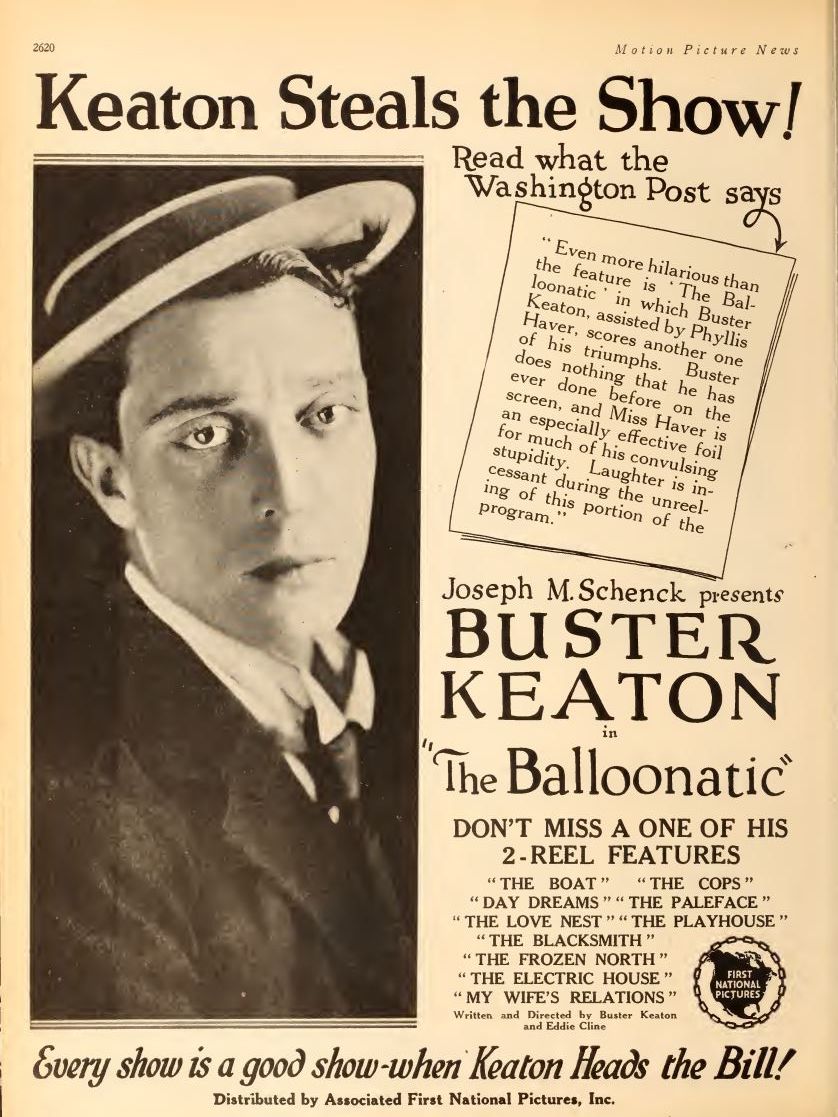
"The Balloonatic" (great name) may have been the first of Buster's silent short films that I saw. The San Francisco Main Library used to show films one day a week at lunchtime.

Motion Picture News, 24-February-1923

"Buster Keaton rises to great heights..." Ha ha. 

Motion Picture News, 22-June-1923

"Keaton Steals the Show!"

Motion Picture News, 05-May-1923

Buster's short comedies were popular all over the world. 

Motion Picture News, 12-May-1923

"The Love Nest" was Buster's last silent short. Buster's last talkie short film for Educational, released in 1937, was "Love Nest on Wheels." No relation.

Motion Picture News, 24-March-1923

This still shows a nice contrast between the size of Buster and the size of his frequent nemesis, Big Joe Roberts. 


Motion Picture News, 24-March-1923

"Buster Keaton had so much fun and furnished so much amusement in a comedy about a boat on the high seas, shown some time ago, that he has evidently attempted to provide a sequel."


Ridgewood Herald-News, 11-January-1923

After completing his second season of short films Buster Keaton took a three-month vacation. On his return, he started working on a feature.

Motion Picture News, 03-February-1923

Metro, which had released Buster's first season of silent comedies, wanted to distribute the first feature in which he had creative control, The Three Ages.

Motion Picture News, 16-June-1923

Photoplay, October, 1922

Journalist Adela Rogers St Johns interviewed Buster Keaton's son Joseph, who must have been three or four months old. He didn't have much to say. She said that neither Buster nor the little guy had ever been photographed smiling.

Moving Picture World, 20-May-1922

A boyhood photograph of Buster smiling.  "The First and Only Time He Was Caught Smiling." Not true, but funny.

This post is part of the Ninth Annual Buster Keaton Blogathon, hosted by Lea at Silent-ology. Thank you to Lea for all the hard work. I think it is wonderful that this blogathon has reached a ninth year. Thank you to everyone who visited and I encourage you to read and comment on as many posts as you can. Bloggers love comments.