Showing posts with label Lee De Forest. Show all posts

Saturday, December 21, 2024

Eddie Cantor -- See Him Dance and Hear Him Sing in the "Phonofilms" -- December 21, 2024

Minneapolis Journal, 19-December-1924

Eddie Cantor was a wildly talented performer on stage, screen, records, radio and television. He appeared in a one-reel De Forest Phonofilm reel. He often appeared in blackface. Please excuse the racism. 

Saturday, November 23, 2024

The Phonofilm See and Hears It -- November 23, 2024

Toronto Star, 04-November-1924

Lee De Forest, a pioneer in vacuum tubes and radio, introduced his Phonofilm sound-on-film picture process in 1923. By 1924, his movies were showing in major theaters.

Toronto Star, 04-November-1924

Kingston Whig-Standard, 21-November-1924

Plastigrams were 3-D movies that used a process invented by Frederic Eugene Ives and Jacob Leventhal. The movies were viewed with red- and blue-lensed glasses. Note that Plastigrams were billed above the feature.

Saturday, July 20, 2024

The Third Dimension on the Screen at Last -- July 20, 2024

Anderson Herald, 20-July-1924

Plastigrams were 3-D movies that used a process invented by Frederic Eugene Ives and Jacob Leventhal. The movies were viewed with red- and blue-lensed glasses. Note that Plastigrams were billed above the feature. 

Anderson Herald, 20-July-1924

This article has more details about the contents of the film. "So startling were the effects seen by the spectators that they experienced an entirely new set of thrills when articles seemingly were thrust in their faces from the screen, of when a beautiful girl held a foaming drink out to them, or when taken for a thrilling and dangerous ride in a speeding automobile."

Exhibitors Herald, 05-July-1924

Customers at Seattle's Coliseum enjoyed Plastigrams. 

Exhibitors Herald, 19-July-1924

Lee De Forest, a pioneer in vacuum tubes and radio, introduced his Phonofilm sound-on-film picture process in 1923. By 1924, his movies were showing in major theaters.

Washington Evening Star, 06-July-1924

De Forest talked about making a talking adaption of Trilby, a popular novel. It was just talk. We will see more about Vitagraph's new color process later. 

Washington Evening Star, 07-July-1924

De Forest had even planned his cast. Arthur Edmund Carew would play Svengali and Hope Hampton would play Trilby.


This ad refers to Phonofilms as "De Forest's Marvelous Radio Talking Pictures." 

Exhibitors Herald, 19-July-1924Exhibitors Herald, 19-July-1924

This article carefully does not describe Vitagraph's new color process but says that it will be used for parts of the movie Behold This Woman.

Chicago Tribune, 14-July-1924Exhibitors Herald, 05-July-1924

This fancy ad invites film people to see a demonstration of a new natural color process created by Claude Friese-Greene. Claude Friese-Greene was the son of William Friese-Greene, who claimed that he had invented motion pictures in the 1880s. William went on to try to develop a natural color motion picture process and Claude carried on his father's work.

Exhibitors Herald, 05-July-1924

Exhibitors Herald, 12-July-1924

In lieu of successful and affordable natural color processes, many films were printed on tinted stock, or shots were tinted after printing. 

Thursday, May 23, 2024

Absolutely New -- the Marvel of the Age! -- May 23, 2024

Montreal Daily Star, 31-May-1924

Lee De Forest, a pioneer in vacuum tubes and radio, introduced his Phonofilm sound-on-film picture process in 1923. By 1924, his movies were showing in major theaters. "Extra Special Added Attraction."

Film Daily, 11-May-1924

Plastigrams were 3-D movies that used a process invented by Frederic Eugene Ives and Jacob Leventhal. The movies were viewed with red- and blue-lensed glasses. I wonder what these psychologists found interesting. I need to see if there is a copy of that book available.

Film Daily, 05-May-1924

The World in Color was a magazine-format series of short films "Issued monthly by Kelley Color Laboratory." William Van Doren Kelley, inventor of the Prizma natural color process, opened a laboratory in New Jersey which would be dedicated to making natural color prints.

Film Daily, 11-May-1924

Film Daily, 11-May-1924

I don't know anything about Reel-Colors, Inc, but I will keep my eyes open.

Film Daily, 05-May-1924

Claude Friese-Greene was the son of William Friese-Greene, who claimed that he had invented motion pictures in the 1880s. William went on to try to develop color motion pictures and Claude carried on his father's work. 

Film Daily, 14-May-1924

Film Daily, 28-May-1924

Last month, we saw that the Brock Company, which I still know nothing about, applied hand coloring to sequences in feature films.

Film Daily, 21-May-1924

Experts from ATT announced that transmitting motion pictures (television) would never be practical. Always good to ask the experts. 

Exhibitors Herald, 24-May-1924

Another piece of technology which is not directly related to movies made a huge change in the movie industry. Before air conditioning, many theaters in hot areas had to close during the summer. 

Monday, March 25, 2024

At Last! The Third-Dimension Movie -- March 25, 2024

Motion Picture News, 15-March-1924

Plastigrams were 3-D movies that used a process invented by Frederic Eugene Ives and Jacob Leventhal. The movies were viewed with red- and blue-lensed glasses. 

Motion Picture News, 15-March-1924

Film Daily, 26-March-1924

Claude Friese-Greene was the son of William Friese-Greene, who claimed that he had invented motion pictures in the 1880s. William went on to try to develop color motion pictures and Claude carried on his father's work. 

Film Daily, 25-March-1924

Prizma, Inc, creators of Prizma Color, declared bankruptcy in 1924. This was despite many filmmakers having added a reel of color to their feature films. 

Film Daily, 21-March-1924

A receiver's sale disposed of the company's assets.

Motion Picture News, 08-March-1924

Inventor Lee De Forest formed a company to produce talking films using his Phonofilm sound-on-film process. 


Friday, January 26, 2024

Demonstration of Phonofilm Assures Speaking Movies/Do It in Technicolor -- January 26, 2023

Washington Evening Star, 05-January-1924

Lee De Forest, a pioneer in vacuum tubes and radio, introduced his Phonofilm sound-on-film picture process in 1923.

Demonstration of Phonofilm
Assures Speaking Movies

By the Associated Press
CLEVELAND. Ohio. January 5. -- The phonofilm, a combination of radio and motion pictures, the invention of Dr. Lee De Forest, has been demonstrated successfully, according to those who have heard and seen the talking pictures. It is his object to produce motion pictures in which the characters speak. Dr. De Forest gives this explanation of the process:

"In the studio a motion picture is taken in the usual manner, but in addition to tbe camera lens, which registers action, a microphone registers every sound made by the actor. A wire from the microphone passes through an audion amplifier to a gas-filled tube, called the photion, located in the camera. The light from this tube fluctuates in exact accordance with the amplified telephonic currents which originates from the actor's lips.

Sound Waves Photographed.

"A very line slit is located near the negative film, through which these fluctuating light rays are registered on the sensitive emulsion of the negative as fine lines which are actual photographic sound waves and, being on the same film as the picture, insure perfect synchronism at all times.

"A positive print then is made in the usual manner. In reproducing, a small attachment is placed on the standard motion picture machine. This attachment contains a small incandescent lamp, which is placed in front of the photographed sound waves on the films. This light, passing through the sound record, falls upon a photo-electric cell, its brilliancy being governed by the density of the photographed sound waves. The photo-electric cell’s electrical resistance at any instant is determined by the amount of light falling upon it.

Synchronize Sound and Sight.

"The telephonic current from the cell then is passed through the audion amplifier, where it is built up hundreds of thousands of times. Thus, the actor's words are converted into telephonic currents, amplified, photographically registered on the film and eventually transformed back again into telephonic currents, which are made audible by the loud speaker.

"As the motion picture must be projected upon a screen to be viewed, it is likewise necessary to project the sound, in order that it may appear to come from the actor's lips. This is done simply by running a lamp cord from the machine to the screen, where a loudspeaker is attached."

Motion Picture News, 05-January-1924

The use of Technicolor as an extra in feature films was growing. In Cecil B DeMille's Ten Commandments, the Biblical prologue was shot in Technicolor. 

Motion Picture News, 05-January-1924

Paramount announced that its first color film would be an adaption of Zane Grey's novel Wanderer of the Wasteland

Film Daily, 10-January-1924

"Do it in Technicolor."

Monday, November 20, 2023

Lee De Forest Introducing the De Forest Phonofilm (Talking Movies) -- November 20, 2023

Mount Vernon Argus, 24-November-1923

Lee De Forest, a pioneer in vacuum tubes and radio, introduced his Phonofilm sound-on-film picture process.

Wednesday, September 6, 2023

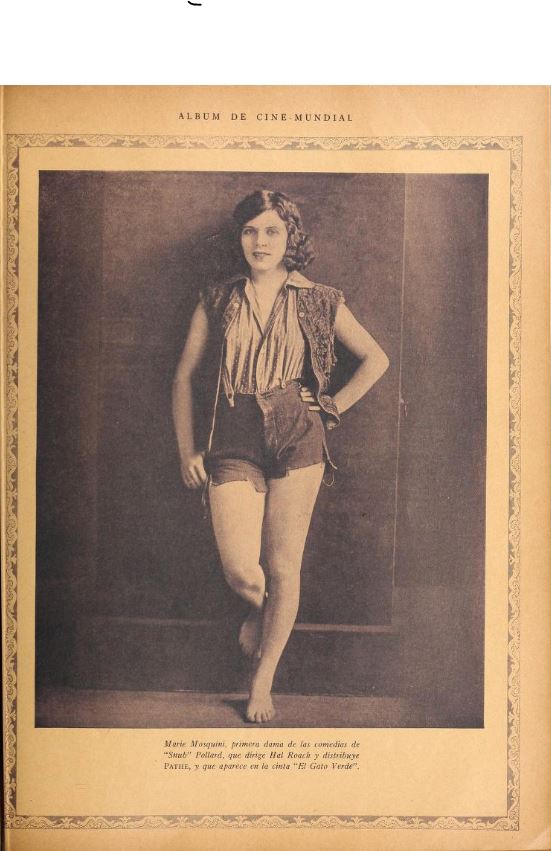
Marie Mosquini -- September 6, 2023

Cine-Mundial, September, 1923

Cute Italian-American actress Marie Mosquini starred in hundreds of short comedies. Hal Roach often teamed her with Snub Pollard. I remember her best as Buster Keaton's wife in "One Week." They had great chemistry together. After she retired from movies around 1930, she married her second husband, Phonofilm inventor Lee De Forest. 

Los Angeles Times, 01-February-1922

This item says Marie Mosquini and Snub Pollard got engaged. I think she was already married to her first. They never married each other, as far as I know. Anyway, they look happy.

Wednesday, August 23, 2023

Photographed DIRECTLY in the TRUE Colors of Nature -- August 23, 2023

Falls City Journal, 28-August-1923

100 years ago this month, Toll of the Sea with Anna May Wong, was being shown in Falls City, Nebraska. This was the second Technicolor film produced and the first to be widely released. 

Film Daily, 31-August-1923

Meanwhile Dr Lee De Forest was looking for people to invest in his Phonofilm a sound-on-film process.

Friday, July 21, 2023

Dr De Forest's Speaking Flame -- July 21, 2023

Philadelphia Inquirer, 15-July-1923

Inventor Lee De Forest explains a "flame microphone" which he planned to use with his Phonofilm sound picture process.


Dr De Forest's "Speaking Flame"

One of the most interesting of recent scientific developments and one which will appeal to the public at large, is the "speaking flame" which Dr De Forest has invented and will make use of in his Phonofilm or speaking pictures. In describing the new idea, Dr De Forest says: "Take the ordinary bat-wing gas burner or a certain form of Welsbach mantel gas light, or special forms oxy-acetylene gas flames, insert two heat-resisting electrodes therein, in proper relation to the flame and to each other, connect these electrodes to an appropriate electro-motive force, and you will then have an extremely sensitive sound converter which gives an electric reproduction of the sound waves in the air enveloping the flame, which is of an entirely different order of fidelity from that ever obtained from any form of microphonic device, using a diaphragm, whether this be of the carbon, electro-magnetic, of electrostatic variety. In my phonofilm work we have found in the same way that when a series of very fine and very short platinum wires are heated to a dull red from a local source of current the resistance of these wires changes, alternately increasing and decreasing in conformity with the sound waves impinging thereon: so that from a telephone transformer connected in series with a battery and this thermo-microphone, a remarkable faithful representation of the sound waves is obtained, even though the frequency of these be as high as 3000 per second. The sensitiveness of this device is greatly enhanced through a gentle stream of air, by fluid evaporation in the neighborhood, or by other auxiliary means. Of all the diaphragm types of transmitters, unquestionably the electro-static type, as perfected by the engineers of the Western Electric Company, comes nearest to approximate perfection. While this is extremely insensitive compared with the best carbon microphone types, there is no comparison between the fidelity of reproduction by the two means. But one listening in a telephone to the reproduction by means of the flame microphone, and then by means of the electro-static microphone will at once exclaim that the fidelity of reproduction in the first case is of quite a different order from that obtained even from the highly perfected diaphragm of the best electro-static microphone."

Film Daily, 03-July-1923

Brewster color was a relatively inexpensive two-color process.

Thursday, April 27, 2023

Phonofilm Demonstration Tonight -- April 27, 2023

Film Daily, 04-April-1923

Doctor Lee De Forest was to give a public demonstration of his Phonofilm process, which recorded images and sound on the same strip of film. De Forest used the work of associate Theodore Case and his Case Research Lab. De Forest did not share credit. The demonstration may have been held at the Engineering Societies' Building which still stands at 25 West 39th Street in Manhattan.

Film Daily, 04-April-1923

De Forest proposed a weekly release program of Phonofilms. 

Motion Picture News, 07-April-1923

The Pathé Company announced that its weekly Pathé Review would include sections in Pathécolor, a stencil process rather than a natural color process. 

Motion Picture News, 28-April-1923

Sections of Cosmopolitan's movie Enemies of Women were hand-colored. 


Thursday, March 23, 2023

Radio Moves are Next -- March 23, 2023

Alaska Daily Empire, 28-March-1923

American inventor Charles Francis Jenkins demonstrated and patented a successful electro-mechanical television system in October 1922. He did much of his work in parallel with Scottish inventor John Logie Baird. "Remain at Home to See Show."

Seattle Star, 24-March-1923

Meanwhile back in the movie theaters, inventor Lee De Forest gave a public demonstration of his Phonofilm process, which recorded images and sound on the same strip of film.