Showing posts with label DVD. Show all posts

Saturday, March 9, 2019

DVD: Kidnapped -- March 9, 2019

Moving Picture World, 29-September-1917
Fritzi, the proprietor of the wonderful blog Movies Silently, is now a DVD producer.  For her first production, she had a brilliant idea which requires a little bit of explanation.

Moving Picture World, 03-March-1917
On 11-February-1917, inventor Thomas Edison turned 70 years old.  He received a testimonial banquet from his employees in West Orange, New Jersey.  The article's history is not entirely accurate.  I highlighted some of the text of the article.  

"Trade Honors Edison, Its Creator, on Natal Day


"First Real 'Feature' Made and Modern Conquest Subject
"Shown at Testimonial Banquet to 'Father of Pictures'

"A SHOWING of the first great 'feature' motion picture ever produced was one of the striking features of a testimonial banquet that was tendered to Thomas A. Edison, in honor of his seventieth birthday, at Orange, N. J., by the employees of the Edison Affiliated Industries. The banquet to (the - JT) famous inventor, who devised the first motion picture camera as well as the first machine designed to project moving pictures on a screen, was given by the various divisions of the vast Edison industries, for the purpose of emphasizing the high regard in which Mr. Edison is held by those who are engaged in the production of the various devices that owe their existence to his rare genius and unremitting toil. The Edison studios of Bedford Park, N. Y., were strongly represented at the banquet and contributed largely to the entertainment that followed the dinner.

"The affair was of decided interest to the motion picture world not only because of the showing of the historic first 'feature' production, but because it marked the first public showing of Edison Conquest Pictures, new productions that have been made on lines laid down by Mr. Edison, and that represent his conception of ideal motion pictures. The contrast between the first actual photoplay ever produced and the new productions of the Edison studios was highly impressive.

"The first feature production that ever was made, the picture that was shown last night, was 'The Great Train Robbery,' a photoplay that will be remembered by many of the pioneers in the film industry, and the forerunner of all Western thrillers. It was released November 30, 1903, and it marked a decided advance in the evolution of the silent drama. It was the first story with a definite plot to be produced as well as the first production to reach the length of one-reel. Previous to that time, only short subjects, ranging in length from twenty-five to three hundred feet, had been made. 'The Great Train Robbery' was approximately seven hundred and fifty feet in length, a stupendous production for that era.

"The popularity of the production is indicated by the fact that estimates show that it made approximately $400,000 for the Edison Company, a record that few productions have approached.

"Four of the new Edison Conquest pictures, including a production of Robert Louis Stevenson's 'Kidnapped,' were included in the program. Motion picture authorities present were authority for statements that the new pictures are going to make a big advance in motion picture production.

"Among the figures of prominence in the film world who were present were. W. W. Hodkinson, who will direct the distribution of Conquest Pictures; George Kleine, of the Kleine-Edison-Selig-Essanay, through which a series of five-reel Edison master-pictures are being released, and L. W. McChesney, manager of the Thomas A. Edison,. Inc., studios.

"The divisions that united in giving the testimonial banquet to Mr. Edison were: The Motion Picture Division, of Bedford Park; the Musical Phonograph Division, the Storage Battery Division, the Dictating Machine Division, of Orange; the Primary Battery Division, of Bloomfield, N. J., and the Chemical Manufacturing Division, of Silver Lake, N. J."

Motion Picture News, 24-March-1917
Thomas Edison, or his ghostwriter, said:
"We have all heard a great deal during the past few years about the growing demand for better films for motion picture patrons of all ages. I have felt from the very start that little would be accomplished toward meeting this demand seriously until some responsible producer thought more of the future good of the business than the present gain. I have assumed the investment necessary to produce a better grade of clean and wholesome films with full confidence that the American people will support 'EDISON CONQUEST PICTURES' so that they may ultimately produce a fair return on their original cost. These pictures are free from all features which have made the motion picture objectionable to many people and may be viewed by the entire family.

"THEY ARE NOW READY."

The idea behind Conquest Pictures, made by the Edison Company and distributed by K-E-S-E (Kleine-Edison-Selig-Essanay) was to provide theaters with a complete package, a feature film and a set of short subjects.  The Conquest idea was not Edison's, but was conceived by George Kleine (The "K" in K-E-S-E).

Motion Picture News, 24-March-1917
The Conquest slogan was "The Open Road to Romance and Knowledge."  I'd like to know what a barefoot boy with a bindle has to do with conquest.

Moving Picture World, 29-September-1917
Conquest Program No. 9 was a package made up of a five-reel feature adaption of Robert Louis Stevenson's popular adventure novel Kidnapped and four short subjects, a scenic view of Provincetown, Massachusetts, a silhouette version of "Little Red Riding Hood," a microscopic view of pond life, and "Friends, Romans and Leo," a one-reel comedy.


Fritzi had the idea of recreating the program.  All five movies still exist, against great odds, and she was able to assemble them into a new package on a DVD-R.  Maestro Ben Model provided a suitable piano accompaniment for each element. Fritzi raised money for the production through a Kickstarter campaign.

The full title is Kidnapped: A Complete 1917 Night at the Movies.  I find it interesting that no one seems to have thought of doing a complete program like this.  I suppose the poor survival rates of silent films makes it difficult to put together a group like this.

Moving Picture World, 06-October-1917
"The program is about the average quality of Conquest programs."

'Friends, Romans and Leo" was a comedy about a slave, played by Raymond McKee, who saved the Roman Emperor from a moneylender and won the hand of the Emperor's daughter.  It had many anachronistic jokes. The lion was funny. Alan Crosland directed.

"Little Red Riding Hood" was an adaption of the fairy tale done in silhouette.  When I hear of a silhouette film, I think of Lotte Reiniger's animated movies, but this film was done with live action. I noticed that in close shots, we could see some of the features of the actors.

Moving Picture World, 13-October-1917
"Quaint Provincetown" had some interesting views of life in a town inhabited by fishermen and artists.  It had no narrative flow.

Moving Picture World, 06-October-1917
"Microscopic Pond Life" was well photographed and nearly as exciting as you might expect.

The feature, Kidnapped, moves swiftly through the events of Stevenson's novel.  Raymond McKee was too old to play David Balfour, but he was fun to watch.  Joseph Burke played David's Uncle Ebeneezer in an over-the-top way, which was appropriate for the part.  Robert Cain was suitably colorful as Alan Breck.  The settings were frequently beautiful.  Alan Crosland directed.  So Raymond McKee and Alan Crosland were involved in this movie and "Friends, Romans and Leo."

Kidnapped: A Complete 1917 Night at the Movies is worth seeing and it makes a nice companion to the Kino box set Edison - The Invention of the Movies: 1891-1918.  I recommend it highly.

You can order it from Amazon.

I should take this opportunity to mention that Fritzi has also created a podcast which is worth a visit:
http://moviessilently.com/2019/02/26/the-first-movies-silently-podcast/

Tuesday, January 10, 2017

DVD: Accidentally Preserved, Volume 4 -- January 10, 2017


They're at it again.  Famous film accompanist Ben Model has produced a fourth volume of the Accidentally Preserved series.  This time, Model dug into his collection of old 9.5mm prints, which were made for the home rental or purchase market. Most of the movies in this collection only exist in old home use prints.  Naturally he also created the musical scores.  Volumes 1, 2 and 3 of Accidentally Preserved used 16mm prints.

The DVD begins with a brief text introduction to 9.5mm films.  Pathé introduced the format in 1922.  The films, printed on safety stock, were eventually distributed across Europe, in the UK and the United States.  16mm was more popular in the US.  Pathé subsidiaries continued to sell and rent 9.5mm films until around 1960.


The US subsidiary was called Pathex.

The first movie in the set was "Nonsense," a 1920 Mermaid Comdies two-reeler, directed by Jack White and released by Educational.  It starred Jimmie Adams and Sid Smith as two farmhands who competed for the attention of Marvel Rea, the beautiful niece of the farmer.  The unidentified bad guy calls her "Mary Hickford" in one intertitle.  There was little plot, but there were lots of gags and it moved right along.

Exhibitors Herald, 07-May-1921
This movie was released in both two and one-reel versions in 9.5mm.

The Ninety and Nine was a 1922 Vitagraph feature based on the popular 1902 melodrama by Ramsay Morris.  The greatly abridged 9.5mm version dashes through bits of the story to get to the huge forest fire scene.  Warner Baxter is the hero and Colleen Moore with long hair is the leading lady.  The town simpleton looks like Harpo Marx.

The locomotive used to make the dash through the fire has the railroad name on the side of the cab painted over and the number of the locomotive, 1379, is mostly obscured.  The locomotive should have been numbered 99.

Exhibitors Herald, 19-May-1923
The Ninety and Nine was a major production and exhibitors used a variety of tricks to promote it, including an automobile disguised as a locomotive.

Bobby Ray starred in "Meet Father," an Arrow film, in 1924.  It also stars Josephine the Monkey from The Navigator and Pete the Dog from Our Gang.  Bobby loves a girl whose father wants her to marry a tough boxer.  Bobby is absent-minded and not tough.  He carefully studies a book on fighting.  Bobby uses his little car to chase the boxer over a famous cliff in the Pacific Pallisades.

"The Wages of Tin" is a 1925 Hal Roach two-reel comedy starring Glenn Tryon.  The 9.5mm version is one reel.  Glenn reads a book on how to operate an automobile.  He rents a Model T Ford to impress Blanche Mehaffy.  Things don't go well.  The intertitles must be from a UK version.  "That'll be another two quid."  "I say, can I write you a cheque?"

Mae Marsh stars in a two-reel cut-down of a Vitagraph feature, Tides of Passion.  Her husband is a louse.  He ships out for India and forgets her.  He fools around with other women and falls overboard on the way back.  He gets the woman who rescues him, Laska Winter or Winter Blossom, pregnant.  He dies.  Mae Marsh tries to help with the baby, but the mother gets jealous.  There is a nice rescue from the rocks when she tries to commit suicide.  It goes by quickly.

Photoplay, July, 1925
Photoplay said the feature version was slow.  The abridgement may have been an improvement.

"A Man's Size Pet" starred cowboys Ben Corbett and Pee Wee Holmes as a pair of rivals who played tit for tat in the west.  There is a bear and a guy in a bear suit.  Leading lady Dorothy Kitchen, also known as Nancy Drexel, was really cute.

Pathescope 9.5mm Sound, 1956-7
This movie was listed in the Pathescope 1956-1957 catalogue.

"Walter's Paying Policy" was a 1926 British short starring Walter Forde, who had elements of Harold Lloyd in his style.  Walter and his rival worked for Busy Bee Insurance (You Won't Get Stung) and needed to sell a policy to the owner of a famous vase to get a big promotion.  It was funny.

The Fleischer Brothers, known for their animated cartoons, also made live action movies, like the Carrie of the Chorus series, in the 1920s.  "Morning, Judge" starred former chorus girl Peggy Shaw as a chorus girl who gets involved in problem with small-town prudes.  It was cute.

Moving Picture World, 04-September-1926

www.listal.com
Peggy Shaw was also cute.

Update 26-January-2017.  Ben Model reports that the movie was not "Morning Judge" but "Chicken Cooped."  

Ben Model's music was great.

I highly recommend the dvd.  

Volume One:
http://bigvriotsquad.blogspot.com/2014/01/dvd-accidentally-preserved-january-27.html

Volume Two:
http://bigvriotsquad.blogspot.com/2014/03/dvd-accidentally-preserved-volume-2.html

Volume Three:
http://bigvriotsquad.blogspot.com/2016/01/dvd-accidentally-preserved-volume-3.html


Monday, January 25, 2016

DVD: William Gillette in Sherlock Holmes -- January 25, 2016

Moving Picture World, 21-October-1916
Back in 2014, I wrote about William Gillette, author of a famous play about Sherlock Holmes and the first actor to become famous for playing the part:
http://bigvriotsquad.blogspot.com/2014/03/sherlock-holmes-looks-exactly-like.html

At that time, Essanay's 1916 production of Sherlock Holmes, starring Gillette in his only feature film appearance, was thought to be lost.

Later in 2014, the San Francisco Silent Film Festival and the Cinémathèque Française announced that a print of the film had been discovered at the  Cinémathèqe.  The two organizations worked together to restore the film and translate the French titles into English.  It debuted at the 2015 San Francisco Silent Film Festival.

Later in 2015,  Flicker Alley released it on DVD and Blu-Ray.  I ordered and received my copy in early 2016.

Moving Picture World, 07-October-1916
The box contains two discs and a booklet.  The first disc has the movie with English or French titles.  Neil Brand provided the musical score.

The second disc has several extras.  There is a talk about restoring the film by Robert Byrne at the 2015 San Francisco Silent Film Festival.  I liked his use of illustrations.  American Mutoscope and Biograph's 1900 "Sherlock Holmes Baffled" was the first known Sherlock Holmes film.  "A Canine Sherlock Holmes" was a 1912 Charles Urban production starring Spot, the Urbanora Dog.  Spot gave a strong performance.  "Più forte che Sherlock Holmes" was a 1913 Giovanni Pastrone trick film. Talkies were the Fox Movietone interview with Arthur Conan Doyle and film of Gillette's miniature steam railroad at his Connecticut estate.

The booklet has essays on William Gillette, the production of the film, its restoration, its musical score and the two Movietone productions.

The feature was found in a set of cans, each containing several small sections of film.  The feature had been cut up into a serial for French exhibition.  The titles and intertitles had been roughly translated into French.  The film was divided up for tinting into orange for day scenes and interiors and blue for night scenes.

I was surprised while watching the film to see several fades that occurred in the middle of scenes.  They did not seem to represent time lapses.

Bisbee, Arizona Daily Review, 24-December-1916
William Gillette was old, but I saw that Orson Welles was right, Sherlock Holmes did look like William Gillette.  He could be commanding.  Edward Fielding didn't bring any character to Watson.  Marjorie Kay was pretty as Alice Fielding, but didn't display much acting.  French actor Ernest Maupain was scary as Moriarity.

The exterior of 221B Baker Street did not look appropriate.  The finale took place in Watson's office, after a title that said 221B had been burned.

I went to sleep while watching the movie on two different days, but it was not the movie's fault.  I have had to work late several days.

I'm grateful to the San Francisco Silent Film Festival, the Cinémathèque Française and Flicker Alley for giving me the opportunity to watch this movie.

Moving Picture World, 01-April-1916

Saturday, January 16, 2016

DVD: Accidentally Preserved, Volume 3 -- January 16, 2016


They're at it again.  Famous film accompanist Ben Model has produced a third volume of the Accidentally Preserved series.  Model and others dug into their collections of old 16mm prints, which were mostly made for the home rental or purchase market. Some of the movies only exist in old home use prints.  Naturally he also created the musical scores.  Some of the scores were done using a virtual organ.

The DVD contains nine films, all comedies, all shot silent, and one released with a synchronized sound track.

"Wanted: A Nurse" was a 1915 Vitagraph one-reeler starring Mr and Mrs Sidney Drew.  Sidney Drew, uncle of the famous Barrymores, was a clubman who fell in love with a pretty nurse, played by Lucile McVey, Sidney's second wife.  The movie required much image stabilization to make it viewable.  It was a charming story, worth the effort.

"Service A La Bunk" was a 1921 TuSun one-reeler starring Bobbie (aka Bobby) Ray, whom I don't think I had ever seen before.  There were some nice gags with a pedal car.  The effeminate restaurant owner had on a strange makeup, which appeared to include teeth drawn on his lower lip.  There was a nice scene on a Los Angeles rooftop.  There was also one blackface gag.

A very short film called here "A Citrate Special" was unique.  There is no information about where or when it was produced.  It employs a series of scatological gags.  It could not have been released to the public.

"The Whirlwind" was a 1922 movie produced by and starring Joe Rock.  I have wanted to see Joe Rock ever since I read a book of interviews with people who had been in the early movie business.  The chapter about Joe Rock was very interesting, but his starring movies have been hard to come by.  The wind effects reminded me of Steamboat Bill, Jr.  Joe Rock was good, making his entrance in an auto powered by a sail.

"No Vacancies" was a 1923 Speed Comedy about a shortage of rental housing.  Things never change.  It meandered a bit, but had some funny gags.

"Love's Young Scream" was a 1928 Christie comedy about a complicated elopement and an exploding jail.  Professional old guy Jack Duffy appeared in this one and "No Vacancies."  This one zipped right along.  It was preserved from a print made for television. 

Big Boy appeared in "Hot Luck," a 1928 Jack White comedy.  There was lots of action around a firehouse, which would please my friends who like fire equipment.

"Whose Baby" was a 1929 Universal comedy starring Arthur Lake, who later played Dagwood Bumstead over and over again.  Here he was not obnoxious, but the way he and others treated the baby was disturbing.

Little Billy Barty appeared in "Half a Hero" shot silent in 1929 by the Weiss Brothers, but released in 1930 with a synchronized soundtrack.  Only the second reel survives.  There was a chimp, two dogs, a monkey and a pretty white horse.  Billy was cute.  I remember seeing him in many movies on their first releases.  I was going to say first runs, but then I thought about "A Citrate Special."

Steve Massa wrote the introductions and recreated missing titles and intertitles.  

Look for the DVD.  It is a lot of fun.

The Accidentally Preserved website: http://www.accidentallypreserved.com/

Volume One:
http://bigvriotsquad.blogspot.com/2014/01/dvd-accidentally-preserved-january-27.html

Volume Two:
http://bigvriotsquad.blogspot.com/2014/03/dvd-accidentally-preserved-volume-2.html

Tuesday, January 12, 2016

DVD: The Marcel Perez Collection -- January 12, 2016

Motography, 29-January-1916

Undercrank Productions, producers of the Accidentally Preserved and Musty Suffer series have also made The Marcel Perez Collection, a tribute to a little-known silent-era comedian. One reason he was little known is that he went by a variety of names in a variety of places.

Perez was probably born in Spain and began appearing in films for Pathé Frères in France.  In 1910, he signed with Ambrosio Films in Turino, Italy.  The first set of films includes five films he made for Ambrosio.  He played a character called Robinet.  The movies are fun and Perez shows a nice goofy quality.  "Robinet's White Suit" works a nice series of variations on an old gag.  After Italy entered World War One in 1915, Perez went to America and starred in films and directed there.  This was unusual because most people who starred in film comedies in Europe did not succeed when they moved to America.

Perez did very well, appearing under a variety of character names including Bungles, Tweedledum, Twee-Dee and Dweedledum.  The second set of films includes five American movies that Perez directed and starred in.  He plays a hayseed in "A Bathtub Elopment," but more urban characters in the others.  In "A Busy Night" he plays most of the characters.  Some films are missing footage, but we are lucky to see what is there.  The whole first reel is missing from "Camouflage," but what survives is great fun.  It does include some blackface.

Ben Model's accompaniment is impeccable.  

The set was published with an accompanying book by Steve Massa, Marcel Perez: The International Mirth-Maker.  It examines what we know about the complicated life of Perez.  I enjoyed the movies and the book. 


Moving Picture World, 14-October-1916

Sunday, October 11, 2015

DVD: The Mishaps of Musty Suffer, Volume 2 -- October 11, 2015

Moving Picture World, 11-September-1915

In 2014, famous motion picture accompanist Ben Model released The Mishaps of Musty Suffer, a DVD which presented 11 of the 30 one-reelers starring Harry Watson, Jr as Musty Suffer.  All but 5 of the 30 survive.  The Library of Congress acquired the films in 1947 and preserved them. I wrote about the first DVD here:
http://bigvriotsquad.blogspot.com/2014/08/dvd-mishaps-of-musty-suffer-august-1.html


Harry Watson, Jr and his partner George Bickel started working together in circuses, including Ringling Brothers and Forepaugh-Sells Brothers.  They moved on to vaudeville and then early editions of the Ziegfeld Follies

Producer George Kleine made two features with Bickel and Watson in 1915.  These count as very early slapstick features.  A three-reel re-release version of The Fixer is one of the extras on the DVD.  The pacing was uneven, but I enjoyed it.  I enjoyed seeing Watson in (mostly) civilian clothes.  One of the Mexican generals was played by Snitz Edwards. 

Later in 1915, Kleine produced Keep Moving, a picaresque fantasy feature starring Harry Watson, Jr as Musty Suffer.  Kleine did not release the feature.  Instead, he recut it into a series of one-reelers.  He must have added more material, because the first group included ten films.  Two more groups of ten films each followed.  The last group was released by Essanay, and half of those were produced by that company.  Those are the films that are lost. 

Most of the films open with a title that says "The Mishaps of Musty Suffer in Numerous Whirls."

The first Whirl on this set is "Out of Order" from 1916.  It includes the Fairy Tramp and Musty's magic horseshoe. Musty winds up working in the Busy Bee Amusement Arcade, which includes a dime museum, a shooting gallery a movie theater with escalator, a shoe shine stand, an automat restaurant, a skating rink, a bowling alley and a dance hall.  Musty is called up to work in the ticket booth, the shooting gallery, the shoe shine stand, the movie theater and the museum.  This gives many possibilities for gags.  He also serves as a spieler, and follows his spiel with a wonderful dance.

In "Showing Some Speed," Musty plays the same messenger boy he played in "Blow Your Horn,"with the same abusive boss.

"Strictly Private" is the third Whirl on the set.  "Musty hunts wild horses in the bad land of New Jersey."  He finds a spirited steed, played by two guys in a horse costume.  Musty calls upon the Fairy Tramp for a cabbie's suit and a carriage.  The poor horse has a hard time pulling the carriage.

"Musty's Vacation," the last Whirl on the set, may have been the last one produced.  It has the Essanay Indian logo at the end.  Musty finds a lunch ticket and gets plastic surgery in an attempt to look like the picture on the cover.

The other extra on the set is "The Actor's Fund Field Day," a 1910 Vitagraph short showing fund raising activities at the Polo Grounds, home of the New York Giants.  Bickel and Watson perform their band routine.

Watson was a great clown.  Model's music enhances each item.  I look forward to finding and reading Steve Massa's notes on the movies.

Did I make you anxious to buy it?  Go here:
http://amzn.com/B00W67RNJQ


Moving Picture World, 25-September-1915


Friday, August 1, 2014

DVD: The Mishaps of Musty Suffer -- August 1, 2014

Moving Picture World, April 8, 1916

They're at it again.  Famous motion picture accompanist Ben Model has released two volumes in the DVD series Accidentally Preserved, and they were accompanied by a book by Steve Massa:
http://bigvriotsquad.blogspot.com/2014/01/dvd-accidentally-preserved-january-27.html
http://bigvriotsquad.blogspot.com/2014/03/dvd-accidentally-preserved-volume-2.html

Both were funded through Kickstarter. 

Model's latest project, also accompanied by a book by Massa, presents 11 of the 30 one-reelers starring Harry Watson, Jr as Musty Suffer.  All but 5 of the 30 survive because producer George Kleine was careful to preserve his work and release it to the educational market. 

Harry Watson, Jr and his partner George Bickel started working together in circuses, including Ringling Brothers and Forepaugh-Sells Brothers.  They moved on to vaudeville and then early editions of the Ziegfeld Follies

Producer George Kleine made two features with Bickel and Watson in 1915.  These count as very early slapstick features.  Later in 1915, Kleine produced Keep Moving, a picaresque fantasy feature starring Harry Watson, Jr as Musty Suffer.  Kleine did not release the feature.  Instead, he recut it into a series of one-reelers.  He must have added more material, because the first group included ten films.  Two more groups of ten films each followed.  The last group was released by Essanay, and half of those were produced by that company.  Those are the films that are lost. 

Most of the films open with a title that says "The Mishaps of Musty Suffer in Numerous Whirls." 

The quality of the images is generally excellent, with lots of sharp detail. 

The first film in the set, "Going Up!," was the fourth Whirl in the first series and definitely one of the ones taken from the feature.  It includes the Fairy Tramp and Musty's magic horseshoe.  I was stunned by the quality of the image in the opening, where Musty drains some gasoline from a car and then drinks, and then hops a ride on the luggage rack of another car. 

Many films in the series included fantasy elements, like the Fairy Tramp, quick changes done with stop motion, and stop motion animation of objects. 

The next film in the set, "The Lightning Bell-Hop," was Whirl #6 in the first series.  It includes fantastic gags such as a working gaslight drawn in chalk, and a very skinny room with very skinny furniture for a very skinny customer. 

The third film in the set, "Just Imagination," was Whirl #8 in the first series.  The Fairy Tramp and the magic horseshoe appear again.  The Fairy Tramp gets Musty a job in a medical study, which turns out to be a series of cruel, but mostly funny, pranks. 

"Blow Your Horn" was the first Whirl in the second series of ten films.  Musty becomes a bicycle messenger and has a series of adventures.  The best part is when he works with two life-sized dummies who move in unison with him. 

"While You Wait" was the third Whirl in the second series.  Musty gets a series of jobs from an employment agency, but they are all in the same house at the same time.  He is a maid, a butler and a gardener. 

"Local Showers" is the fourth Whirl in the second series.  Musty has a toothache and goes to a nightmarish dental office. 

"Outs And Ins" is the seventh Whirl in the second series.  Musty is magically transformed into a worker in an automat restaurant.  When he finds people trying to cheat, he deals with them harshly.  There are some interesting sanitary practices, like putting dirty plates back on the shelf. 

The last complete movie in the set, "Spliced and Iced," is the only representative of the third series, being the seventh member.  A tall Cupid, possibly played by the actor who was the Fairy Tramp, shoots Musty with a huge arrow.  A mysterious man called "Mister Sherman" keeps giving Musty advice about love and marriage.  I had to run the movie back to see if I had missed his introduction, but he just popped up.  Musty marries a woman who may have been played by a fat, ugly man and it is not a happy match.  At the end, Musty declares "Sherman was right" and jumps off a cliff.  He doesn't jump up at the bottom.  The shot is followed by a shot of an American flag.  I had to think about it, but "Sherman was right" is a phrase that comes up at times, generally agreeing with General William Tecumseh Sherman's "War is Hell." 

Extras include a boxing scene from "Hold Fast," the third Whirl of the first series.  This was a famous Bickel and Watson routine.  There is also a newsreel showing Watson visiting Chicago for an exhibitors' convention, and a gallery of stills. 

Watson was a great clown, with a very expressive face.  I enjoyed the set. 

Ben Model's music enhanced every item.   Steve Massa's book filled in many of the details I would not have known about.  Thanks to both of them and everyone who contributed to the production. 

Daily Variety, 02-June-1916.

Thursday, March 6, 2014

DVD: Accidentally Preserved, Volume 2 -- March 6, 2014


In January, I reviewed Accidentally Preserved, a DVD made by famous film accompanist Ben Model.  Now I have watched Volume 2, which came out in February this year.  Again, Model dug into his collection of old 16mm prints, which were mostly made for the home rental or purchase market.  Some of the movies only exist in old Kodascope prints.  Naturally he also created the musical scores.


The DVD contains nine films, seven short comedies and two public service films. 


"Why Wild Men Go Wild" was an Al Christie production directed by William Beaudine.  It starred Bobby Vernon, whom I had only seen in Sennett movies.  It was silly, but worth watching.  There was a cute swimming pool gag at the end. 


"Charley on the Farm" was a cartoon produced by Pat Sullivan and animated by Otto Messmer, who later created Felix the Cat.  It was one of a series that featured Charlie Chaplin.  I think Messmer captured Charlie's movements and gestures.  He also recycled many gags from Chaplin's Essanay short "The Tramp." 


"Sherlock's Home" was a two-reel entry in the "Telephone Girl" series, starring cute Alberta Vaughn.  I thought it dragged in spots, but it was fun.  It also featured the team of Al Cooke and Kit Guard, whom I learned about in Steve Massa's excellent Lame Brains and Lunatics.  The title came from a light heavyweight boxer called Hurricane Sherlock.  His opponent in a match was played by the real Kid McCoy, the dirtiest fighter in history.  Mal St Clair directed it and Darryl F Zanuck, later president of 20th Century Fox, wrote it. 


"The Little Pest" was a Universal Bluebird one-reeler starring Neely Edwards.  When the little boy in the sailor suit arrived, I asked my daughter "The little blond kid.  Is he evil?"  She looked at him and said "Yes, I've had him in my classes."  Bud Jamison played the evil kid's father.  I enjoyed it, especially when the kid dismantled Neely's car. 


"Papa's Boy," a Lloyd Hamilton two-reeler, was my favorite item.  Hamilton's father wanted he-man Glen Cavender to make a man out of his wimpy, butterfly-chasing son.  There was a nice series of gags with Hamilton chasing butterflies with a net, some sort of a grabber, and a huge pin.  Cavender and Hamilton went camping.  There were two nice sequences with an alligator and a tent on fire.  Norman Taurog directed. 


"Helter Skelter" was an Educational two-reeler, but the first reel of the only surviving print is unprojectable.  The second reel is very lively, with Malcom Sebastian (Big Boy) and his dog Mutt leading a merry chase around the house of some rich folks. 


"Cook, Papa, Cook" starred Henry Murdock, who was usually a supporting player.  He had a fight with his wife, triggered by their mischievous son, and tried to make breakfast.  At least it moved quickly. 


"How Jimmy Won the Game" was a public service short about blasting cap safety.  Until I saw it, I had not remembered that I used to see blasting cap safety ads during kid's shows on television.  This one was pretty stark, warning about blowing eyes out or hands off.  I was impressed by the crappy condition of the field where the kids played baseball. 


The last item was a short animation for Christmas Seals.  It may have been animated by Dick Huemer. 


I thought the best score was the one for "Papa's Boy." 


The Accidentally Preserved website: http://www.accidentallypreserved.com/

Monday, February 10, 2014

DVD: The Big Parade -- February 10, 2014


One of my Christmas presents was the Blu-Ray edition of King Vidor's The Big Parade.  American studios made so many war movies during World War One that people became tired of them.  In 1919, stories say that Cecil B DeMille had to change the title of The Admirable Crichton to Male and Female because Adolph Zukor thought people would assume it was about an admiral.  This is probably not true, but it gives an idea of the way the market was running. 

Jeffrey Vance's audio commentary talks about how in 1924, three Broadway plays about the war did good box office and inspired movie producers to take a another look at war films.  On a side note, I looked up the three plays in the Internet Broadway Database (http://ibdb.com/).  Nerves by John Farrar and Stephen Vincent Benet, with Humphrey Bogart, ran for 19 performances.  Havoc by Harry Wall ran for 48 performances.  What Price Glory by Maxwell Anerdson and Lawrence Stallings, ran for 435 performances.  Fox optioned What Price Glory and made a successful movie out of it. 

The recently-formed Metro-Goldwyn-Mayer studio could not get What Price Glory, so they got Lawrence Stallings. This helped to fulfill the wish of hot director King Vidor, who wanted to make a movie which would run for more than one week.  Stallings, a Marine, had served at Belleau Wood.  He brought a treatment called The Big Parade.  Vidor developed it into a script, incorporating many stories that Stalling had him told about the military. 

Jeffrey Vance's audio commentary includes long excerpts from recorded interviews that Vidor made for the Directors' Guild. 

The Blu-Ray disc comes in a hard cover book, with biographies of King Vidor, stars John Gilbert, Karl Dane and Renée Adorée, and sections on the production of the film and the musical score.  There are many nice photos. 

The print is beautiful, derived from the original camera negative.  The musical score worked very well for me, especially the repeated references to "My Buddy." 

John Gilbert seemed like a real person, growing from a thoughtless playboy to a real friend to a wounded warrior.  Karl Dane was funnier than I had remembered.  Renée Adorée was adorable.  The battle scenes started slowly and worked up to unbearable. 

I liked the descriptions in the commentary and the book about Vidor's use of improvisation in the chewing gum and fox hole scenes. 

The extras were the MGM studio tour and a theatrical trailer, both completely silent.  I read somewhere that there should have been a documentary about King Vidor, but I couldn't find it. 


Monday, January 27, 2014

DVD: Accidentally Preserved -- January 27, 2014


One of my Christmas presents was Accidentally Preserved, a DVD made by famous film accompanist Ben Model.  He dug into his collection of old 16mm prints, which were mostly made for the home rental or purchase market.  Some of the movies only exist in old Kodascope prints.  Naturally he also created the musical scores.  He got the funding for the project through Kickstarter. 

The DVD contains nine short films, eight one-reel comedies and one promotional film, plus one bonus comedy clip.  Three of the comedies are Cameos, released by Educational. 

"The Lost Laugh" stars Wallace Lupino, Lupino Lane's brother.  I don't know why he periodically burst into laughter after falling down or getting burned.  Monte Collins played an obnoxious washing machine salesman. 

"Loose Change" stars Jack Duffy as a tight Scotsman and Neal Burns as his nephew.  It was produced by Al Christie. 

"Wedding Slips" starred Monte Collins as a newlywed speeding around the countryside with his wife Lucille Hutton.  There are gypsies and a gorilla.  It was directed by Jules White. 

"Shoot Straight," a Hal Roach production, starred Paul Parrott, Charley Chase's brother, as a luckless hunter.  He has trouble catching squirrels and ducks.  Jobyna Ralston, who later starred with Harold Lloyd, is the leading lady. 

"The House of Wonders" was a two-reel promotional film for Elgin Watches.  It would be very interesting for people who like watches. 

"The Misfit" was made as a two-reeler, but it only survives in a one-reel version.  Clyde Cook joins the Marines to get away from his harridan wife.  It includes many of the standard service comedy marching jokes. 

"The Water Plug," a Reelcraft comedy, starred Billy Franey, who was acting very Chaplin-like. 

"Mechanical Doll" was a Fleischer Out of the Inkwell comedy.  Koko had a nice journey though the city, running along telephone wires.  He had more closeups than I remember seeing in silent cartoons. 

"Cheer Up" starred Cliff Bowes, who I had never seen before.  Virginia Vance had to choose between two suitors.  It was directed by Jack White. 

I liked the fact that some of the prints were scratchy.  I miss that. 

Accidentally Preserved 2 came out this month.  I hope to order it soon. 

I also ordered a book by Steve Massa that collects all the notes from the films on the two Accidentally Preserved sets.  It is printed in a size that fits nicely in the DVD case. 

The Accidentally Preserved website: http://www.accidentallypreserved.com/

Tuesday, January 21, 2014

DVD: Treasures 6: From the New Zealand Film Archive #2 -- January 21, 2014

One of my Christmas presents was the sixth Lost and Found: American Treasures From the New Zealand Film Archive.  This edition was shorter than the others, consisting of a single DVD, but it contains some wonderful items. 


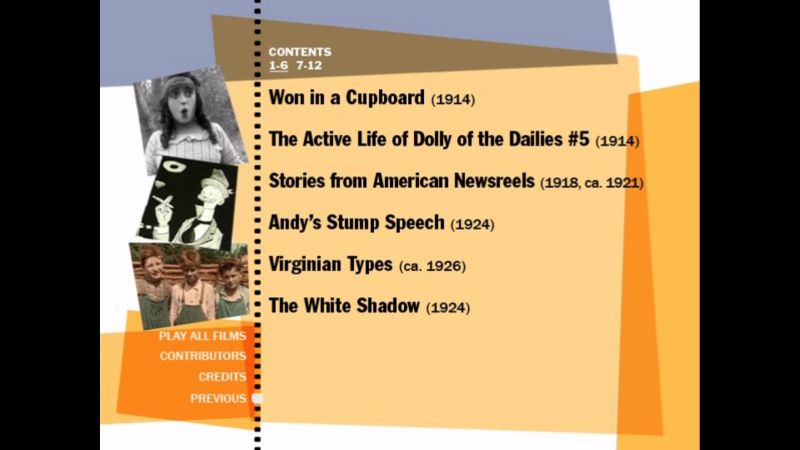
"Won in a Cupboard" is the oldest surviving film directed by Mabel Normand.   In the US, it was titled "Won in a Closet," but "closet" is used differently in the British world.  The plot was a bit hard to follow, but that is not uncommon with early Keystones.  The strangest scene has Mabel and her ideal, Charles Avery, walking towards each other in a split screen, and meeting at a tree in the middle.  The subtitle said "Like a Dream," and it was correct. 

"The Active Life of Dolly of the Dailies #5" was an episode of an Edison series, not yet a serial, starring Mary Fuller as a newspaperwoman.  It was largely set in Chinatown, and mostly featured actual Asians, although there were one or two white men in yellowface.  I was shocked at the end when the newspaper editor told Dolly not to let the kidnap victim's family know she had been recovered until the newspaper broke the story. 

"Stories From American Newsreels" had two sets of stories.  A "Co-Operative Weekly Review" has two World War One stories, about high school girls learning factory jobs and nurses being trained.  A Selznick News has a woman driving an ostrich cart at the famous Pasadena ostrich farm and a man with a radio set installed in his car.  At the end, he drives the car remotely. 

"Andy's Stump Speech" was a two-reeler starring Joe Murphy as Andy Gump.  I remember reading reprints of The Gumps comic strip in books and finding it ugly and unfunny.  I can usually understand old topical humor, but this was beyond me.  The movie was funny.  Poor Joe Murphy looked like Andy Gump. 

"Virginian Types" is a fragment of a longer movie about the Appalachian community of Old Rag, Virginia, in the Shenandoah Valley.  The short was colored using the Pathécolor stencil process. 

The White Shadow is a large part of a British film directed by Graham Cutts.  It is the earliest surviving film on which Alfred Hitchcock worked.  Back in 2012, on my other blog, The Pneumatic Rolling Sphere Carrier Delusion, I took part in a blogathon to raise funds to allow the National Film Preservation Foundation to stream the film on the internet, For the Love of Hitchcock, The Film Preservation Blogathon:
Dial HOllywood 9-2411 for Hitchcock
Hitchcock -- Berdarold, Piccy, London
 Alfred Hitchcock, SRO, RKO, UA, Univ
Hitchcock -- Club: Royal Auto
Hitchcock -- He Has Had a Non-Stop Career
 
On my other blog, The Pneumatic Rolling Sphere Carrier Delusion, I reviewed the fifth Treasures From the American Film Archives, The West:
Disc one: http://cablecarguy.blogspot.com/2012/01/treasures-5-west-1-january-11-2012.html
Disc two: http://cablecarguy.blogspot.com/2012/01/treasures-5-west-2-january-12-2012.html
Disc three: http://cablecarguy.blogspot.com/2012/01/treasures-5-west-3-january-19-2012.html

Monday, January 20, 2014

DVD: Treasures 6: From the New Zealand Film Archive #1 -- January 20, 2014

One of my Christmas presents was the sixth Lost and Found: American Treasures From the New Zealand Film Archive.  This edition was shorter than the others, consisting of a single DVD, but it contains some wonderful items. 


Almost every review of the set that I have read talks about "Lyman H Howe's Famous Ride on a Runaway Train," a single reel released by Educational in 1921.  He had made earlier versions in 1908 and 1914.  Most of the footage in this version was shot before the 1920s.  The print, found in New Zealand, matches with a sound track disk from the Library of Congress.  It starts with an animated title sequence.  A little boy oils a large locomotive.  A title says his dad in an engineer.  There is some nitrate deterioration over the title and a shot of an engineer starting a locomotive.  There are scenes of trains passing through nice scenery.  Then the trains go faster, some in undercranked shots.  The "runaways" include at least three inclines.  One I recognized as Southern California's Mount Lowe.  Another stretch may have been shot on the down track of Mauch Chunk Pennsylvania's Mauch Chunk Switchback Railway. The movie was fun and I need to spend more time trying to identify locations. 

The second movie was a Paul Terry Aesop's Fables, "Happy-Go-Luckies."  A dog and a cat ride on a freight train and arrive at a dog show.  They impersonate a unique dog and win the show.  It was fun. 

The trailer for Strong Boy, a John Ford film, is all that remains. 

Upstream was a John Ford feature set almost entirely in a theatrical boarding house.  I enjoyed the various types from vaudeville and the legitimate theater.  I liked the ending, where the ham villain got his comeuppance. 

"Birth of a Hat" was an industrial film from the Stetson Company.  It began with a short history of hats and then went through the process of making a hat, from the pelt through every step.  It was a very manual process and workplace safety was minimal. 

"The Love Charm" was a Tiffany-Stahl one reeler shot in two color Technicolor.  It was set in the South Seas.  I was surprised to see that Duncan Renaldo had written it.  Ann Christy, who had been Harold Lloyd's leading lady in Speedy, played the daughter of a trader.  On seeing the handsome captain of a yacht, she tells her father "He is white, just like me."  Hoo boy. 

I'll write about the second half tomorrow. 

On my other blog, The Pneumatic Rolling Sphere Carrier Delusion, I reviewed the fifth Treasures From the American Film Archives, The West:
Disc one: http://cablecarguy.blogspot.com/2012/01/treasures-5-west-1-january-11-2012.html
Disc two: http://cablecarguy.blogspot.com/2012/01/treasures-5-west-2-january-12-2012.html
Disc three: http://cablecarguy.blogspot.com/2012/01/treasures-5-west-3-january-19-2012.html