Showing posts with label mechanical television. Show all posts

Saturday, August 9, 2025

Radio Music for Film -- August 9, 2025

Film Daily, 27-August-1925

Radio was a hot topic in 1925. Ufa, the big German film production company, did an experiment with RCA. An audience of 500 at the Briarcliff Lodge, a ritzy hotel in Briarcliff Manor, New York watched Fritz Lang's Siegfried, which was part one of his adaption of Die Nibelungen. During the first half of the film, the article says "there was no orchestra at that showing." During the second half, guests heard a broadcast on RCA,'s station WJY, which carried a score from the Century Theater in New York City. Composer and conductor Hugo Riesenfeld did the arrangement and led the orchestra. It must have been difficult to keep the music in sync with the movie. 

Automobile Blue Book, Volume One, 1919

New York Daily News, 28-August-1925

Springfield Morning Union, 23-August-1925

This article about the broadcast says how the synchronization problem was taken care of: "A trained musician will be stationed with the projection operator who will instruct the operator as to the speed od showing the film in order to coordinate with the music coming in via the air route."

This seems like an expensive way to bring orchestral music to theaters in small towns.


Film Daily, 27-August-1925

Radio Film on Coast

15 Theaters Screen Special Reel and
Hear Voices of Players in Perfect Synchronization

Los Angeles -- Fifteen theaters on Monday night projected a reel specially prepared, and at the same time broadcast through their radio receiving sets a talk by the principals in the picture in perfect synchronization.

A new angle touching on the possibilities of the radio and the motion picture is believed to have been hit upon. While this particular attempt savors strongly of Metro-Goldwyn-Mayer publicilty its import cannot be overlooked. The studio prepared a picture with Norma Shearer and Lew Cody as central figures. It was designed to exploit "A Slave of Fashion" in which both appear. By arrangement with the Examiner, Station KFI and the Freed-Eisemann Radio Corp., the picture was projected simultaneously at nine o'clock in fifteen theaters of the West Coast chain, including the Cameo, Alhamra, Criterion, Strand, Circle, Highland, Rivoli, Rosebud, Alvarado, De Luxe, Apollo at Hollywood and Liberty at Long Beach.

While Miss Shearer and Cody talked at the station, the operator in each of these theaters donned headphones and cranked his machine in unison with the ticking of the metronome, all metronomes being calibrated in harmony with the master mechanism at KFI. The master film was also shown at the broadcasting station in order to give the players their cues when to talk, pause, laugh and inflect the voice. The picture in itself was out and out exploitation. It showed Miss Shearer and Cody leaving their homes for KFI and their arrival. In the last portion, extreme close-ups of them speaking into the microphone were shown, revealing their lip movements for an extreme synchronization test.

The results were proclaimed in no uncertain fashion. The exploitation value is held to be so tremendous by M.-G.-M. that another performance will be staged tonight at Loew's State when the broadcasting will be done in full view of the audience, revealing exactly how it is done.

One important figure here expressed the opinion that the test was sufficient proof to him that radio films were a definite possibility and that one reel dramas with all action spoken might soon become a reality through the air.

Douglas Shearer, brother of Norma worked out the details and conducted the first experiment. The Los Angeles critics praised the effort highly.


Partial Success Here
Static Interferes with "Siegfried" Experiment, But Sponsors Claim
It's Feasible

The broadcasting from the Century, of the Wagnerian musical score for "Siegfried" to Briarcliff Lodge for a special showing of this production on Tuesday night may mark a new development.

This initial experiment is the first step in an attempt to develop a practical method for supplying theaters in small towns with special musical scores played by a high grade orchestra in a big city first-run. Joe Fliesler of Ufa sponsored the idea and he arranged with Major General J. G. Harbord, president of the Radio Corp. of America to broadcast the score through station WJY.

By way of contrast, the first half of the picture was shown without any musical accompaniment to the hundreds of guests at the Lodge. Alongside the screen stood the radio sets ready to tune in for the second half. Exhibitors will be interested to know the steps necessary to bring special orchestra music into their theater to synchronize with their screening of a feature.

The Century screening was showing at a speed of 85, and the music was synchronized to that speed. The Briarcliff operator ran his machine at the same speed. The radio operator tuned in a few minutes before the given time of the screening of the second half. As both pictures were being screened in perfect time together, the synchronizing over the radio became purely automatic. It is held to be easy to take up any variations in the music by increasing the speed of the projector.

In this experiment, results were not conclusive as the wrong broadcasting station was selected, Briarclifif Lodge being badly situated to pick up WJY. Static was present, and made necessary tuning out at frequent intervals. But there were stretches when the orchestration 35 miles a way came through perfectly, and in accurate synchronization.

The Ufa was satisfied with results obtained under these unfavorable conditions. It was said that it represented only the first step in a series of experiments. The opinion was expressed that ultimately it will be possible for example for Famous through the new Paramount theater to broadcast the musical score on all its features to every house in neighboring towns which happens to be playing the current feature.

The whole plan is held to be one of mechanical principles involving nothing but proper team work between a radio station, and the theaters which are to receive the synchronized orchestration. Any problems that may arise are said to be only those that confront any owner of a radio set.

Ordinarily the director of the orchestra synchronizes his music to the film. Here the process is just reversed -- the Film is synchronized to the music. The benefit to the exhibitor apparently is that it gives him the radio to appeal to the radio fans, as well as exceptional music of big city orchestras not ordinarily secured even over the radio.

The reaction of the audience at Briarcliff was very favorable, judging from comments heard after the performance.


Busy on Radio Movies

Writing in the Evening World yesterday, George R. Witte stated that Col. Edward H. R. Green, son of Hetty Green, is experimenting with the sending of motion pictures by wireless. He has conducted a number of expensive experiments but to date has kept the extent of his progress secret.

C. Francis Jenkins, Washington inventor, has likewise been working on the transmission of motion pictures through the air and only recently claimed to have perfected his invention. Even more recent than this is the word from Madison, Wis., of the success along same lines met by Douglas F. W. Coffey, a college student who has wirelessed motion pictures a distance of eight miles.

Meanwhile, in the Los Angeles area, fifteen theaters showed a special one-reeler. Stars Lew Cody and Norma Shearer promoted their film A Slave of Passion. They broadcast their dialogue from radio station KFI and synchronization with the film in the fifteen theaters appeared to work. The projectionist in each theater wore headphones and timed their cranking using a metronome. Norma's brother Douglas was involved in the experiment. He later got a credit as recording supervisor on nearly every M-G-M talkie for twenty years.

The showing of Siegfried at the Briarcliff Lodge did not go smoothly because the radios could not pick up the station without static. 

The item also mentions three experimenters who were working on mechanical television. 

Pasadena Post, 24-August-1925

"Radio-Cinema." That is a new one on me.

Long Beach Press-Telegram, 24-August-1925


Tuesday, April 23, 2024

Says Movies of Future Will Reproduce Sound and Color -- April 23, 2024

Motion Picture News, 26-April-1924

"...Leon Bakst, famous Russian scenic artist, predicts that the motion picture of tomorrow will be in natural colors and reproduce sound by means of radio." 

Motion Picture News, 19-April-1924

The weekly Pathé Review included a section in Pathécolor, which was a stencil process.

Film Daily, 09-April-1924

Film Daily, 16-April-1924

Film Daily, 24-April-1924

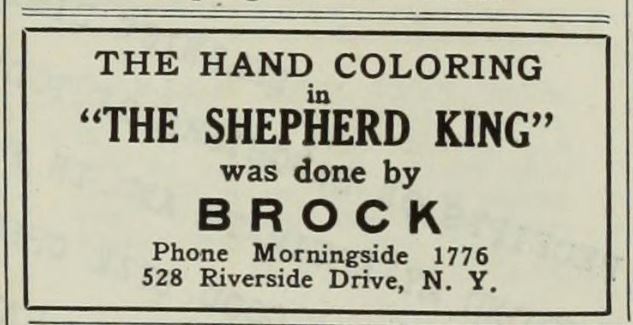
The Brock Company, which I know nothing about, appears to have kept busy applying hand coloring to sequences in feature films. 

Motion Picture News, 26-April-1924

This item is a bit confusing. Where most Phonofilms were single shots showing vaudeville act, De Forest said his new film would be shot with exteriors and a cast of twenty. I can't find a film like that in the Phonofilm filmography. J Searle Dawley (great name) did direct some Phonofilms, and De Forest supplied the soundtrack for a 1925 Fleischer Brothers cartoon called "East Side, West Side." I will have to dig around. 

Motion Picture News, 12-April-1924

"...there has been much widespread comment and query as to whether or not the talking motion picture has a real future, or whether this is only another novelty." 

Film Daily, 24-April-1924

De Forest planned to donate prints of his Phonofilms to the Smithsonian Institution "for the permanent use of that establishment." 

Motion Picture News, 26-April-1924

The reader will notice that WE Waddell is said to be the person who wrote the story for the ambitious Phonofilm "East Side, West Side." 


"Does the Public Want Talking Pictures?
"By W. E. Waddell

"There has been much discussion recently as to whether or not there is a demand for other than pantomime motion pictures. In the opinion of many the silent drama fills every requirement.

"The old-timer is wont to say, 'O, yes, I've seen talking pictures and they are no good — the people don't want them.' He is guessing when he says the people do not want them, for no one in the history of amusements has yet been able to successfully guess what the public wants, and when he refers to talking pictures he has seen in the past he is thinking of various combinations of phonograph and motion picture machines. By this method there has been no illusion, no perfect tone production.

"In addition there are still more vital reasons why this method is doomed to failure. A phonograph record is limited to time of running, and no change of scene can take place. The motion picture of today consists of many quick changes of scene and settings.

"Many of the 'shots' are not over ten feet (ten seconds) in length. Therefore a picture that talks cannot successfully compete with its silent brother if it be limited to a single set.

"What happens when the film breaks with the phonograph-motion picture combination? There is only one answer to that. Burn it up, and get another print, for synchronism has been permanently destroyed.

"But a new talking picture has arrived in the remarkable adaptation of radio to motion pictures, invented by Dr. Lee DeForest, who calls it the Phonofilm. There is no phonograph used in connection with the Phonofilm. The film itself literally talks and reproduces music. The actor performs exactly as he does upon the speaking stage. While the camera lens is catching every movement of his lips a tiny gas-filled tube by its side is faithfully catching every sound he utters.

"By the Phonofilm method pictures may be made with all the latitude of the silent drama except that the director must discard his megaphone.

"Long shots, close-ups, interior and exterior scenes may be made without regard to continuity. Then they are assembled in the usual way, with perfect synchronization.

"What happens when the film breaks? Nothing. Simply patch it together and a fraction of a word with its accompanying action is missing as in a regular motion picture; but synchronization is not disturbed.

"Many stage successes are useless for the reason that their charm lies in clever repartee. Therefore a world of splendid material is available for the talking picture that has been considered useless for the silent drama. In addition, musical comedies, light and grand operas, great orchestra concerts, may be reproduced."

Motion Picture News, 12-April-1924

Meanwhile, inventors on both sides of the Atlantic Ocean were working to develop mechanical television systems. C Francis Jenkins was working in the US. This item mentions that he had developed an early motion picture projector, the Phantoscope. 

Film Daily, 14-April-1924

John Logie Baird was working on his own system in the UK.

Thursday, June 15, 2023

Inventor Can Transmit Movies by Wireless -- June 15, 2023

San Francisco Examiner, 16-June-1923

Many inventors were working on mechanical television, which would allow radio waves to carry pictures. C Francis Jenkins was the leading American developer. 

Inventor Can Transmit Movies by Wireless 

Washington, June 15. -- (By Universal Service.) -- The principle by which moving pictures can be transmitted by radio has been successfully worked out by C. Francis Jenkins, Washington inventor, it was revealed today. 

Demonstrations of the apparatus have been conducted with such a degree of success that experts who witnessed them predicted that in the comparatively near future, California, for instance, will be able to see a parade being held in Washington. 

The latest test was held in the presence of officials from the Bureau of Standards and the Navy and Postoffice Departments. They saw, reproduced upon a screen, the wiggling fingers of Professor Jenkins' hand, which was held before a "radio eye" device considerable distance away. 

While the reproduction was not as clear as it might have been, it was considered remarkable in view of the short time Professor Jenkins has been working on the invention. 

Jenkins recently attracted much attention by transmitting a still picture by radio from Philadelphia to Washington.