Showing posts with label 3-D. Show all posts

Saturday, January 25, 2025

Plastigrams -- Here's the Year's Biggest Novelty -- January 25, 2025

Lethbridge Herald, 26-January-1925

Plastigrams were 3-D movies that used a process invented by Frederic Eugene Ives and Jacob Leventhal. The movies were viewed with red- and blue-lensed glasses.  We have seen the image before.

Brooklyn Chat, 31-January-1925

Several films like So This is Marriage included Technicolor sequences.

Minneapolis Star-Tribune, 07-January-1925

The Johnny Hines comedy The Early Bird was supported by "A Kelley Color Novelty."


Saturday, November 23, 2024

The Phonofilm See and Hears It -- November 23, 2024

Toronto Star, 04-November-1924

Lee De Forest, a pioneer in vacuum tubes and radio, introduced his Phonofilm sound-on-film picture process in 1923. By 1924, his movies were showing in major theaters.

Toronto Star, 04-November-1924

Kingston Whig-Standard, 21-November-1924

Plastigrams were 3-D movies that used a process invented by Frederic Eugene Ives and Jacob Leventhal. The movies were viewed with red- and blue-lensed glasses. Note that Plastigrams were billed above the feature.

Saturday, July 20, 2024

The Third Dimension on the Screen at Last -- July 20, 2024

Anderson Herald, 20-July-1924

Plastigrams were 3-D movies that used a process invented by Frederic Eugene Ives and Jacob Leventhal. The movies were viewed with red- and blue-lensed glasses. Note that Plastigrams were billed above the feature. 

Anderson Herald, 20-July-1924

This article has more details about the contents of the film. "So startling were the effects seen by the spectators that they experienced an entirely new set of thrills when articles seemingly were thrust in their faces from the screen, of when a beautiful girl held a foaming drink out to them, or when taken for a thrilling and dangerous ride in a speeding automobile."

Exhibitors Herald, 05-July-1924

Customers at Seattle's Coliseum enjoyed Plastigrams. 

Exhibitors Herald, 19-July-1924

Lee De Forest, a pioneer in vacuum tubes and radio, introduced his Phonofilm sound-on-film picture process in 1923. By 1924, his movies were showing in major theaters.

Washington Evening Star, 06-July-1924

De Forest talked about making a talking adaption of Trilby, a popular novel. It was just talk. We will see more about Vitagraph's new color process later. 

Washington Evening Star, 07-July-1924

De Forest had even planned his cast. Arthur Edmund Carew would play Svengali and Hope Hampton would play Trilby.


This ad refers to Phonofilms as "De Forest's Marvelous Radio Talking Pictures." 

Exhibitors Herald, 19-July-1924Exhibitors Herald, 19-July-1924

This article carefully does not describe Vitagraph's new color process but says that it will be used for parts of the movie Behold This Woman.

Chicago Tribune, 14-July-1924Exhibitors Herald, 05-July-1924

This fancy ad invites film people to see a demonstration of a new natural color process created by Claude Friese-Greene. Claude Friese-Greene was the son of William Friese-Greene, who claimed that he had invented motion pictures in the 1880s. William went on to try to develop a natural color motion picture process and Claude carried on his father's work.

Exhibitors Herald, 05-July-1924

Exhibitors Herald, 12-July-1924

In lieu of successful and affordable natural color processes, many films were printed on tinted stock, or shots were tinted after printing. 

Thursday, July 11, 2024

Taka-Chance Week -- Second Chapter -- July 11, 2024

Wichita Eagle, 11-July-1924

I thought it was interesting that Stanley N Chambers, manager of the Miller Theater in Wichita, came up with the concept of Taka-Chance Week. "...every feature of our program will be a surprise..." Titles would not be announced ahead of time.

"Plastergrams" must be a misspelling of "Plastigrams," an early 3-D system. 

Wichita Eagle, 11-July-1924


Monday, March 25, 2024

At Last! The Third-Dimension Movie -- March 25, 2024

Motion Picture News, 15-March-1924

Plastigrams were 3-D movies that used a process invented by Frederic Eugene Ives and Jacob Leventhal. The movies were viewed with red- and blue-lensed glasses. 

Motion Picture News, 15-March-1924

Film Daily, 26-March-1924

Claude Friese-Greene was the son of William Friese-Greene, who claimed that he had invented motion pictures in the 1880s. William went on to try to develop color motion pictures and Claude carried on his father's work. 

Film Daily, 25-March-1924

Prizma, Inc, creators of Prizma Color, declared bankruptcy in 1924. This was despite many filmmakers having added a reel of color to their feature films. 

Film Daily, 21-March-1924

A receiver's sale disposed of the company's assets.

Motion Picture News, 08-March-1924

Inventor Lee De Forest formed a company to produce talking films using his Phonofilm sound-on-film process. 


Thursday, September 21, 2023

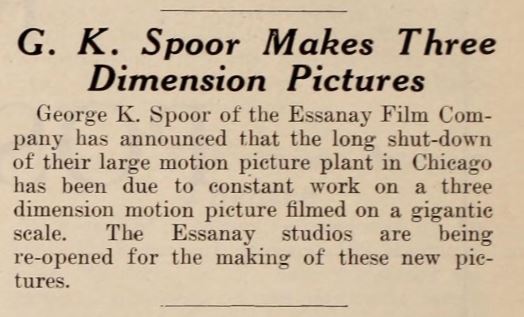
GK Spoor Makes Three Dimension Pictures -- September 21, 2023

Motion Picture News, 22-September-1923

George K Spoor who had founded the Essanay Company with Broncho Billy Anderson, announced that he was reopening the company's Chicago studio to produce "a three dimension motion picture on a gigantic scale. I wonder if "gigantic scale" referred to the 65mm Natural Vision process. 

Motion Picture News, 22-September-1923

The Lee-Bradford Corporation announced it would distribute a series of color cartoons made by Frank Nankivell. I do not know what color process he used. The films were called the Red Head Comedies. 


Wednesday, April 12, 2023

Ann Miller 100 -- April 12, 2023

listal.com

Dancer and actress Ann Miller was born 100 years ago today, on 12-April-1923. I remember her in Stan Freberg's Great American Soup commercial. She wore her hair like a friend of my mom's whom I didn't like. Later I saw her in movies and learned that she had been a wonderful dancer. We saw Kiss Me Kate in 3-D at the Four Star Theater and I was stunned by "It's Too Darned Hot." 

Ann Miller Great American Soup 1970 on Yahoo! Video

listal.com

listal.com


Friday, January 20, 2023

Three Dimension Motion Pictures Produced by Means of the Teleview -- January 20, 2023

Motion Picture News, 18-November-1922

Way back when in October, before I took a break, I said I would post some more information about Harry K Fairall's 3-D movie system, which was the first successful system to show 3-D or stereoscopic movies. His only film, "The Power of Love," is probably lost. This article shows his viewing system, the Teleview. Two synchronized projectors alternated showing frames from each side. The Teleview was attached to viewers' seat. It included a rotating disc synchronized to the projectors, which showed each eye the alternating frames. The system was not all that successful, although the guy in the image looks happy.

Motion Picture News, 04-November-1922

While we are on the subject of technology, The Color Cinema Company announced that it would produce short comedies in color. The first would be called "Making Hubby Like It." I can't find anything about the company or a movie by that title.

Saturday, October 29, 2022

Stereoscopic Pictures Said to Have Been Attained -- October 29, 2022

Motion Picture News, 28-October-1922

Harry K Fairall developed the first successful system to show 3-D or stereoscopic movies. His only film, "The Power of Love," is probably lost. Next month we will see a photo of his viewing mechanism.


American inventor Charles Francis Jenkins demonstrated and patented a successful electro-mechanical television system in October 1922. He did much of his work in parallel with Scottish inventor John Logie Baird.