Showing posts with label Joseph Schenck. Show all posts

Monday, May 26, 2025

Buster Keaton -- Our Hospitality -- Family Feud -- May 26, 2025

Washington Evening Star, 25-November-1923

This post is part of the Eleventh Annual Buster Keaton Blogathon, hosted by Lea at Silent-ology. A blogathon that has lived for eleven years is a rare and wonderful creature.
For the eleventh annual blogathon, I have written about a feature that was a big step forward for Keaton in the art of storytelling, Our Hospitality.

Be sure to click on most images to see larger versions.

I first became interested in Buster Keaton when I watched The General with my grandfather and he told me how much he had always liked Buster Keaton.

When I discovered that the Anza Branch Library had a shelf of books about movies, I found two books about Buster Keaton, Buster's memoir My Wonderful World of Slapstick and Rudi Blesh's Keaton. I read both and I enjoyed learning about his career in vaudeville and his career in the movies.

Buster made a series of nineteen two-reel comedies in 1920-1922. No one ever asks me, but I tell people that this series of comedies and Charlie Chaplin's series for Mutual are the two best series of silent comedy shorts ever made.

After the short comedies were done, Buster spent the next several years producing a wonderful collection of feature-length comedies.
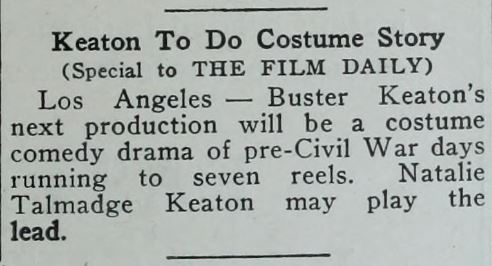
Film Daily, 07-July-1923

While Three Ages was an anthology of three stories set in different eras and places, Buster's next film would "be a costume comedy drama of pre-Civil War days." Buster's wife, Natalie Talmadge, would be his co-star. It was not mentioned here, but Buster would co-direct with John G (Jack) Blystone. Buster's brother-in-law Joe Schenck produced.

Film Daily, 22-September-1923

The movie, to be called Hospitality, needed a set representing Broadway and Forty-second Street in Manhattan in 1830. Buster's technical director, Fred Gabouri put it together.

Motion Picture News, 17-November-1923

The title of the movie was changed to Our Hospitality. Based on the strong demand for Three Ages, the distributor Metro decided to make "double the usual number of prints."


The film's action is driven by a bloody feud between the Canfield and McKay families. This was inspired by the long and violent Hatfield–McCoy feud. The McCoys lived on the Kentucky side of the Big Sandy River, which is a tributary of the Ohio River. The Hatfields lived on the West Virginia side. Both states remained in the Union during the US Civil War (Kentucky is sometimes called the only state to secede after the Civil War), but both families mostly "took a rebel stand," as the Band said in "The Night They Drove Old Dixie Down."

loc.gov

The Hatfield family poses for a photo in 1897. Family patriarch Devil Anse is the second person in the middle row, with a long scraggly beard and a rifle. Photos of the McCoy family, which was not as well off, are hard to come by.

One man who stayed loyal to the Union was Asa Harmon McCoy. When he returned from the war, a group of Confederate partisans, which included members of the Hatfield family, murdered him in cold blood. This cowardly attack is sometimes regarded as the beginning of the feud.

Things were quiet until 1878, when a McCoy accused a Hatfield of purloining a hog. Justice of the Peace (!) "Preacher Anse" Hatfield, based on the testimony of Bill Staton, who was related to both families, found in favor of the Hatfields. Two McCoys shot and killed Bill Staton but were found innocent because of self-defense.

After dozens of members of each family were killed, the feud slowed down after 1891. Trials of members of both families continued until 1901.

The feud became famous in American folklore. The families came to reconcile during the 20th Century. Members of both families appeared on the gameshow Family Feud -- which seems to be appropriate -- for a week in 1979. The McCoys won the series and received prizes including a pig. Many tourists visit the area where the feud took place.

There have been many movies and television shows, some serious and some funny, some factual and some barely related to the real story, about the feud or inspired by it.

listal.com

listal.com

listal.com

listal.com

listal.com

listal.com

listal.com

listal.com


Our Hospitality begins with a serious scene set in 1810. During a stormy night, illuminated by flashes of lightning, the leaders of the Canfield and McKay families shoot and kill each other. This was another step in a long feud. McKay's wife, worried that the feud would consume the life of her infant son, Willie, who is the last of the McKays, flees to Manhattan to live with her sister. Willie is played by Natalie and Buster's son Joseph Keaton, who is billed as Buster Keaton Jr. When the mother dies, the aunt raises Willie and never tells him about the feud.


In 1830, Willie, now played by Buster Keaton, is a not-very-bright young man about town. He takes a ride on a wooden bicycle, called a velocipede. Willie receives a letter from an attorney telling him that he is the heir to his father's estate. Willie imagines a huge mansion. Willie's aunt tells him about the feud, but he insists on going south to claim his inheritance.


Willie catches a train headed south. Speaking as a railfan, I will just mention that this would not have been possible in 1830, since Manhattan is an island and most railroads were not that long. The train is pulled by a locomotive, modeled on George Stephenson's Rocket of 1829. Buster's dad, Joe Keaton, plays the engineer who drives the train. The passenger cars resemble stagecoaches. Willie's faithful dog runs along behind the train, having no trouble keeping up, 


At the last moment, another passenger boards the car where Willie is seated. She is Virginia Canfield, played by Buster's wife Natalie Talmadge. They are attracted to each other, but they are shy about it.


The ride is comically bumpy. The ceiling is too low for Willie to put on his tall hat. Willie hits his head repeatedly because of the undulating track, so he ducks under his hat to put it on. A big bump pushes his hat down over his eyes.


Willie replaces his tall hat with Buster's traditional pork pie. This always gets a good laugh in the theater.

I won't go through the rest of the movie in detail, but when Willie gets to the town, he looks for the family estate. He asks a man for directions, who turns out to be one of Virginia's large brothers. He wants to kill Willie but isn't armed. When he borrows a pistol after several attempts, he can't find Willie.

Willie meets Virginia, who invites him to dinner. Virginia's father and brothers hunt for Willie. Willie arrives at the Canfield house. Virginia's father and large brothers realize that they can't murder a guest in their house, so they have to wait till he leaves. Willie figures out that they want to kill him and works hard to stay in the house. When Willie escapes, he passes through some rugged scenery, shot near Lake Tahoe, and winds up in the river. Trying to rescue him, Virginia falls in the river, headed towards a waterfall. Willie rescues her. Willie and Virginia get away from the hunters and get married. Her family has to accept that the feud is over.

Casper Daily Tribune, 01-July-1924

"The Greatest Comedy Ever Filmed." Many people must have felt that way. The film was a great success.
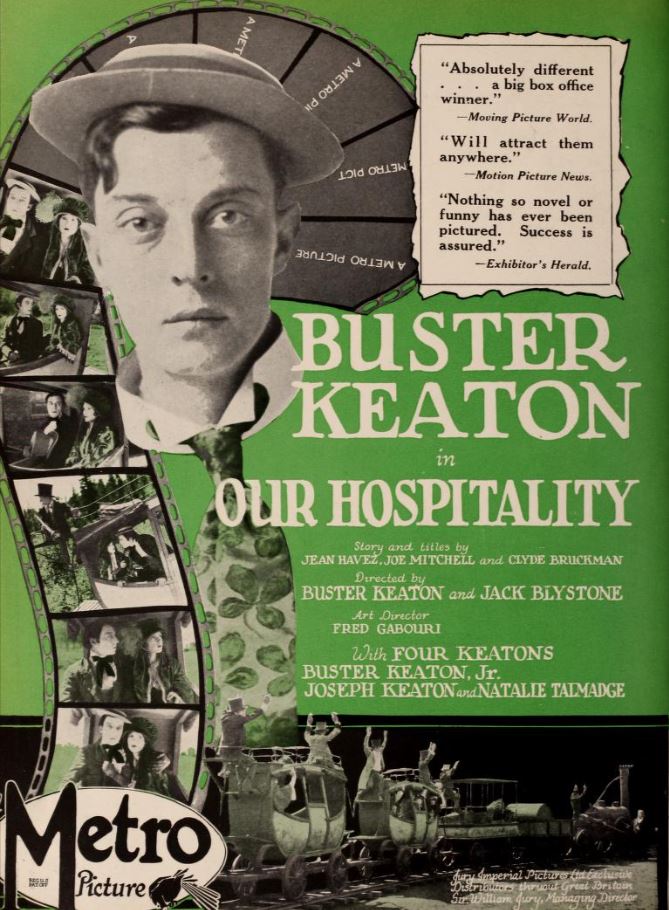
Motion Picture News, 19-January-1924

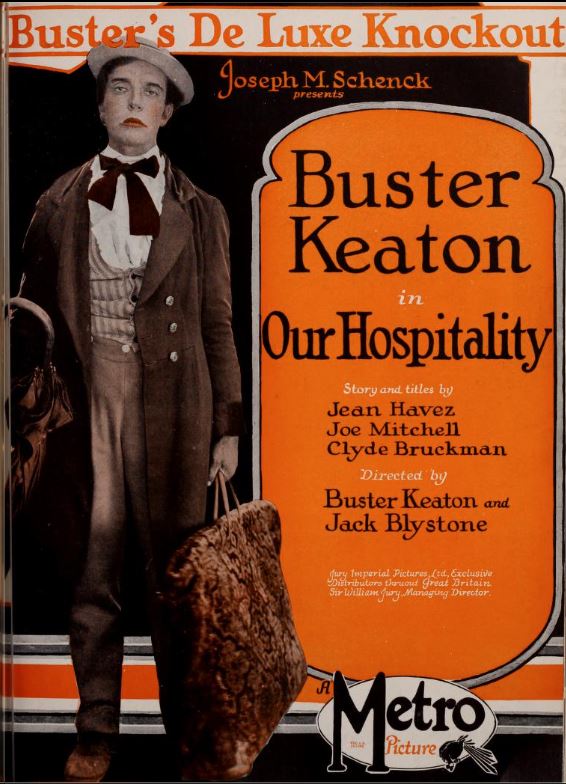
Trade ads with color were not cheap.


Motion Picture News, 15-December-1923

Four page trade ads with color were even more expensive. They did a terrible job coloring Buster's face on the first page.
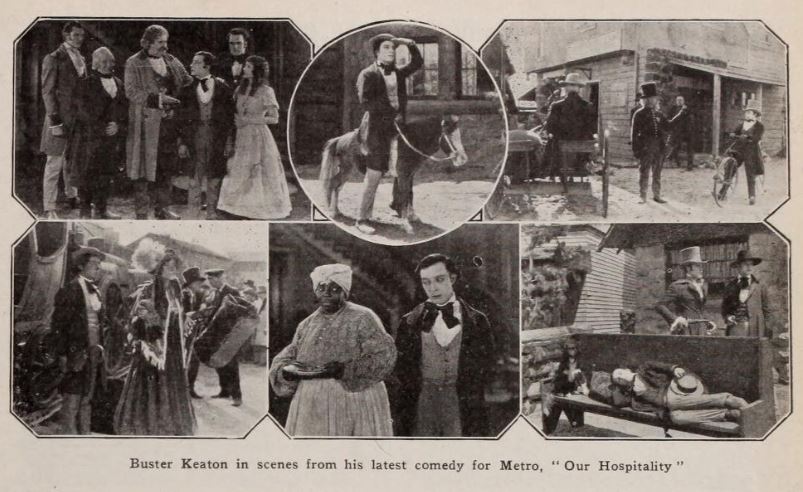
Motion Picture News, 01-December-1923

If you haven't seen Our Hospitality, see it.

themoviedb.org

I was interested to learn that several Indian movies, including the Bengali language Faande Poriya Boga Kaande Re (2011), directed by Soumik Chattopadhyay, have been adapted from Our Hospitality.

This post is part of the Eleventh Annual Buster Keaton Blogathon, hosted by Lea at Silent-ology. It is amazingly impressive to me to see a blogathon go on for eleven years. Thank you to Lea for all the hard work. Thank you to everyone who visited, and I encourage you to please read and comment on as many posts as you can. Bloggers love comments.


Monday, February 18, 2019

Comique: Roscoe, Buster, Al and Luke -- February 18, 2019

Motion Picture Studio Directory and Trade Annual, 1918
This post is part of the Fifth Annual Buster Keaton Blogathon, hosted by Lea at Silent-ology. For the first annual blogathon, I wrote about Buster Keaton's time in vaudeville: The 3-4-5 Keatons. For the second annual blogathon, I wrote about Buster Keaton and the Passing Show of 1917, the show he signed for after leaving vaudeville. For the third annual blogathon, I wrote about Buster's transition from vaudeville to the movies, Buster Keaton: From Stage to Screen.   For the fourth annual blogathon, I wrote about Buster Keaton's time in the US Army: Buster Keaton Goes to War.

This time I chose to write about the Comique Film Corporation, the production company that gave Buster Keaton his first chance to work in motion pictures.

Be sure to click on most images to see larger versions.

I first became interested in Buster Keaton when I watched The General with my grandfather and he told me how much he had always liked Buster Keaton.

When I discovered that the Anza Branch Library had a shelf of books about movies, I found two books about Buster Keaton, Buster's memoir My Wonderful World of Slapstick and Rudi Blesh's Keaton. I read both and I enjoyed learning about his career in vaudeville and his career in the movies.

Buster had been part of the family's rough-house acrobatic comedy act since he was a young child.

Roscoe Arbuckle, who did not like to be called "Fatty," was a skilled comedian who started his movie career with Selig and Universal before he came to Keystone in 1913. While there, he made many movies with Mabel Normand. They were a good team. He also helped Charlie Chaplin learn the ropes of working in movies. Like many of Mack Sennett's stars, Arbuckle left to get a raise.

Motography, 07-October-1916
"The name of Mr. Arbuckle's concern will be the Comique Film Corporation and J. M. Schenck of the Loew enterprises be associated with him."  I find this interesting: "Mr. Arbuckle has a rather new idea in the starting of a company in that he is not going to have any stock company of players.  His entire force is going to consist of three people, himself, Al St. John and a girl -- and he didn't tell who the girl was, perhaps he doesn't know himself.  The rest of the players will be picked up as needed and dropped again after they have served their purpose."

New Movie Magazine, March, 1932
Joe Schenck was born in Russia.  He came to the US in 1892.  Joe and his brother Nick went into the amusement business, eventually owning the famous Palisades Park in New Jersey.  Joe and Nick became partners with Marcus Loew in operating movie theaters.

www.listal.com
In 1916, Joe married Norma Talmadge, who was becoming a big star at Vitagraph and Triangle.  In 1917, Joe became her producer and head of the Norma Talmadge Film Corporation.  They soon formed the Constance Talmadge Film Corporation to make movies with Norma's sister.

Exhibitor's Herald, 10-May-1924
Schenck's studio manager was Lou Anger, who had been a "Dutch" comic in vaudeville.  Dutch comics  used heavy German accents.  Anger persuaded Roscoe Arbuckle to sign a contract with a new production company named Comique.  Comique would share a studio with the two Talmadge companies.  Roscoe's nephew, Al St John, came along.

Motion Picture News, 07-April-1917
The Comique productions would be released through Paramount.  Anticipating big demand, this ad says "All any exhibitor has to do to get my comedies is to pay for them, whether he is now doing business with the Paramount Exchange or not."

Moving Picture World, 25-January-1919
Roscoe's dog Luke had worked with him at Keystone and then appeared in many of the Comiques.

Buster Keaton left his family's vaudeville act in January, 1917.  In February, Buster was in New York. He visited agent Max Hart and told him he was trying to find work as a single act. Hart was enthusiastic; he took Buster to see JJ Shubert, who offered Keaton a part in a big Broadway revue, The Passing Show of 1917, at $250 a week. Buster started to try to figure out how to do a single act.

from Buster's My Wonderful World of Slapstick: "But just a day or two before rehearsals were to start, I ran into Lou Anger, a Dutch comedian who had worked on vaudeville bills with us many times. Anger was with Roscoe (Fatty) Arbuckle, the screen comedian..."

Motography, 21-April-1917
Lou Anger took Buster to the busy studio, where they found Roscoe Arbuckle directing his first Comique production, "The Butcher Boy," set in a general store.  Roscoe gave Buster a role.  He would enter the store, where Roscoe and Al were throwing bags of flour at each other.  Roscoe threw one, Al ducked and Buster got hit in the face.  Roscoe's dog Luke also had a part. Roscoe directed "The Butcher Boy" and all of the other Comiques.

Motion Picture News, 26-My-1917
Buster Keaton did not appear in the second Comique production, "A Reckless Romeo."

Motion Picture News, 12-May-1917
George N Shorey's review of "A Reckless Romeo" is not positive.

Moving Picture World, 07-July-1917

While Buster Keaton did not appear in "A Reckless Romeo," he made up for it by appearing in two different roles in the third Comique film, "The Rough House."  This ad has a nice picture of Roscoe peeling spuds.

Moving Picture World, 14-July-1917
I think Roscoe is supposed to look like an auctioneer with a gavel in this ad.

Motion Picture News, 18-August-1917

"His Wedding Night" was the fourth Comique production.  I like the image of Roscoe, Alice Mann and Al.  Buster played a delivery boy.  .

Motion Picture News, 04-August-1917
Buster appears in drag.  Note that "Buster" is in quotes.

Motion Picture News, 29-September-1917
Moving Picture World, 06-October-1917
The next Comique production was "Oh! Doctor," which is sometimes listed as "Oh Doctor!". Roscoe poses with Alice Mann, who was playing a vamp.

Moving Picture World, 29-September-1917
Roscoe plays a doctor, and Buster plays his son.

Moving Picture World, 13-October-1917
Roscoe is trapped in the coils of the vamp's dress.

Moving Picture World, 13-October-1917
Once Roscoe finished his next movie, set at Coney Island, Comique was going to move to California.

Moving Picture World, 03-November-1917
In this ad for "Fatty at Coney Island," Roscoe poses in drag with Al St John. Roscoe's dog Luke makes a cameo appearance.

Moving Picture World, 20-October-1917
Buster appears in this illustration.  This movie is famous as one where Buster laughs.

Moving Picture World, 10-November-1917
Moving Picture World, 24-November-1917
Comique had moved to California and Roscoe had created an elaborate town set for his next movie. The use of the word "Jazz" in the name of the town is fairly early.

Moving Picture World, 08-December-1917

"A Country Hero," the first Comique production on the West Coast, is thought to be Buster Keaton's only lost film.

Moving Picture World, 08-December-1917
"Clean and Extremely Entertaining."

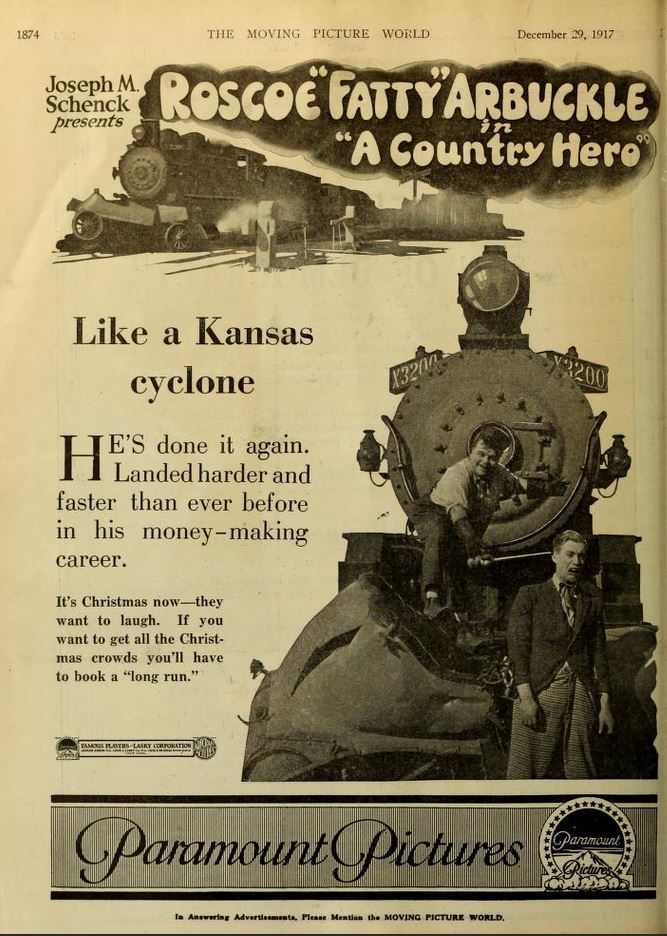
Moving Picture World, 29-December-1917
Roscoe and Al appear with a locomotive which has mashed an automobile.

Exhibitors Herald, 28-September-1918
The most famous American propaganda movie of World War One is "The Bond," a one-reeler produced and paid for by Charlie Chaplin. It was intended to encourage people to buy Liberty Bonds to support the war effort. I did not know until recently that it was one of a large group of such films starring many Hollywood luminaries including Sessue Hayakawa, Mary Pickford and Roscoe Arbuckle.

Moving Picture World, 05-October-1918
Roscoe's film was "A Scrap of Paper."  According to the IMDB  (https://www.imdb.com/title/tt0463180/?ref_=nm_flmg_act_29), Roscoe confronts the Kaiser and the Crown Prince, played by Al St John, and tells them that scraps of paper (Liberty Bonds) will defeat Germany.  Buster Keaton did not appear in this movie.

Moving Picture World, 16-February-1918
Buster Keaton had a significant role in "Out West," an ambitious and funny western.

Moving Picture World, 12-January-1918
Scenes were shot in the desert and in a wild canyon near Long Beach.

Moving Picture World, 02-February-1918
"'Fatty,' stranded in a desert, subdues the bad men in 'Mad Dog Gulch' and with the help of a pretty girl reforms them all." Alice Lake was the Salvation Army girl.

Motion Picture World, 30-March-1918
"The Bell Boy" is one of my favorite Roscoe Arbuckle/Al St John/Buster Keaton movies. I wrote about half the movie for a blogathon in 2015. Some day I shall have to write about the other half:
Roscoe Arbuckle and Buster Keaton in "The Bell Boy"
http://bigvriotsquad.blogspot.com/2015/10/roscoe-arbuckle-and-buster-keaton-in.html

Motion Picture World, 30-March-1918
I particularly like the horse-drawn streetcar.

Moving Picture World, 13-April-1918
Buster Keaton was given a draft status of 1-A, meaning he was eligible to be drafted. "When Buster goes the screen will lose one its newer favorites; one who has more than made good from the first jump -- and he's more than a powerful jumper."

Hickory NC Daily Record, 20-August-1920
I couldn't find a trade ad for the next Comique production, "Moonshine."  Roscoe and Buster played Internal Revenue agents.  Al St John was a moonshiner.

Moving Picture World, 04-May-1918
Roscoe and his company were stuck in the mountains while making "Moonshine."

Alaska Daily Empire, 26-February-1919
"Good Night Nurse," the next Comique production, was billed above the feature Rimrock Jones which starred Wallace Reid.

Moving Picture World, 20-July-1918
Roscoe's wife commits him to a sanitorium (think rehab) to cure his drinking problem.  Buster Keaton was a doctor and Al St John was his assistant.

Moving Picture World, 20-July-1918
Roscoe gets away by dressing in drag.  Notice that Buster Keaton is smiling.

Paramount Comedy Releases Press Books (Sep 1918-Sep 1919)
Gordon Ramsey might not approve of Roscoe's kitchen in "The Cook."  Buster Keaton is his assistant and Alice Lake is the waitress.  Al St John tries to rob the place.  Roscoe's dog Luke plays a part.

Moving Picture World, 17-August-1918
One of the highlights of "The Cook" is Buster's Egyptian dance.

Moving Picture World, 07-December-1918
The Rialto Theater in Butte, Montana ran this ad for a double bill of Zane Grey's Riders of the Purple Sage and Roscoe Arbuckle's "The Cook."

Moving Picture World, 10-August-1918
Lou Anger announced a move to the Diando studios in Glendale "For the production of at least one picture at the plant."

Moving Picture World, 31-August-1918
"The Cook" was Buster's last Comique appearance for \a while as he left to do his duty to his country.
Paramount Comedy Releases Press Books (Sep 1918-Sep 1919)
"The Sheriff" does have Al St John or Buster Keaton.  Roscoe's leading lady is Betty Compson.  Roscoe's dog Luke appears.

Moving Picture World, 19-October-1918
Roscoe gets his law enforcement ideas from the movies of Douglas Fairbanks and William S Hart.

Paramount Comedy Releases Press Books (Sep 1918-Sep 1919)

"Camping Out" featured Roscoe and Al, but not Buster and Luke.

Moving Picture World, 28-December-1918
"Camping Out" was filmed on Catalina Island.

Moving Picture World, 11-January-1919
"The Village Chestnut" was a Mack Sennett production starring Louise Fazenda.

The Maui News, 30-May-1919
I haven't found much about "The Pullman Porter," which featured Roscoe and Al.

Paramount Comedy Releases Press Books (Sep 1918-Sep 1919)
In "Love," Roscoe and Al fight for the hand of Winifred Westover.  Buster was still in the Army and Luke did not appear.  This is the only non-Keaton Comique that I have seen.

Moving Picture World, 04-January-1919
Roscoe Arbuckle's new studio on Alessandro Street.

Paramount Comedy Releases Press Books (Sep 1918-Sep 1919)
I haven't found much about "The Bank Clerk."

Paramount Comedy Releases Press Books (Sep 1918-Sep 1919)
In "A Desert Hero," Roscoe became the sheriff of a town where the sheriffs had a life expectancy measured in minutes.

Moving Picture World, 30-August-1919
Buster was back in "Back Stage," one of the funniest Comique productions.

Moving Picture World, 12-July-1919
"Buster Keaton is back in the cast, with Al St. John, Mollie Malone and others to add to the hilarity."

Moving Picture World, 29-November-1919
"The Hayseed" featured Roscoe, Buster and Luke, but not Al.

Film Daily, 16-November-1919
Roscoe poses with Luke.

Moving Picture World, 17-January-1920
"The Garage" was the last movie featuring Roscoe, Buster and Luke.  Al St John did not appear.  It is one of the funniest Comiques.

Moving Picture World, 10-January-1920
"Things get underway with a high-speed action..."  The movie is very well paced.

Moving Picture World, 24-January-1920
"'The Garage' is the last comedy 'Fatty' made before his sojourn in more serious photodrama."  The higher-ups at Paramount had decided that Roscoe should star in feature films.  Joe Schenck handed the Comique company to Buster Keaton.  Roscoe made successful feature films until his scandal broke.  Buster Keaton made one of the two greatest series of short silent comedies.  The other was Chaplin's Mutual series.  Buster and Roscoe would work together a few more times.  Al St John was starring in short comedies for various producers and went on to become a beloved sidekick in hundreds of B Westerns.  Luke died in 1926.

If you want to see any of the Arbuckle-Keaton movies that are known to survive, I strongly recommend Kino's Arbuckle and Keaton Volume One and Volume Two. They have a nice score by the Alloy Orchestra. Get both volumes if you can.

This post is part of the Fifth Annual Buster Keaton Blogathon, hosted by Lea at Silent-ology. Thank you to Lea for all the hard work. Thank you to everyone who visited and I encourage you to read and comment on as many posts as you can. Bloggers love comments.