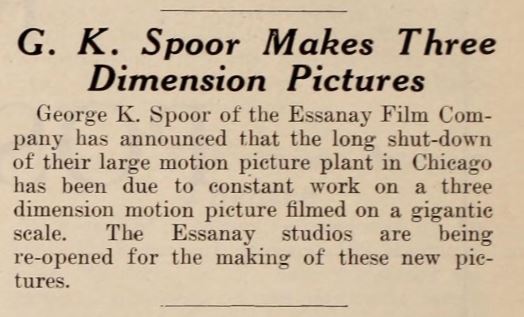
|
| Motion Picture News, 26-April-1924 |
"...Leon Bakst, famous Russian scenic artist, predicts that the motion picture of tomorrow will be in natural colors and reproduce sound by means of radio."
 |
| Motion Picture News, 19-April-1924 |
The weekly Pathé Review included a section in Pathécolor, which was a stencil process.
 |
| Film Daily, 09-April-1924 |
 |
| Film Daily, 16-April-1924 |
 |
| Film Daily, 24-April-1924 |
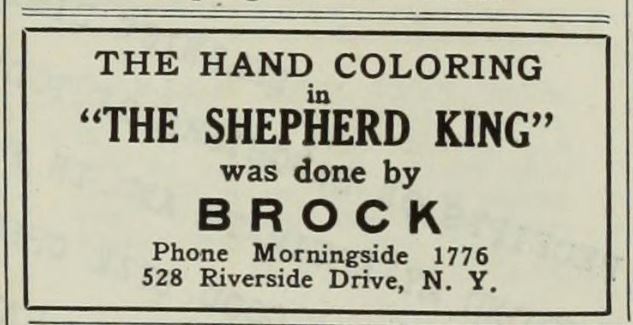
The Brock Company, which I know nothing about, appears to have kept busy applying hand coloring to sequences in feature films.
 |
| Motion Picture News, 26-April-1924 |
This item is a bit confusing. Where most Phonofilms were single shots showing vaudeville act, De Forest said his new film would be shot with exteriors and a cast of twenty. I can't find a film like that in the Phonofilm filmography. J Searle Dawley (great name) did direct some Phonofilms, and De Forest supplied the soundtrack for a 1925 Fleischer Brothers cartoon called "East Side, West Side." I will have to dig around.
 |
| Motion Picture News, 12-April-1924 |
"...there has been much widespread comment and query as to whether or not the talking motion picture has a real future, or whether this is only another novelty."
 |
| Film Daily, 24-April-1924 |
De Forest planned to donate prints of his Phonofilms to the Smithsonian Institution "for the permanent use of that establishment."
 |
| Motion Picture News, 26-April-1924 |
The reader will notice that WE Waddell is said to be the person who wrote the story for the ambitious Phonofilm "East Side, West Side."
"Does the Public Want Talking Pictures?
"By W. E. Waddell
"There has been much discussion recently as to whether or not there is a demand for other than pantomime motion pictures. In the opinion of many the silent drama fills every requirement.
"The old-timer is wont to say, 'O, yes, I've seen talking pictures and they are no good — the people don't want them.' He is guessing when he says the people do not want them, for no one in the history of amusements has yet been able to successfully guess what the public wants, and when he refers to talking pictures he has seen in the past he is thinking of various combinations of phonograph and motion picture machines. By this method there has been no illusion, no perfect tone production.
"In addition there are still more vital reasons why this method is doomed to failure. A phonograph record is limited to time of running, and no change of scene can take place. The motion picture of today consists of many quick changes of scene and settings.
"Many of the 'shots' are not over ten feet (ten seconds) in length. Therefore a picture that talks cannot successfully compete with its silent brother if it be limited to a single set.
"What happens when the film breaks with the phonograph-motion picture combination? There is only one answer to that. Burn it up, and get another print, for synchronism has been permanently destroyed.
"But a new talking picture has arrived in the remarkable adaptation of radio to motion pictures, invented by Dr. Lee DeForest, who calls it the Phonofilm. There is no phonograph used in connection with the Phonofilm.
The film itself literally talks and reproduces music. The actor performs exactly as he does upon the speaking stage. While the camera lens is catching every movement of his lips a tiny gas-filled tube by its side is faithfully catching every sound he utters.
"By the Phonofilm method pictures may be made with all the latitude of the silent drama except that the director must discard his megaphone.
"Long shots, close-ups, interior and exterior scenes may be made without regard to continuity. Then they are assembled in the usual way, with perfect synchronization.
"What happens when the film breaks? Nothing. Simply patch it together and a fraction of a word with its accompanying action is missing as in a regular motion picture; but synchronization is not disturbed.
"Many stage successes are useless for the reason that their charm lies in clever repartee. Therefore a world of splendid material is available for the talking picture that has been considered useless for the silent drama. In addition, musical comedies, light and grand operas, great orchestra concerts, may be reproduced."
 |
| Motion Picture News, 12-April-1924 |
Meanwhile, inventors on both sides of the Atlantic Ocean were working to develop mechanical television systems. C Francis Jenkins was working in the US. This item mentions that he had developed an early motion picture projector, the Phantoscope.
 |
| Film Daily, 14-April-1924 |
John Logie Baird was working on his own system in the UK.