 |
| futurism.com |
Showing posts with label zoetrope. Show all posts
Showing posts with label zoetrope. Show all posts
Monday, April 29, 2019
3-D Printed Zoetrope -- April 29, 2019

Friday, March 30, 2018
Zoetrope -- March 30, 2018
 |
| Scientific American, 03-April-1869 |
from The Dictionary of Photography for Amateur and Professional Photographers By Edward John Wall, 1902.
Zoetrope. The application of photography to the Zoetrope —or wheel of life—is no new thing, as over twenty years ago Mr. Baden Pritchard made a series of photographs of a steam-engine, moving it forward a little between the taking of each picture; and when the series was viewed in the zoetrope, there was produced a most realistic appearance of the steam engine in motion. We must, however, go back much farther than this for the first idea of the lantern or projection zoetrope, something of the kind having been patented by Jundzill in 1856; but we believe the first exhibition of animated photographs on the screen in London was in 1882, when Muybridge exhibited the horse in motion at the Royal Institution. About the beginning of 1896 exhibitions of animated photographs on the screen became suddenly popular, and almost every maker of apparatus for this purpose gave a new and strange name to his particular form of the lantern or projection zoetrope. In the modern forms the series of negatives is taken on a long band of celluloid at the rate of about 900 per minute. A band of positives is printed from this by rolling the negative band and a band of coated celluloid together so that they shall run in contact in front of a source of light; and the exhibition is effected by means of a lantern, which automatically unrolls the positive band, and projects each photograph in succession upon the screen. For further information on this subject, see CINEMATOGRAPH.
Tuesday, January 30, 2018
Recent Scientific Discoveries -- January 30, 2018
 |
| San Francisco Call, 08-May-1900 |
RECENT SCIENTIFIC DISCOVERIES.
Copyright, 1900, by Seymour Eaton.
Note— These papers on Practical Science have been prepared for The Call's Home Study Circle by Professor William J. Hopkins of Drexel Institute.
VI. MOVING PICTURES.
If we look at one of the conventional pictures of a running horse— a picture twenty years old, preferably— and compare it with some of the more recent pictures of the same subject we may see a marked difference. In the older picture the horse is stretched out in an attitude which, to the eye not specially trained, suggests speed. In the more recent one he may perhaps be seen standing like an awkward statue on one leg, with no visible means of support for the rest of him. And yet this is. in a sense, true to life, for it represents accurately the position of the horse at one instant. Except to the technically trained eye it conveys no impression of rapid motion, for the eye does not see things that way.
Persistence of Vision.
The response of the optic nerve and its connections to any action which produces the sensation of light Is not instantaneous nor does the sensation cease at once with the cessation of the cause. It persists for an appreciable time, varying from about one-thirtieth to one-tenth of a second, according to the intensity of the light. In the case of the running horse, therefore, the rapidly changing positions blend into an impression which is pretty well represented by the kind of picture that was customary before the days of instantaneous photography.
Muybridge's Pictures.
It would never have occurred to any one before Muybridge had come to this country and had shown his instantaneous pictures of moving horses that any horse ever assumed such attitudes. Even with the evidence before their eyes the first sensation of the majority his hearers was one of amusement and incredulity. His photographs were obtained by using a series of cameras so placed that the horse came before each one in succession and caused the exposure to be made at the right instant by the breaking of a thread. With the cameras at the right intervals there was thus obtained a series of pictures which showed successive instantaneous attitudes of the horse, with brief breaks between. If these pictures could be presented before the eye, one at a time, in order and rapidly enough, the impression of one would persist until the next appeared and the horse would be seen running, trotting or cantering naturally. Such an instrument, very crude and simple, existed at that time and had been in use for many years as a scientific toy. It was the zoetrope, the forerunner of the kinetoscope and all its kin.
The Zoetrope.
The zoetrope consists of an open cylinder, usually of cardboard, so mounted that it can be whirled on a vertical axis. In the upper half of this cylinder are cut equidistant vertical slits. The pictures in order showing the successive instantaneous positions In the motion to be represented are placed inside the cylinder, against the lower half, so that one picture is opposite each slit. On whirling the cylinder, therefore, keeping the eye at the row of silts, the pictures follow each other in rapid succession, only one being seen at a time. The sensation of each lasts until its image is replaced by that of the next, and the impression is that of the action of which the individual pictures show different stages.
Moving Picture Machines.
All machines for showing moving pictures by whatever name they may be called are nothing more than improvements and elaborations on the optical principle of the zoetrope. There are but few essential things which a successful machine of this sort must accomplish, but their accomplishment is not in every case altogether easy. The pictures must be presented so rapidly that there is no appreciable break between, either in light or in positions of the moving figures. The light must be admitted exactly as the picture is in place and must be cut off just before the picture Is changed. The different pictures must be shown in exact register or there will be a shifting or dancing effect which is not intended and is unpleasant.
Instead of a number of separate cameras to take the pictures, a single instrument is used, so arranged that the shutter is in practically continuous vibration at the rate of thirty or more exposures a second. In its proper place behind the shutter and lens a continuous strip of film is run in time with the shutter. Its motion is necessarily jerky, for it must be at rest for the exposure, while the shutter is open, and move ahead one space while the shutter is closed. By the development of this long strip of film there is obtained a series of negatives, from which positives are printed, in similar long strips, and these positive strips are used in the viewing or projecting instrument. If the positives are examined separately it will usually be difficult. If not impossible, to detect any difference in positions of the figures in pictures which lie near together in the strip, and when these pictures are passed through the projecting instrument at the same rate as that of the taking camera the movements of the figures upon the screen appear natural and lifelike.
The projecting instrument for moving pictures is a regular projecting lantern, with the addition of mechanism, attached to the objective, for keeping the shutter and the pictures in motion. This motion is kept up by a motor or by a hand-wheel, and the shutter or fan is run by the same mechanism that moves the film. A picture is held against the opening while the lens is uncovered, then released as the vane covers the lens, and the next one takes Its place, to be shown, in turn, the instant the vane has passed.
Practical Uses.
The chief use to which moving pictures have' been applied thus far is that of entertainment, and unfortunately the subjects which have aroused the most interest have been prize-fights. There are, however, many directions in which this instrument may prove of great value. It is proposed to make use of it in war and how far such an idea can be carried out we shall perhaps know better after the close of the present war in Africa. There are certain practical difficulties in having a kinetoscope camera at the front always ready for service, even If its use were permitted.
The value of a series of instantaneous photographs taken at short intervals in analyzing rapid motion is sufficiently obvious. By passing the pictures through the viewing instrument at a reduced speed the motion may be made as slow as we wish and its nature clearly seen. Another application of this principle which has recently been proposed is less obvious. It is proposed to take photographs at long intervals of movements which are very slow. Then, passing the series of_ pictures from these negatives through the viewing instrument at the usual speed the slow motion becomes rapid. Suppose, for example, that a photograph is taken every few hours of a sprouting seed and growing plant. When shown by the viewing or projecting instrument the sprout may be seen breaking through the ground, gaining in height and size, putting forth leaves, buds and branches and reaching its maturity, all in a few minutes. The same method may be applied to many things other than plants. To this modification of the principle of moving pictures it has been considered necessary to give a new name -- the "phantoscope."
Sunday, October 29, 2017
Synthetic Reconstruction of the Elements of an Analyzed Movement -- October 29, 2017

Joseph Plateau was a Beligian mathematician. Ottomar Anschutz created the electrical tachyscope, a form of zoetrope. Charles-Émile Reynaud created the Praxinoscope and Théâtre Optique. Georges Demenÿ used his Photophone to analyze mouth movements in speech.
I like the 3-D zoetrope.
CHAPTER XVIII
SYNTHETIC RECONSTRUCTION OF THE ELEMENTS OF AN ANALYZED MOVEMENT
Summary.—Plateau's method; his phenakistoscope The zootrope; its applications to the study of horses' paces and their relations to one another—The use of instantaneous photography in connection with the zootrope — Muybridge, Anschütz— Scientific applications of Plateau's method—Points of a good apparatus— Improvements made by different authors—Attempts at constructing a chronophotographic projector.
Although chronophotography represents the successive attitudes of a moving object, it affords a very different picture from that which is actually seen by the eye when looking at the object itself.
In each attitude the object appears to be motionless, and movements, which are successively executed, are associated in a series of images, as if they were all being executed at the same moment.
The images, therefore, appeal rather to the imagination than to the senses. They teach us, it is true, to observe Nature more carefully, and, perhaps, to seek in a moving animal for positions hitherto unnoticed.
This education of the eye may, however, be rendered still more complete if the impression of the movement be conveyed to the eye under conditions to which it is accustomed. Such is the object of Stroboscopy, a method of immense scientific importance. The principles of this method were discovered by Plateau, and they depend on the physiological property of the retina of retaining for a brief moment the impression of an image after the object which has produced it has disappeared. The duration of this retinal picture is estimated at part of a second. So that if an image is placed before our eyes ten times in a second the idea of discontinuity is lost, and the images appear to be in continual evidence.
If the images shown to us are represented in the successive positions assumed by the object in motion, the impression conveyed to the eye is that of a continuous movement with no intermission. Now, we have seen that not only 10, but even 20, 40, or 60 images can be produced by chronophotography per second. If the 60 photographs taken during one step of a galloping horse could be passed before the eyes at the rate of 10 per second, the duration of the whole step would be spread over a period of 6 seconds, and hence we should have a considerable time in which to observe the motion of the limbs, so hard to follow under normal conditions.
In the same way a flying bird could be represented with slower wing movement, and so too with other phenomena which escape notice on account of their extreme rapidity.
Inversely, when a movement is so slow as to escape observation, photographs could be taken of it at long intervals and presented to the eyes in sufficiently rapid succession to allow of the changes being clearly perceptible. In other cases, if the photographs are presented to the eye at the same intervals as separate the successive exposures, the movement will appear as it actually took place. Such is the use of the stroboscope. We will now show the successive developments of this method.
Plateau's Phenakistoscope. — Everybody knows the ingenious toy invented by Plateau at the beginning of the present century, and to which he gave the name of "Phenakistoscope."
The original form of this instrument was a plaything which delighted us as children; it was destined, however, one day, to be used for more interesting purposes. The phenakistoscope consists of the following parts, a cardboard disc perforated at equal distances round the periphery by small slits. One side of the disc is blackened, and on the other a series of images are arranged representing men or animals in the various attitudes which correspond to the successive phases of a movement.
When the disc is spun round on its axis opposite to a mirror, and the eye applied to the blackened side on a level with the revolving slits, the reflections of the various images are seen one after another corresponding to the different attitudes assumed by the original object; this conveys an impression of actual movement. Fig. 202 represents the disc of a phenakistoscope; on it are arranged the successive photographs of a flying gull.
If this side is made to revolve in front of a mirror and the eye be applied on a level with the slits, the gull can be seen flapping its wings. The rapidity of the movement depends on the velocity of rotation.
The disc must be turned in the right direction, otherwise the images will succeed one another in the inverse order to that in which they actually occur, and the direction of movement will appear reversed.
Zootropes.—The manufacture of these articles became a commercial industry, and some of them were turned out in more convenient forms; one of them was called the "zootrope," and consisted of a cylindrical chamber revolving on a vertical axis. Narrow upright slits were made round the brim, and inside the cylindrical wall a strip of paper was pasted on which a series of images was arranged so as to represent the successive attitudes of a man or animal in motion. If these figures were observed through the slits while the zootrope was revolving, the same impression as that caused by the phenakistoscope was produced.
This contrivance, which has been adopted by many manufacturers, possesses one obvious advantage, namely, that several people arranged round the apparatus can watch the phenomenon at the same time.
Application of the Zootrope to the Study of Horses' Paces.—In the year 1867 we made use of the zootrope for the purpose of representing the various paces of a horse in motion, and also for showing how the various paces differed from one another. The latter could be shown by merely altering the sequence of the movements of the fore and hind limbs. This was the concrete demonstration of the sequence expressed by the chronographic charts.
At this time instantaneous photography had not been thought of, and so we used simple drawings to show the successive positions, our data were derived from the registered charts and from the actual foottracks.
We chose first the simplest case, namely, the paces of an ambling horse, in which the two limbs on the same side acted simultaneously. Twelve positions were drawn on a long strip of paper, six to represent the rise of the two feet on the right-hand side, the other six to represent their period of contact on the ground, the two feet on the left-hand side were of course in the opposite phases.
By arranging this strip of paper in the zootrope, the paces of an ambling horse could be easily recognized through the slits.
Now, for the purpose of showing how the other paces could be derived from those of ambling, we had recourse to the following device. Vertical lines were drawn through the middle of the horses' bodies, and square frames were constructed round the posterior halves of the figures containing the hind limbs of the animals. The squares of paper were then cut out, and the original strip of paper then remained, representing a series of positions of the fore quarters, and behind each of these mutilated images there appeared a square hole in the paper. The strip of paper was then placed on another of the same size, and the hind portions of the images which had been cut away were gummed each in its proper position upon the lower strip. When this was done, the two strips taken together presented the appearance of the original slip, namely, the successive attitudes of an ambling horse during the performance of one stride. If the lower strip is moved on one place, so that the fore feet of one image are united to the hind feet of the image immediately behind it, the fore feet will be ^ of a step in advance of the hind feet, and the whole series thus broken up will give the appearance in the zootrope of a racking pace, in which the hind limbs slightly anticipate the movements of the fore limbs.
By sliding the lower strip of paper a little further forward the appearance of a walking pace is produced. Still another move in the same direction and we have a broken trot, and then again a walk.
This is the concrete expression of the relations given by the chronographic chart Fig. 123. (I omitted the chart from this post -- JT)
With this method persons familiar with horses' paces can recognize each example, and realize its derivation from the others. We have been most ably seconded in these researches by M. Mathias Duval, now professor at the Faculty of Medicine and at the School of Fine Arts. This savant recognized the importance of this method for teaching complicated and rapid movements such as could otherwise only be learned at the cost of much labour by specialists. M. Zecky, professor at the School of Fine Arts at Vienna, has adopted the same method for representing horses' paces. We still possess some very carefully drawn series which he sent us.
Use of Instantaneous Photography in connection with the Zootrope.—In this method the accuracy with which the paces were represented was entirely dependent on the skill of the artist, and hence it was left for photography to perfect the zootropic representation of motion.
From the time when Mr. Muybridge succeeded in taking a photographic series of the positions assumed by men and animals in motion, he invariably resorted to Plateau's method for synthesizing the movements he had analyzed.
The apparatus used by Mr. Muybridge was a sort of projection phenakistoscope, in which pictures of horses painted on glass discs, and copied from the author's photographs, were placed in the focus of the projecting lantern and made to rotate. Slits made in the discs admitted light at the required moments. A considerable audience could thus see upon the screen silhouettes of horses moving in various directions and at various paces.
Zootropes of Muybridge and Anschütz.—We have already remarked that the figures were painted. Now, one great disadvantage of Muybridge's apparatus, and, indeed, of the zootrope itself, is that the figures are out of proportion, owing to their reduction in the transverse direction, so that the painted horses on the revolving discs have to be made longer than they really are, so as to appear in their true proportions when thrown upon the screen.
M. Anschütz prepared for the ordinary zootrope strips of paper covered with photographic prints of men and animals in motion. In this case the figures were distorted; horses especially showed an appreciable diminution in length.
Solid Figures in the Zootrope.—We also made use of the zootrope in studying the movements of birds' wings, and for this purpose we resorted to a particular contrivance. Instead of a strip of paper covered with figures, we introduced into the zootrope a series of wax models painted in oils, and representing the bird in all the successive phases of its wing movement. The illusion was complete, and a flying bird could be seen flying round and round the apparatus; sometimes flying away from the observer, sometimes across, and sometimes towards him. (This zootrope with solid figures is still preserved at the Physiological Station.)

Scientific Applications of Plateau's Method.—All these applications would be simply childish if they were limited to the reproduction of phenomena which could be observed by the eye in the case of living creatures. They would be attended, in fact, by all the uncertainties and difficulties which embarrass the observation of the actual movement. In a bird, for instance, the wings could only be distinguished as an indistinct mass, just as they appear in nature. But a combination of the zootrope and chronophotography has further possibilities, for it enables the observer to follow movements, which would otherwise be impossible to examine, by slowing down the motion to any desired rate. We have already pointed out during a single stroke of the wing, which lasts 1/5 of a second, a series of twelve photographs can be taken at intervals of 1/60 of a second. Now, these twelve photographs, which correspond to a single stroke of the wing, can be made to pass before the eye in one second. This succession is sufficiently rapid to produce an impression of continuous motion. Under these conditions, the rate of movement is reduced to one-fifth of its actual velocity, and the eye can follow it in all its phases, whereas, in a living bird, only a confused flutter of the wings can be distinguished.
In the same way, by slowing down the phases of a horse's paces by means of the zootrope, they can be more easily analyzed than by observations made directly on the animal.
It is not, however, only by reason of their rapidity that some movements elude observation, sometimes their very slowness renders them inaccessible to our senses, take, for instance, the growth of animals and plants. These movements may, however, become quite visible if they are photographed at considerable intervals of time, and the corresponding series of images passed rapidly before the eyes by means of the zootrope.
Professor Mach, of Vienna, suggests a curious line of research by means of this method. His idea is to take a number of photographs of an individual at equal intervals of time, from earliest infancy until extreme old age, and then to arrange the series of images thus obtained in Plateau's phenakistoscope. If this were done, a series of changes, which had been brought about during a period of many years, would pass before the eyes of the beholder in the course of a few seconds, and thus the stages of a man's existence would pass in review before the gaze of the onlookers in the form of a strange and marvelous metamorphosis.
This method invented by Plateau seems likely to extend our knowledge as regards all kinds of phenomena. But the future of the method is dependent on the possible correction which can be effected in the distortion of the images, and on the discovery of a satisfactory means of projecting a number of moving figures on a screen, so as to be visible to a large audience. And, further, it will be necessary to augment the number of successive photographs, so as to represent a performance of considerable duration.
Improvements suggested by Different Makers.—So that the images might be projected without distortion, several object-glasses were arranged in a circle, and at the focus of each positive images were arranged representing the different phases of a movement. All the object-glasses were directed towards the same spot on the screen in such a way that by successively illuminating each of the positive images placed behind them, the corresponding attitudes were successively projected on the screen. To effect the successive illuminations of the slides, it has been suggested that a Drumont lamp should be made to revolve as a source of light.
Images projected in this way ought to be perfect; but the focusing of each, and the determination of the direction of the object-glasses, would be a most laborious operation. Moreover, the number of object-glasses is necessarily limited to five or six, and thus the extent of the movement periodically repeated, as the lamp completes its revolution, is necessarily very short.
M. Raynaud's Praxinoscope.—Under this title, M. Raynaud (Reynaud - JT) has given to the world an extremely ingenious instrument. As in the ordinary zootrope, the figures are arranged within a cylinder, and are reflected by a prismatic mirror situated at the centre of the apparatus, and thence reach the eye of the observer. The contrivance is peculiar in that the substitution of one position for another is effected without any intermediate eclipse, so that the images, owing to the constant illumination, appear exceedingly bright. By interposing a photographic object-glass in the path of the reflected images, M. Raynaud has thrown them upon a screen, and magnified them to the required dimensions. Finally, by substituting for the flat circular strip of figures a long strip which winds off one roller on to another, the writer has been able to display a performance of considerable duration. As yet, M. Raynaud has only employed figures' drawn or painted by hand; doubtless he could obtain remarkable results by substituting a series of chronophotographs. A slight defect in the apparatus is that the plane of the projected images is slightly oblique as regards the principal axis of the object-glass, this is due to the construction of the apparatus. It is thus impossible that all the parts of the images can be in focus, and hence the projection on the screen is somewhat indistinct.

M. Demeny's Photophone.—M. Demeny has employed another method for reproducing the movements of the face, the tongue, and the lips, executed during speech. My assistant at the Physiological Station has prepared on a length of film a chronophotographic series consisting of twenty-four portraits of a man articulating certain words. When this series of portraits was transferred to the circumference of a glass disc and placed in the focus of a photographic object-glass, they were brightly illuminated from behind, and rendered visible for brief intervals by an arrangement of fenestrated diaphragms, as used in chronophotography. The shortness of the exposures, and the perfect working of this apparatus, represented the images as immovable, and they appeared exactly at the same spot, in spite of the rotation of the disc upon which they were placed. (This instrument was designed by M. Demeny, and called the "Photophone" (C. R. de l'Academie des Sciences, July 27,1891).
These photographs give such a perfect representation of speech that deaf mutes accustomed to read the movements of the lips have been able to recognize the words spoken by the person photographed.
I doubt whether it is possible to make a more perfect zootrope, and yet there are a few defects that one can mention. Firstly, the number of images that can be transferred to the disc is necessarily limited, unless the apparatus is of enormous size; and, secondly, since a good definition of the movements can only be obtained by very brief exposure, it follows that the amount of light given off must be too small to produce with distinctness an enlarged projection, and this is the case even when the source of illumination is of the most powerful description.
This list of the different forms of apparatuses used in the synthesis of movement is, no doubt, incomplete; but it may serve to indicate the respective advantages and disadvantages of each system, and to serve as a guide to those who may wish to make fresh researches in the same direction.
The Points of a Good Apparatus.—In apparatuses in which the figures rotate with a continuous movement the image can only be made to appear motionless by giving such a short exposure that the movement during that time is inappreciable.
Now, the brevity of the period of illumination entails a considerable loss of light, and hence the image, when projected on a large scale, is hardly visible at all. If, on the other hand, it is necessary to produce a brilliant projection, the duration of the exposure must be as long as possible; in that case, however, the image which is for the time being under observation must be absolutely motionless. It is obviously impossible to ensure alternate periods of rest and motion with discs or other heavy pieces of revolving apparatus. The solution of this problem is the same as that which we adopted in chronophotography. The apparatus which is used for the analysis of movement is reversible, at least in principle, and might be used for their synthetic reconstruction. Let us imagine that a strip of film has imprinted on it positive images, and that this strip is placed at the focus of the object-glass, and brightly illuminated from behind. If these figures are then projected on a screen as far removed from the object-glass as were the original objects, the figures will appear to actual scale.
Every time the objective is exposed by the rotation of the diaphragm an image is thrown on the screen, the outlines of which are perfectly defined, because the film is arrested by compression at the moment of exposure. As a matter of fact, it is better to adopt a special contrivance for projecting moving figures.
The following are the reasons which induced us to construct a new instrument, to which we have given the name, "Chronophotographic projector."
The Chronophotographic Projector.—In a projecting apparatus the exposure should be as long as possible, and the transparency should be arrested during the whole period of its projection upon the screen. These conditions must be fulfilled if bright and clear images are required. In the case of the analyzing apparatus, the exposures, on the contrary, should be as brief as the illumination will allow. For an insect's wing, the exposure should be no more than 25000 part of a second. Now, with such a short exposure, an image would be almost invisible if greatly enlarged by projection; and this would still be the case even were the source of illumination very powerful. The most important point in constructing a projector is to secure as long an exposure as is possible. For instance, if ten images were taken per second, the exposure should be half or a third as long; that is to say, for 1/20 or 1/30 of a second, instead of for 1/1000 of a second, which is the usual exposure allowed by an analyzing apparatus. Instead of the small fenestrations on the circular diaphragms, long slits should be made, occupying a third of their circumference. During this long exposure, the film should be completely arrested, and for this purpose the compressor should have a particular kind of cam.
To realize the nature of a movement satisfactorily, it is as well to reproduce it several times. This may easily be done by an apparatus fitted with revolving discs; but, as in our apparatus, we have to use a length of film, it should be glued together at the ends, so as to produce an endless series of images continually rotating at the focus of the objective. Such a strip as this could not be introduced into the ordinary chronophotographic apparatus.
We have therefore constructed a special apparatus, in which an endless length of film containing forty or sixty figures, or even more, is allowed to pass without cessation under the field of the objective.
The illumination, which is from behind, and consists either of the electric light or the sun itself, projects these figures upon a screen. This instrument produces very bright images, but it is noisy, and the projected figures do not appear as absolutely motionless as one could wish.
Having arrived at this point in our researches, we learned that our mechanic had discovered an immediate solution of this problem, and by quite a different method; we shall therefore desist from our present account pending further investigations.
Friday, May 20, 2016
The Illusion of Motion -- May 20, 2016

This post is part of the Classic Movie Ice Cream Social Blogathon, hosted by Fritzi at Movies Silently (http://moviessilently.com/2016/05/20/the-classic-movie-ice-cream-social-is-here/). Fritzi wants to focus "on classic movie-themed cheer. I’m supplying the ice cream (in digital form) and you’ll bring the cheer."
 |
| disney-pal.com |
 |
| 2007 |
 |
| 2007 |
 |
| 2007 |
 |
| 2008 |
 |
| 2008 |
 |
| 2009 |
 |
| 2009 |
 |
| 2009 |
 |
| 2010 |
 |
| 2010 |
 |
| 2012 |
 |
| 2012 |
 |
| 2012 |
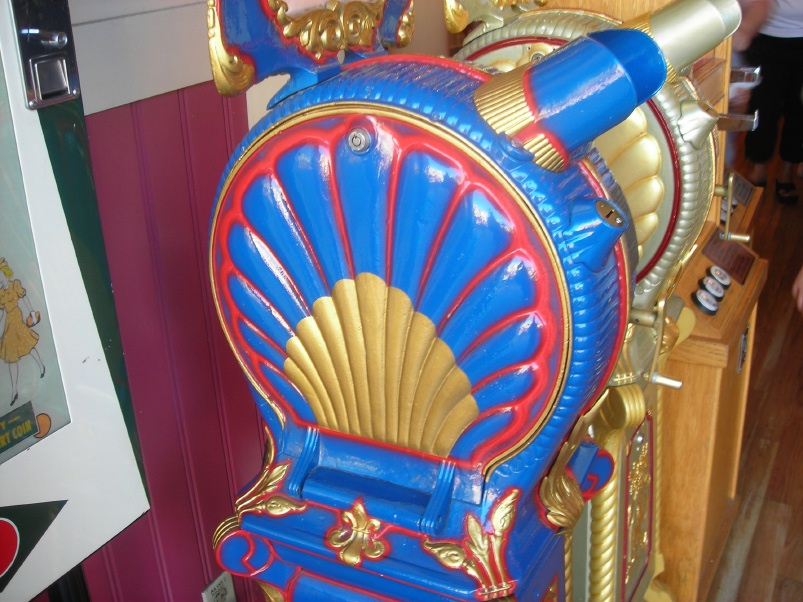
Each machine carries instructions and extensive patent information on a plate on the front of the machine. The instructions are simple: "Push Penny in Slot Then Turn Crank to the Right."
 |
| 2010 |
 |
| 2010 |
 |
| Magic: Stage Illusions and Scientific Diversions, Including Trick Photography, Albert Allis Hopkins, ed. |
"The 'mutoscope' is compact, and the pictures are large. It is not any larger than the cover of a sewing machine. The enlarged bromide prints, measuring four by six inches, are mounted in close consecutive order around the cylinder and extend out like the leaves of a book, as shown in the illustration. In the operation of the mutoscope the spectator has the performance entirely under his own control by turning a crank which is placed conveniently at hand, and may make the operation as quick or as slow as he desires, and can stop the machine at any particular picture at will. Each picture is momentarily held in front of the lens by the action of a slot attached to the roof of the box, which allows the pictures to slip by in much the same way as the thumb is used upon the leaves of a book."
The Mutoscope was invented by William Kennedy Laurie (WKL) Dickson, who had led the Edison team that developed the Kinetoscope and Kinetograph. The Mutoscope and its accompanying camera, the Mutograph, were carefully designed to work around Thomas Edison's patents on motion picture devices.
How did I get interested in the Mutoscope? Several times when I was young I took a book out of the Anza Branch Library that explained how movies work. I can't remember the title. I tried to make several of the pre-cinema devices in the section on early moving picture devices.
 |
| The Young Folk's Cyclopædia of Games and Sports by John Denison Champlin and Arthur Elmore Bostwick, 1890 |
I used to make Thaumatropes with my daughter. Kids enjoy them and I recommend making them as a good way to pass a rainy afternoon.
 |
| The Young Folk's Cyclopædia of Games and Sports by John Denison Champlin and Arthur Elmore Bostwick, 1890 |
|
| Scientific American / New Series, Volume 20, Issue 14, April 3, 1869 |
This can also be done with a second disk in front of the one with the images. The front disk has the slots and it rotates in the opposite direction from the one with the images. I built one of these as a project for university class. I should have taken a photo.
 |
| The Story of the Motion Picture: 65 B.C. to 1920 A.D. By Ben Jehudah Lubschez |
When my daughter was young, I purchased a toy drum-type Zoetrope and we drew strips to view in it. Just recently, my wife took her class to a field trip at the Disney Family Museum in San Francisco's Presidio. They created Zoetrope strips.
 |
| Magic: Stage Illusions and Scientific Diversions, Including Trick Photography, edited by Albert Allis Hopkins |
The methods above used drawing or posed photographs to recreate motion. In 1878, San Francisco photographer Eadweard Muybridge used a series of cameras to photograph the stages of motion as it was happening. This took place down the Peninsula from where I lived, at the Stanford Farm, the future home of Stanford University. I found this fascinating. I wanted to reanimate Muybridge's images and I wanted to create my own, but I could never gather enough functioning cameras. Muybridge went on to do studies of many kinds of motion, and used a Zoetrope to present them.
 |
| Magic: Stage Illusions and Scientific Diversions, Including Trick Photography, edited by Albert Allis Hopkins. |
from Magic: Stage Illusions and Scientific Diversions, Including Trick Photography, edited by Albert Allis Hopkins:
"The apparatus is the invention of Ottamar Anschuetz, of Lissa, Prussia. A special camera was used, adapted to take a number of photographs in quick succession. The instrument for displaying the pictures is called the "electrical tachyscope." It consists of an iron wheel of sufficient diameter to hold an entire series of positive prints on the periphery. The wheel is arranged upon a rigid standard, and provided with a series of pins which register exactly with the picture. Upon the standard behind the wheel is located a box containing a spiral Geissler tube which is connected with the terminals of a Ruhmkorff coil. The primary coil is provided with a contact maker and breaker adapted to be operated by the pins projecting from the wheel, so that every time a picture comes before the Geissler tube it is illuminated by an electrical discharge through the tube. This discharge, being instantaneous, shows each picture in an apparently fixed position. These pictures succeed each other so rapidly that the retinal image of one picture is retained until the next is superimposed upon it, thereby giving to the observer the sense of a continuous image in constant motion."
French artist and inventor Charles-Émile Reynaud created the Praxinoscope, which improved on the Zoetrope by replacing the slots with a set of mirrors in the middle of the drum. The video was shot at the Musee Mechanique in San Francisco's Fisherman's Wharf. The Musee Mechanique is a wonderful place to visit to play with old amusement machines.
 |
| Magic: Stage Illusions and Scientific Diversions, Including Trick Photography, edited by Albert Allis Hopkins. |
from Magic: Stage Illusions and Scientific Diversions, Including Trick Photography, edited by Albert Allis Hopkins:
"Up to the time of the invention of this theater, the apparatus that produced the synthesis of the successive phases of an action were limited to reproduction upon a very small scale, which can only be enjoyed by a limited group. The object of the optical theater was to provide an apparatus for the reproduction of a series of actions upon a considerable scale. The continuity of the image obtained by the praxinoscope, invented in 1877 by M. Reynaud, had not up to this time been realized by any projecting apparatus. The effect is produced by using a crystalloid band upon which the images are painted as represented at A in our engraving. The operator can revolve it in one direction or the other by means of two reels. The images pass before the lantern, B, and are projected by the aid of the objective, C, upon an inclined mirror, M, which projects them upon the transparent screen, E. Another projection lantern, B, causes the appearance on the screen of the scene, amid which appear the characters, which change their posture according as the painted band, A, is revolved by the operator."
Inspired by Reynaud, I drew a couple of animated films on strips of paper. If they still exist, I should try to scan them and animate them.
Reynaud premiered the Théâtre Optique in 1892 to much acclaim. In 1893, a team working for Thomas Edison demonstrated the vertical Kinetoscope, which allowed an individual to watch a movie. In 1895, Auguste and Louis Lumière demonstrated a projector which allowed a crowd of people to watch a movie. The Théâtre Optique was quickly forgotten, In 1910, Reynaud threw his equipment and most of his animations into the Seine.
Despite sad stories like Reynaud's, I get a lot of pleasure out of looking at pre-cinema, and sometimes trying to recreate it. If you catch kids in the right mood, it can help them understand how movies work.
This post is part of the Classic Movie Ice Cream Social Blogathon, hosted by Fritzi at Movies Silently (http://moviessilently.com/2016/05/20/the-classic-movie-ice-cream-social-is-here/). Thank you to Fritzi for all the hard work. Thank you to everyone who visited and I encourage you to read and comment on as many posts as you can. Bloggers love comments.
This post is my second blogathon post of 2016 and my 42nd since 2007. This is my 24th blogathon. This page has a list of all my blogathon posts.
Coincidentally, the first day of this blogathon is the 125th anniversary of the first public demonstration of the horizontal Kinetoscope by a team of Thomas Edison's workers led by WKL Dickson. On 20-May-1891, in West Orange, New Jersey, they played this film, later called the "Dickson Greeting," to the National Federation of Women's Clubs. The Kinetoscope required further development, which came to fruition in 1893.
Sunday, January 24, 2016
The Zoetrope -- January 24, 2016
From The Story of the Motion Picture: 65 B.C. to 1920 A.D. By Ben Jehudah Lubschez. Last month we read about WG Horner's invention of the Phenakistoscope:
http://bigvriotsquad.blogspot.com/2015/11/the-phenakistoscope-november-22-2015.html
James Clerk Maxwell was a Scottish scientist.
Some twelve months after Plateau's invention of the Phenakistoscope, W. G. Horner in 1834 described the Daedaleum, a cylindrical derivation of the Phenakistoscope, later called the "Wheel of Life," and "Zoetrope." With this no mirror was needed as with Plateau's device. It consisted of a hollow cylinder which could be rotated on its axis. The various phases of a moving object were depicted around the lower edge of the inside of the cylinder, and the vertical slots were cut above the images near the upper edge of the cylinder. Looking thru the slots at the pictures while revolving the cylinder, produced the illusion. For some reason this device was not popularly introduced until i860, and it is still on the market as a toy. Various forms of it were patented in the United States, England and France. Rather serious models of it were patented by Desvignes in France in i860, and by W. F. Lincoln of Providence, R. I. in 1867.
In all devices having narrow slots for observation of the pictures, more or less distortion resulted as the picture viewed passed before the slot. If the slot moved in the same direction with the picture, as in the Phenakistoscope, the picture appeared elongated; if it travelled in opposite direction from the picture, as in the Zoetrope, the picture appeared compressed. Plateau recognized this shortcoming and compensated for the resultant distortion by distorting his original diagrams in the opposite direction, the two distortions neutralizing each other and the result being normal. In 1869, however, Clerk-Maxwell remedied this defect in the Zoetrope by substituting for the slots, lenses so arranged as to form the images of the moving pictures at the center of the revolving cylinder of the Zoetrope, thus the images would be apparently stationary. In 1877 Reynaud attained the same result in a simpler way and his device, which he called the Praxinoscope, attained a popularity which lasted many years. In the Praxinoscope both the slots and lenses were done away with: around a drum in the center of the cylinder were arranged little sloping mirrors placed half-way between the rim of the outer cylinder and its center. The reflected images of the different phases in the mirrors therefore appeared at the center of the revolving cylinder just as in Clerk-Maxwell's device. Altho by the ingenious use of mirrors the Praxinoscope was combined with the stereoptican and ultimately was used with actual photographs as one of the immediate predecessors of the film machines, it is only a variation of the Zoetrope and would be of little interest except for the fact that in it, and its prototype by Clerk-Maxwell, was recognized the fundamental principle that, to avoid distortion and blurring, the image viewed must be momentarily at rest or apparently so. This principle was independently discovered several years earlier by Dr. Coleman Sellers of Philadelphia in an ingenious photographic machine which he called the Kinematoscope, and which will be taken up later.
Tuesday, January 6, 2015
Edison's Kinetoscope -- January 6, 2015

The earliest version of the Kinetograph/Kinetoscope used tiny images on a cylinder rather than on film. The article is from Manufacturer and Builder, November, 1894. The image is from "The Edison Kinetoscope," The Electrical Engineer, 07-November-1894.
Edison's Kinetoscope
From Manufacturer and Builder / Volume 26, Issue 11, November 1894
The initial idea of Edison's kinetoscope, relating to the production of motion, is based upon the familiar toy known as the zoetrope, or wheel of life. This rude prototype contains a cylinder 10 inches in width and open at the top, around the lower half of whose interior a series of pictures is placed, representing any sequence of motion it may be desired to portray, such, for instance, as wrestling, jumping, or the swift progress of animals. These movements are seen through the narrow vertical slits in the cylinder during the rapid revolution of the little machine, and are designed to blend into one continuous impression. In the zoetrope, however, the pictures are wood cuts of rude execution, and the limited speed obtainable in the production of these militate against the lifelike effect, producing a series of jerks instead of the desired continuity of motion. When instantaneous photography, as evolved by Maddox and others, was utilized superior results were attained, but it seemed impossible to take pictures at sufficiently short intervals to secure the absolute blending of outline essential to a faithful portrayal of life. In Edison's latest form of kinetoscope the photographic film is in the shape of an endless band from 50 to 150 feet in length, which is passed through the field of the magnifying glass perpendicularly placed, and the photographic impressions pass before the eyes at the rate of 46 per second. Projected against a screen, or viewed through the magnifying glass, the pictures are eminently lifelike. Antonio (Antonia? - JT) and W. K. L. Dickson in Cassier's Magazine.Tuesday, April 29, 2014
Mechanical Toys as a Means of Practical Instruction -- April 29, 2014
From Scientific American / New Series, Volume 20, Issue 14, April 3, 1869
He who will introduce toys with the double object of amusing and instructing will be a benefactor to the race. We are aware that many of the popular toys now in use, are based upon mechanical laws, and, in a degree, illustrate mechanical facts; but this elucidation is not a primary or principal object in their construction, and can be found generally, only by a close study or a partial dissection of the toy. It is not apparent to the casual observer; indeed, the object seems to be to conceal the mechanism and exhibit only the result, tempting the inquiring mind -- one that likes to understand the why and wherefore, "that seeks to know where faith should trust" -- to copy the example of the boy who burst the head of his drum to see where the sound came from, or ripped the bellows to find the source of the wind. From the great steam man to the flying top, from Maelzel's automaton chess player to the pasteboard acrobats and dancers, the source of power and its modes of transmission are concealed as much as may be. Yet this is the best, most valuable, most interesting exhibition of the device. Concealment is not knowledge; mystery is not wisdom.
The zoetrope or "wheel of life" is a play upon the organ's vision, a valuable exemplification of the science of optics. As such it is amusing, and bewildering. But how valuable it would be to show the action of machinery, to illustrate mechanical movements. A machine or its parts might, by its use, be presented in actual, or rather apparent motion, showing not only the parts of the machine and their relations, but also their action. Why could not the principle of the zoetrope be extended to exhibit, simultaneously to every individual of a large audience, the movements of machinery? Certainly here is room for invention, or, at least, improvement. This toy might be made a valuable aid to impart scientific and mechanical knowledge. The lecturer who first succeeds in introducing the zoetrope to his class, or audience, to illustrate mechanical movements will inaugurate a profitable and valuable means of imparting knowledge. These suggestions are worthy the attention of our inventors.
The image is from The Young Folk's Cyclopædia of Games and Sports by John Denison Champlin and Arthur Elmore Bostwick, 1890. http://bigvriotsquad.blogspot.com/2014/02/zoetrope-27-february-2014.html
Wednesday, March 26, 2014
The Zoetrope, or Wheel of Life -- March 26, 2014

From Scientific American / New Series, Volume 19, Issue 4, July 22, 1868
We have already noticed this unique optical instrument, which has afforded so much amusement to old and young, and although an American invention, its sale has already become quite extensive in Europe. Sets of figures are furnished with each wheel, and the changes which its rotation effects are both amusing and instructive. The Zoetrope is manufactured by Milton Bradley & Co., Springfield, Mass.The image is from The Young Folk's Cyclopædia of Games and Sports by John Denison Champlin and Arthur Elmore Bostwick, 1890. http://bigvriotsquad.blogspot.com/2014/02/zoetrope-27-february-2014.html
Thursday, February 27, 2014
Zoetrope -- 27-February-2014
From The Young Folk's Cyclopædia of Games and Sports by John Denison Champlin and Arthur Elmore Bostwick, 1890. Several times when I was young I took a book out of the Anza Branch Library that explained how movies work. I can't remember the title. I tried to make several of the devices in the section on early moving picture devices. The zoetrope was harder than the thaumatrope. I finally produced a good zoetrope for a college class that combined science and humanities.
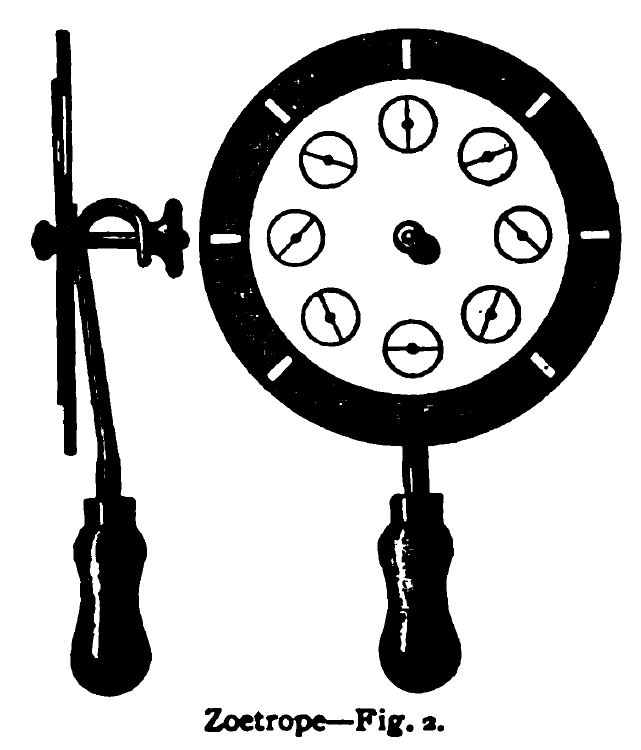
ZOETROPE. A toy by which a succession of figures in different attitudes are made to appear like a single one in motion. The simplest form of the toy consists of two disks fastened on the same axis, six or eight inches apart, so that they will turn on it together. The figures are arranged on one, as shown in Fig. 1, and in the other are a number of slits equal to that of the figures. The figures represent some action at successive instants ; thus, in the first picture the man has his bow drawn to one side ; in the next it is pushed a little farther along, and so on. If any one look through the slits while the discs are turned, and direct his attention to any one spot, he will see a different picture in that spot every time a new slit comes in front of his eye, and he will not see one picture moving away from the spot and another coming up, because the pasteboard between the slits then comes between. Thus he will see in the same place a succession of momentary pictures, each in a slightly different posture, and it will seem to him as though he saw the man playing the bass viol. In this way an endless variety of movements may be counterfeited.
The disk bearing the figures is often made a little smaller than the one with the slits, and fastened with it on the axis at the same point (see Fig. 2). The observer then looks through the slits at a mirror, and the effect is the same as before. The zoetrope in this shape is more easy to manage. Another form is a round box, open at the top, which revolves on an upright stand (Fig. 3). The figures are on strips of paper which fit around the inside of the box, and the slits are vertical ones in the edge.
Six such slips are shown in Fig. 4. The observer looks through the slits toward the figures on the opposite side of the box. The effect is the same as before, though in this case the figures and slits are moving in opposite directions. An arrangement has been devised by a Frenchman for showing the zoetrope to a large audience with the aid of the MAGIC LANTERN. The word zoetrope is from the Greek zoe, life, and trepein, to turn. The toy is also called the Magic Wheel and the Zoöpraxiscope, from the Greek zoe, life, praxis, action, and skopein, to see.

Subscribe to:
Posts (Atom)