|
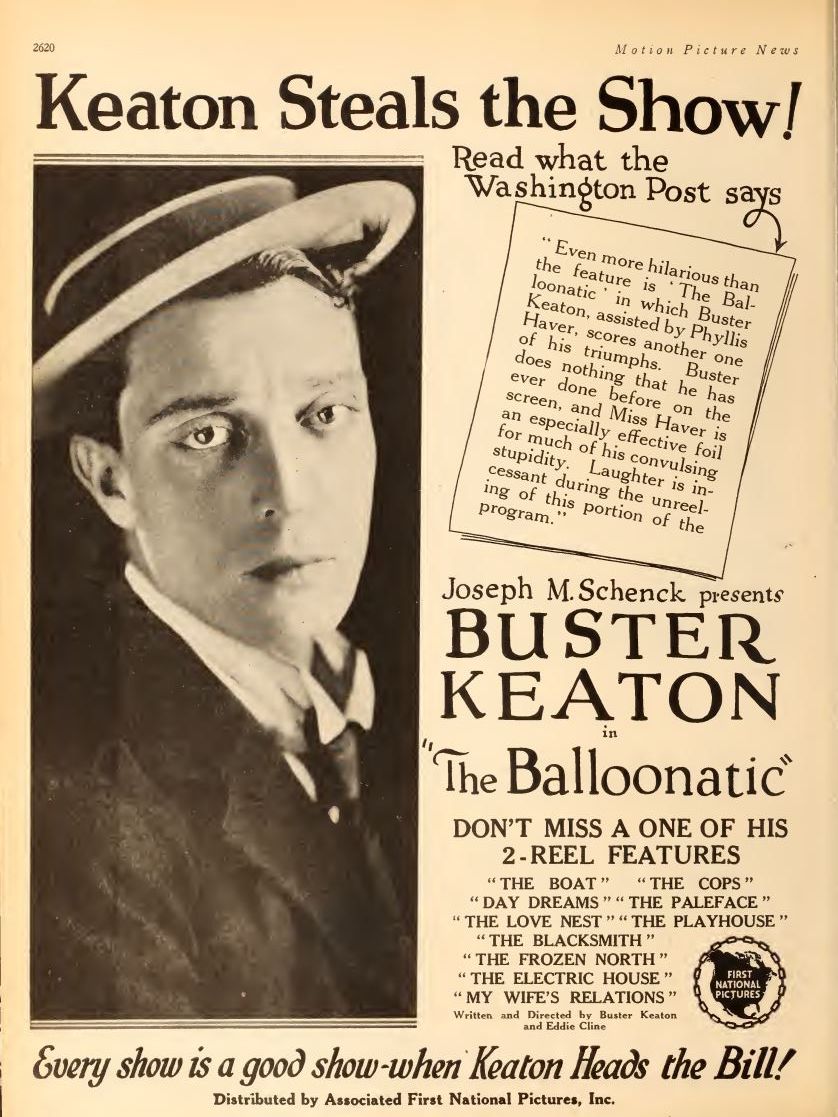
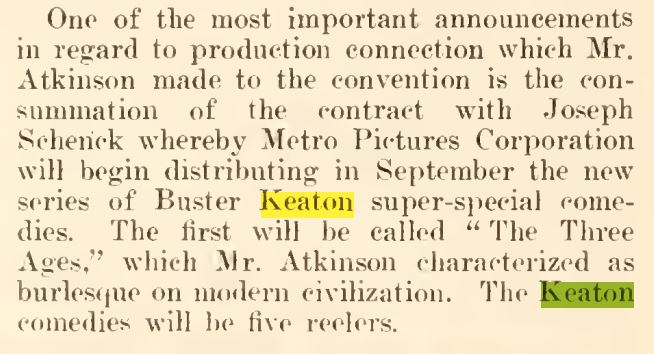
| Indiana Daily Times, November 6, 1920 |
This post is part of the Sixth Annual Buster Keaton Blogathon, hosted by Lea at Silent-ology. For the first annual blogathon, I wrote about Buster Keaton's time in vaudeville: The 3-4-5 Keatons. For the second annual blogathon, I wrote about Buster Keaton and the Passing Show of 1917, the show he signed for after leaving vaudeville. For the third annual blogathon, I wrote about Buster's transition from vaudeville to the movies, Buster Keaton: From Stage to Screen. For the fourth annual blogathon, I wrote about Buster Keaton's time in the US Army: Buster Keaton Goes to War. For the fifth annual blogathon, I wrote about Buster Keaton's time making short comedies with Roscoe Arbuckle, Comique: Roscoe, Buster, Al and Luke.
This time I chose to write about Buster Keaton's first appearance in a feature-length film, The Saphead.
Be sure to click on most images to see larger versions.
 |
| Detroit Times, 04-April-1914 |
I first became interested in Buster Keaton when I watched
The General with my grandfather and he told me how much he had always liked Buster Keaton.
When I discovered that the Anza Branch Library had a shelf of books about movies, I found two books about Buster Keaton, Buster's memoir
My Wonderful World of Slapstick and Rudi Blesh's
Keaton. I read both and I enjoyed learning about his career in vaudeville and his career in the movies.
After Buster Keaton's time making short comedies with Roscoe Arbuckle and serving in the US Army during World War One, Buster appeared in a feature that he did not help direct or write,
The Saphead for Metro.
 |
| www.listal.com |
When I was old enough to travel around San Francisco by myself, I started going to matinees at movie theaters. I had enjoyed the Woody Allen movies that I had seen on television, like
Take the Money and Run. When
Love and Death opened at the Regency I Theater on Van Ness, I saw it and loved it. I went three or four more times. At some showings, I was the only person laughing at the Dostoevsky jokes. When
Annie Hall opened at the Regency, I went to see it five or six times.
Interiors played at another theater, and I didn't think I would find it interesting. When
Manhattan came to the Regency, I went to see it only twice. I loved the black and white photography and the Gershwin score, but I found elements of the story to be creepy. I went to see
Stardust Memories once.
When
The Front came out, I skipped it. Woody Allen appeared in it, but did not write it, direct it or star in it. I think I saw it during a movie night at San Francisco State. It was interesting to see how Allen's performance was different. His timing seemed different, and the movie presented him differently. The whole movie was not as well-paced as one of his own productions.
I saw most of Buster Keaton's silent features at San Francisco's Avenue Theater, where they were accompanied by Bob Vaughn on the Mighty Wurlitzer. The only ones I did not see were
The Saphead,
Battling Butler and
Spite Marriage. When someone (Kino?) released a set of Buster Keaton movies on VHS, I got to see
The Saphead. The first thing I noticed was the timing, which was different. I wouldn't expect a light comedy/drama to have the same timing as a slapstick comedy. Buster's performance, however, was not wildly unlike his performances in movies where he had more control.
Why did Buster Keaton appear in
The Saphead?
 |
| from: In Memoriam: Bronson Howard, 1842-1908 |
The story starts in 1887 when Bronson Howard wrote a play called
The Henrietta. Howard was a popular playwright and
The Henrietta was a popular play, but it required me to do a fair amount of digging to find newspaper references before 1900. "Henrietta" is a remarkably common name.
 |
| from: In Memoriam: Bronson Howard, 1842-1908 |
The original cast included William H Crane as Nicholas Vanalstyne. We will encounter him again. Crane's partner, Stuart Robson, played Old Nick's younger son, Bertie the Lamb.
 |
| Everybody's Magazine, October, 1900 |
 |
| New York Tribune, 27-September-1887 |
A newspaper ad for the first Broadway run, at the Union Square Theatre.
 |
| New York Sun, 25-September-1887 |
"The story is understood to deal mainly with Wall street, and 'The Henrietta' is variously a mine, a woman, a yacht, and so on."
 |
| New York Sun, 25-September-1887 |
"Amusements.
"'The Henrietta,' A New Play by Bronson
Howard for Robson and Crane.
"That generally laughed-at firm of comedians
Messrs. Robson and Crane began their
long season at the Union Square Theatre last
evening with 'The Henrietta,' a new play
written for them by Mr. Bronson Howard. The
venture was extremely careful as to the work
done by the playwright as well as in the
representation, and a great deal of success was
achieved alike by the author and the principal
actors. The theme was Wall street,
and it was treated with so much
wit, sarcasm and waggery that more
laughter than it raised could hardly have been
expected. The difficulty of combining a feminine
interest with the main subject was overcome
with skill and effect except when sober
sentimentality was attempted, for therein lay
all the failure discernible in the piece. The
success was predominant however and when
Mr. Howard was called out, half way through
the performance, the demonstration was hearty
and even enthusiastic. He had quite redeemed
himself from the failure of 'In the Adirondacks.'
"The character provided for Mr. Crane was
that of a leading operator in Wall street. He
was a wholesome old fellow with so many millions
at command that he tossed thousands
around like trifles. He was concerned in a
tremendous deal with the Henrietta Mine, but
he had a love affair on hand with a widow, too,
and to win her he contrived to make her lose
her fortune in stocks. He had a serious matter,
too, in fighting a powerful speculative
antagonist who turned out to be his own scoundrelly
son. In all his acts, comic or grave, Mr
Crane was equal to his task. It is hard for a
low comedian, in a role chiefly farcical, to
suddenly become melodramatic without letting
the laughter continue. Mr. Crane did it.
"Mr. Robson was not so fortunate. His few
sober periods were declined as such by the
audience and even a grievous sacrifice made
with heroic intent, was construed merrily.
But the rest of his embodiment of a vacuous
young clubman, who became a Napoleon of
Wall street by deciding his moves with the
loss of a coin was capitally droll and funny
His part rattled with hits at stock gambling,
and those were uproariously enjoyed by the
male hearers, although on the ladles they wore
naturally lost.
"To divert the feminine portion of the audience
and to by no means displease the rest
were four elegantly costumed actresses each
with a sweetheart and all employed dexterously
to force love and beauty into the prosaic
principal topic. There were four separate and
distinct stories of wooing and marrying ranging
from funny to pathetic and they were all
adroitly interwoven into one plot. Indeed, Mr.
Howard had shown a nicety in this respect
which some of his earlier pieces had lacked.
"Nothing smoother or handsomer in realistic
gentility or less blemished by faulty preparation
has been seen in New York this season.
A good and suitable company had been engaged
and effectively managed."
 |
| New York Tribune, 27-September-1887 |
"The Henrietta is a mining stock, a race horse, a ballet girl and an imaginary syren."
 |
| New York World, 30-December-1887 |
The Henrietta had its 100th performance on 31-December-1887.
 |
| New Haven Journal and Courier, 29-February-1888 |
Robson and Crane were planning to close the show in March and take it on tour, when they had to change their plans because the Union Square Theater "Burned To The Ground." Actually, the auditorium was badly damaged, but the backstage area, sets and costumes survived pretty well.
 |
| New York Sun, 01-March-1888 |
The new plan was to play in Brooklyn for one week and then return to Manhattan at Niblo's Theater for two weeks to finish their New York run.
 |
| New Haven Journal and Courier, 17-March-1888 |
 |
| St Paul Daily Globe, 16-October-1888 |
 |
| Omaha Daily Bee, 28-October-1888 |
The show went on the road. A later newspaper article mentioned that Robson and Crane were no longer talking to each other because of a backstage incident in Baltimore. They decided to end their partnership after the current season.
 |
| Scranton Tribune, 27-April-1895 |
 |
| The Lincoln, Nebraska Courier, 05-October-1901 |
 |
| Minneapolis Journal, 14-November-1904 |
The Henrietta was revived many times, sometimes with Robson and sometimes without Robson or Crane. Robson died in 1902. Bronson Howard died in 1908.
 |
| The New Henrietta, Smith and Mapes, 1913 |
In 1913, Winchell Smith and Victor Mapes got the idea of rebooting, to use a recent term,
The Henrietta. They brought William Crane back to play Old Nick and found a young fellow named Douglas Fairbanks to play Bertie the Lamb. The play was called
The New Henrietta.
 |
| New York Tribune, 20-December-1913 |
The New Henrietta opened at the Knickerbocker Theater on 22-December-1913.
 |
| New York World, 23-December-1913 |
"The New Plays
"'New Henrietta'
"Scores a Big
"Popular Success.
"BY CHARLES DARNTON.
"OLD as 'The New Henrietta' seemed in its simple devices and its even
more simple humor, Bronson Howard's enduring and also endearing play
came over the footlights at the Knickerbocker Theatre last night with
so much vigor that, judging by the cordial attitude of the audience, it scored
a big popular success.
"How many of us who held fast to the memory of the old 'Henrietta' were
half afraid to see the new? Would that stampeding scene of the stock ticker
prove as flat as a yesterday's 'extra'? Would Bertie the lamb bring us back
to our muttons? Would old illusions be destroyed? These questions were
answered by an audience that smiled and chuckled and guffawed reminiscently.
Not that 'The New Henrietta' didn't deserve and get appreciation!
Everybody seemed delighted at everything -- and what more can any one ask for a
play old or new? Candidly, I can't see what Winchell Smith and Victor Mapes
have done in the way of revision beyond cutting out some untimely
material and giving a flippant turn to the dialogue that made it as modern, if not
so remarkable, as Miss Amelia Bingham's gown. They've cut out -- heaven
alone knows why! -- that line of Bertie's that used to set the house in a
roar: 'Every fellow at the club thinks every other fellow a devil of a fellow
but he ain't.'
"Yet Douglas Fairbanks, whose task as Bertie was hardest of all because of
the memory of the late Stuart Robson's inimitable performance, proved himself
capable of creating so much laughter that he suffered far less by comparison
than might have been expected. Though Robson's engaging characterization was
naturally missed, along with the squeak and the lisp and the stammer associated
with the role in our minds, and while the young actor made Bertie a
downright fool, not to say an imbecile, he succeeded with even more than his
usual cleverness in getting a great deal of
fun out of the part. I doubt if there is another actor on the American stage
who could have done as much with the role. If Mr. Fairbanks ever saw Mr.
Robson in this character he certainly made no attempt to imitate the creator
of the role. He had the good sense to play the part in his own way and his
sense of comedy stood him in such good stead that he gave that more or less
grizzled veteran, William H. Crane, a hard race for first place.
"Of course there is no other actor who could approach Mr. Crane as 'Nick'
Van Alstyne, and never has he given a better performance of this Old Ironsides
of Wall street than he gave last night. In the homespun suite of the opening
set he still wore his pocket at the top of his trousers, and he thrust his hands
into them and patronized people generally in the old, familiar way. That
he relished the part was evident from the way he smacked his lips over it.
The type remains the same, and whether you admire old 'Nick' or not -- for, after
all, he is a decidedly bumptious egotist who suggests nothing so much as a
human checkbook -- there is no denying that here is an uncommonly good acting
part. As I said, it was Mr. Fairbanks who had the most difficult task
to face, so more praise to him for the work he did. It may have been
out of consideration for his youthful associate that Mr. Crane made no
mention of Stuart Robson in his curtain speech, but whatever the reason
may have been there was surprise, not to say disappointment, that no word
was spoken for the fine comedian who still lives in the hearts of those who
saw him as Bertie.
"Miss Bingham was in fine form as Mrs. Opdyke -- but, speaking of form,
why, oh! why overdress it so extravagantly? However, quite aside from the
gorgeous fashion In which she adorned herself, Miss Bingham scored as
the widow. Miss Patricia Collinge, who first came into attention with her
perfect embodiment of Youth in 'Everywoman,' was a charming Agnes, though
her acting at times became a bit monotonous She seemed almost too simple,
especially when she rhapsodized over Bertie at the window in this style:
'There's-his-car-and-he's-in-it.' But lovely and gentle and tender -- yes.
One of the best performances of the night was given by Lyster Chambers as
the villainous Turner, and the choking he received at the hands of Mr. Crane
was so realistic it went straight to your collar-button. Miss Eileen Errol was painfully vociferous as Mrs. Turner. In fact, nearly all the members of the
cast were inclined to shout in the beginning, hut they toned down as they went
along and gave the old-new play human and sympathetic treatment."
 |
| New York World, 23-December-1913 |
 |
| New York World, 23-December-1913 |
Note that the villain had changed from being Old Nick's son to his son-in-law.
 |
| New York World, 28-December-1913 |
I wish this ad was printed more clearly. Note that it was much more elaborate than any we have seen before.
 |
| New York Tribune, 18-January-1914 |
The show closed at the Knickerbocker at the end of January. "Engagement positively not to be extended.
 |
| Washington Times, 23-March-1914 |
After playing at other theaters in other boroughs of New York, the show went on the road.
 |
| Moving Picture World, 13-November-1915 |
The Triangle Film Corporation was founded in 1915, to distribute movies produced by three major film makers, DW Griffith, Thomas H Ince and Mack Sennett. Each week the company planned to release a program with one movie from each producer.
 |
| New Iberia Enterprise and Independent Observer, 19-February-1916 |
Douglas Fairbanks went to Hollywood under contract with DW Griffith. His first movie was
The Lamb, which many books say was an adaption of
The New Henrietta. There is very little relation that I can see between the play and the film. Doug, who played Bertie on Broadway, played Gerald, who was an ineffective rich young man, like Bertie. There was no Old Nick. Gerald loves a young woman named Mary, who thinks he is a coward and a weakling. Later, Gerald saves Mary from an attack by Yaqui Indians. This was a pattern followed by many of Doug's movies before he began making swashbucklers.
 |
| Topeka State Journal, 24-November-1915 |
 |
| Topeka State Journal, 24-November-1915 |
During the same month that
The Lamb was released, William H Crane was touring the country in
The New Henrietta.
 |
| Moving Picture World, 04-September-1920 |
Note that this 1920 ad for upcoming Metro features has a parrot rather than a lion. The lion came a few years later when Marcus Loew took over Goldwyn Pictures.
from Buster's
My Wonderful World of Slapstick:
"Shortly afterward, in January 1920, Marcus Loew bought the
Metro studio. He wanted to make sure his chain of theatres would
have a steady supply of quality pictures. Its stars then included
Nazimova, Viola Dana, Bert Lytell, and May Allison, among
others. Being a good showman, Loew saw from the beginning the
need for better stories. He engaged John Golden, the Broadway
playwright, song writer, and producer, as an adviser on theatrical
properties. Among other old plays Golden suggested he buy was
The New Henrietta, in which the famous William H. Crane had
starred on Broadway. Douglas Fairbanks had played the juvenile
role of 'Bertie Van Alstyne' on Broadway and also portrayed the
same character, Bertie, in his first picture, The Lamb.
'When Doug and Mary Pickford, who were married soon
afterward, were asked to suggest someone to play Bertie in the
Metro version of The New Henrietta, they said 'You have the
perfect man for it right here. Fellow named Buster Keaton.'
"Mr. Crane was brought out to play his original role, but the
story was rewritten so that Bertie became the main character. It
was called The Saphead and ran for seven reels at a time when
Metro's biggest dramatic stars were making only five-reelers. This
picture, the first I was starred in, was one of the company's big hits
that year."
 |
| Motion Picture News, 13-November-1920 |
Director Herbert Blaché is primarily remembered today for being the husband of film pioneer Alice Guy-Blaché. June Mathis was a script writer and film executive who did much to promote Rudolph Valentino's career. I don't know why Victor Mapes is not listed as co-author with Winchell Smith. Raymond Rohauer was a film collector and distributor who did much to bring Buster Keaton's films to the attention of the public during the 1960s. He also rubbed many people the wrong way.
This movie set a pattern that Buster followed in some of his other films: a spoiled rich guy has to prove he is a man. He did this in
The Navigator,
Battling Butler,
Steamboat Bill, Jr,
The Doughboy and the Columbia short "General Nuisance."
 |
| Pueblo Chieftan, 15-April-1921 |
The Saphead is slow in spots, but fun to watch. You can find it on YouTube.
William H Crane died in 1928.
After being the subject of (sort of) two plays and (sort of) two movies in about 33 years, as far as I can tell, with the resources available to me, the play has never been revived and the movies have not been remade.
After
The Saphead, Buster began work on his starring series of two-reelers, one of the two greatest series of slapstick comedies.
This post is part of the Sixth Annual Buster Keaton Blogathon, hosted by Lea at Silent-ology. Thank you to Lea for all the hard work. Thank you to everyone who visited and I encourage you to read and comment on as many posts as you can. Bloggers love comments.