|
| Motion Picture News, 29-December-1923 |
Polish-born Joseph Tykociner was a professor of engineering at University of Illinois Urbana-Champaign. Tykociner developed and displayed the first successful sound-on-film system, which combined image and sound on a single strip of film. Despite Tykociner holding several patents for the process, a battle with the university over rights kept him from exploiting it commercially.

 |
| Motion Picture News, 29-December-1923 |
Interesting Details of ApparatusEmployed in Photographing Human VoiceTHERE have been described in previous issues of the News various methods and devices used in registering photographically the human voice. These developments are of such an interesting nature that we feel warranted in publishing the following description which has been submitted on Professor J. T. Tykociner's apparatus, now in the process of being perfected.
The silver screen may be changed into a screen that gives forth the thousand varying emotions of the human voice, thanks to the invention perfected by a Polish scientist, Professor J. T. Tykociner, who is now conducting special research work at the University of Illinois. Silence the orchestra or disable the pipe organ and the present-day movie becomes a rather lifeless exhibition in which the performers do their best to portray the different emotions by means of pantomime. As a result tens of thousands of spectators merely guess at what the hero actually says when he laughs defiance at his adversaries, or else there is a break in the scene and the title is thrown on the screen. With this new invention, when the hero laughs with glee the audience hears the rollicking notes and responds immediately.
To solve this difficult problem in a practical way, many inventors have attempted to couple the motion picture machine with photograph records, but no such combination has met with wide adoption. It was more than twenty years ago that Professor Tykociner conceived the idea of photographing sound on the same film used for taking motion pictures. His purpose was to reproduce the speech or song of artists at the same time that their acting is shown on the screen.
After several years of experimenting he has perfected a working model of such apparatus. These models represent only a part of the invention developed during this period. The models that have been constructed show the following features:
The production of talking motion pictures is accomplished by a camera, which in addition to the ordinary devices used for taking pictures on a film, carries another photographic objective for the purpose of photographing on a narrow portion of the same film the image of a slit illuminated by a mercury arc light. The electric current that feeds the arc is made to vary by connecting the arc to wires leading from amplifiers to the stage, where a telephone transmitter is actuated by sounds and voices accompanying the play of the artists.
The amplification of the sounds to be photographed is accomplished by audio frequency or radio frequency methods. When no sounds are produced on the stage, the light of the mercury arc is steady and therefore the place on the film designated for the photographic sound record and running along the pictures, shows, after the usual developing, a narrow band of uniform transparency. If, however, sound is accompanying the acting on the stage, the light of the arc is forced to fluctuate in accordance with the intensity of the sound coming from the telephone transmitter. Consequently, the image of the slit photographed on the moving picture film appears as a narrow band, shaded by lines more or less crowded and more or less transparent in agreement with the pitch and volume of the sound reproduced on the stage. This shaded band seen along the edge of the film is a true photographic record of the sound produced during the action on the stage. Every single photographed position of the actors has its fixed place on the film. Likewise, every sound produced has its fixed place on the edge of the same film near the corresponding picture. This part of the apparatus transforms the energy of sound waves into electric oscillations and produces changes of the amount of photographically active rays emitted by the mercury arc lamp so that the sensitized moving film is affected in accordance with the sound to be photographed.
The name "phonaction" has been chosen for this sound-recording apparatus, as this word expresses the manifold transformation of sound energy controlling actinic rays by means of a stream of ions.
The "phonaction" produces negatives which, after development, can be used for printing purposes. On the film can be seen a narrow band of shaded cross-lines which represent the photograph of the speech delivered at the time the picture was taken.
The question may well be asked, "How can the motion pictures and the sound be produced at the same time from such a film?" This is made possible through the use of another apparatus that Professor Tykociner has named an "actophone." In this model an ordinary motion picture projecting machine is used. To it are attached an additional light house and a second optical system. By means of the normal optical system, rays of light pass the part of the positive film occupied by the motion pictures, projecting them upon the screen. At the same time rays from the additional light house are directed upon that part of the positive film which carries the photographic sound record. The amount of light that passes through the shaded band varies according to the transparency of the particular places on the film, and illuminates the sensitive layer of the photo-electric tube placed behind the moving film. The photo-electric cell was developed and made by Professor Jacob Kunz of the University of Illinois. This tube has the property of releasing electric charges in quantities strictly in agreement with amount of light entering "the tube. In the actophone such a light, sensitive tube is connected with proper amplifiers, and as a result electric currents are excited, varying with the illumination. The currents thus obtained are strong enough to actuate a loudspeaking telephone located in a convenient place near the screen. While the motion pictures are projected on the screen, the loud-speaking telephone reproduces at the same time the voices and the sounds characteristic to the action occurring on the stage. In this way harmony of action and sound is achieved, creating a complete illusion for the ear as well as for the eye.
Many simple experiments have been made at the university to test this invention. For instance, the sounds are distinctly recorded when the demonstrator knocks on the door and is told, "Come in." The sounds made on opening and closing the door are distinctly heard, as is the greeting, "Good morning." If at the same time a typewriter should happen to click in an adjoining room or a clap of thunder should peal forth, the sounds would be duly recorded. A fox terrier in action makes a good subject. The machine reproduces accurately the sharp, excited barks that the dog emits while leaping in the air to catch a swinging ball. Other tests have included whistling, counting numbers, the ringing of a bell and other experiments, all of which have proved highly gratifying.
Professor Tykociner declares that his invention can readily be adapted to moving picture machines of the types now in common use. This means that the invention may come into wide commercial use. The inventor feels that his work has passed far beyond the experimental stage, and that the actual results obtained so far warrant him in making the assertion that the simultaneous reproduction of sound and action is now definitely assured.
 |
| Motion Picture News, 01-December-1923 |
While Professor Tykociner was working on sound-on-film, British inventor Claude Verity (great name) was creating and demonstrating a sound-on-disk system which relied on the operator to watch signal lights and adjust the speed of the projector or the phonograph to keep in sync. Verity called his system the "Veritiphone."
 |
| Film Daily, 23-September-1926 |
 |
| Film Daily, 06-December-1923 |
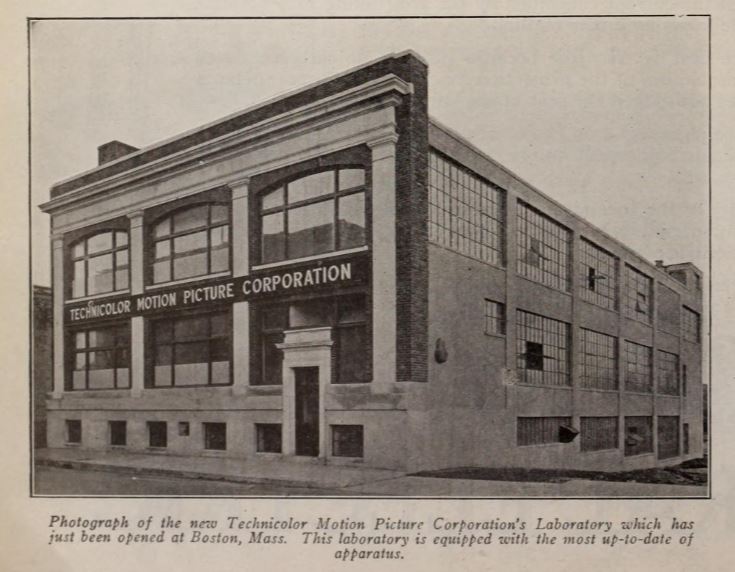
William Van Doren Kelley, inventor of the Prizma natural color process, opened a laboratory in New Jersey which would be dedicated to making natural color prints. The item mentions that Prizma was not producing movies at that time.
 |
| Motion Picture News, 29-December-1923 |