From The Story of the Motion Picture: 65 B.C. to 1920 A.D. by Ben Jehudah Lubschez.
IN 1825 there appeared in England a half-penny toy called the "Thaumatrope." The early forms of moving picture apparatus, whether the simplest toys or the more serious machines, always had high-sounding and classic names. The Thaumatrope was merely a card with the picture of one object, like a bird, printed on the face; and another object, like a cage, printed on the back. Thru the center of the card was a string by means of the ends of which, the card would be whirled end for end, bringing the pictures of the two objects before the eye in quick succession and furnishing, thru the persistence of each image, the illusion of a composite of both; When one picture is a bird and the other a cage, the bird seemingly enters the cage. This toy proved so popular that a warm controversy arose as to who was the inventor. A Doctor Paris and a Doctor Finton each claimed the credit, Dr. Finton's claims now being more generally recognized, having in fact been substantiated.
When my daughter was younger, we went to Disneyland every summer. There were two places on Main Street that we would always visit. The Gibson Girl Ice Cream Parlour served delightful ice cream in huge waffle cones which were made on the premises. I usually had mint chip. Then we would go to the adjoining Penny Arcade.
2007
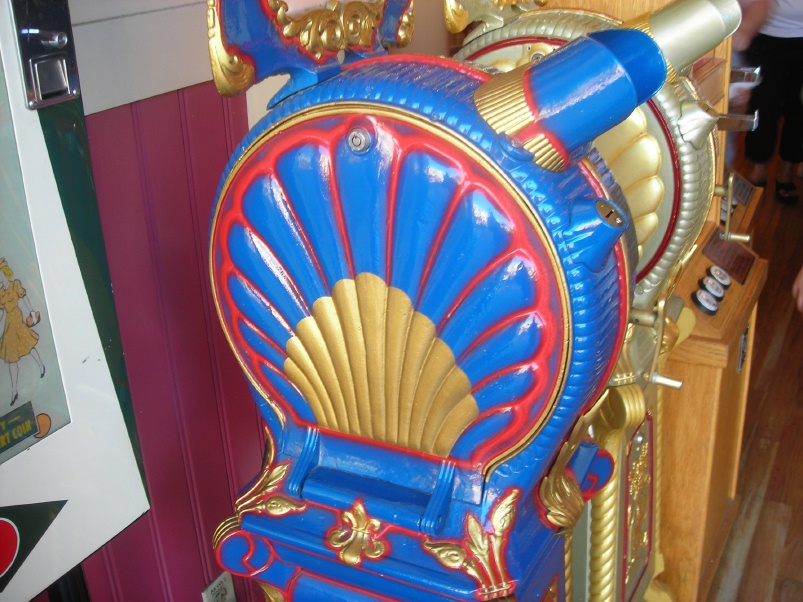
I always had to put a penny in the delightfully painted clamshell Mutoscopes.
2007
2008
2008
2009
2009
2009
2010
2010
2012
2012
What is a Mutoscope? Why did I have to go play with them every year? The Mutoscope is a hand-cranked entertainment machine that works like a
giant flipbook. When I was a kid, I tried to build a device like it, but always had
trouble getting it to work.
2012
Each machine carries instructions and extensive patent information on a plate on the front of the machine. The instructions are simple: "Push Penny in Slot Then Turn Crank to the Right."
2010
When you put your penny in the slot, a light comes on. You see a photo on a card. When you turn the crank, each photo snaps forward, revealing the next one. The sequence of photos gives the illusion of motion. The cool thing is, you can turn the crank as fast or as slow as you like. You can't go backwards. Here we see Charlie Chaplin and Mabel Normand in a scene from a Keystone comedy. Someone with good eyes could probably tell which one.
2010
And here we see a scene from a Tom Mix western, probably one of his early Selig Polyscope productions.
Magic: Stage Illusions and Scientific Diversions, Including Trick Photography, Albert Allis Hopkins, ed.
from Magic: Stage Illusions and Scientific Diversions, Including Trick Photography, edited by Albert Allis Hopkins:
"The 'mutoscope' is compact, and the pictures are large. It is not any larger than the cover of a sewing machine. The enlarged bromide prints, measuring four by six inches, are mounted in close consecutive order around the cylinder and extend out like the leaves of a book, as shown in the illustration. In the operation of the mutoscope the spectator has the performance entirely under his own control by turning a crank which is placed conveniently at hand, and may make the operation as quick or as slow as he desires, and can stop the machine at any particular picture at will. Each picture is momentarily held in front of the lens by the action of a slot attached to the roof of the box, which allows the pictures to slip by in much the same way as the thumb is used upon the leaves of a book."
The Mutoscope was invented by William Kennedy Laurie (WKL) Dickson, who had led the Edison team that developed the Kinetoscope and Kinetograph. The Mutoscope and its accompanying camera, the Mutograph, were carefully designed to work around Thomas Edison's patents on motion picture devices.
How did I get interested in the Mutoscope? Several times when I was young I took a book out of the Anza Branch
Library that explained how movies work. I can't remember the title. I
tried to make several of the pre-cinema devices in the section on early moving
picture devices.
The Young Folk's Cyclopædia of Games and Sports by John Denison Champlin and Arthur Elmore Bostwick, 1890
The Thaumatrope (from the Greek for "wonder turner") is a card, often disk-shaped, with a string tied through a hole on each side. On each face of the card is a part of a picture, most famously a bird on one side and a cage, upside down relative to the bird, on the other. The person playing with the Thaumatrope takes a string in each hand and spins the card rapidly. Persistence of vision merges the images together so the bird appears to be in the cage, or, in the example above, the rider appears to be on the horse. This was a popular toy in the Nineteenth Century. There is some disagreement about whether it was invented by a Frenchman or an Englishman.
I used to make Thaumatropes with my daughter. Kids enjoy them and I recommend making them as a good way to pass a rainy afternoon.
The Young Folk's Cyclopædia of Games and Sports by John Denison Champlin and Arthur Elmore Bostwick, 1890
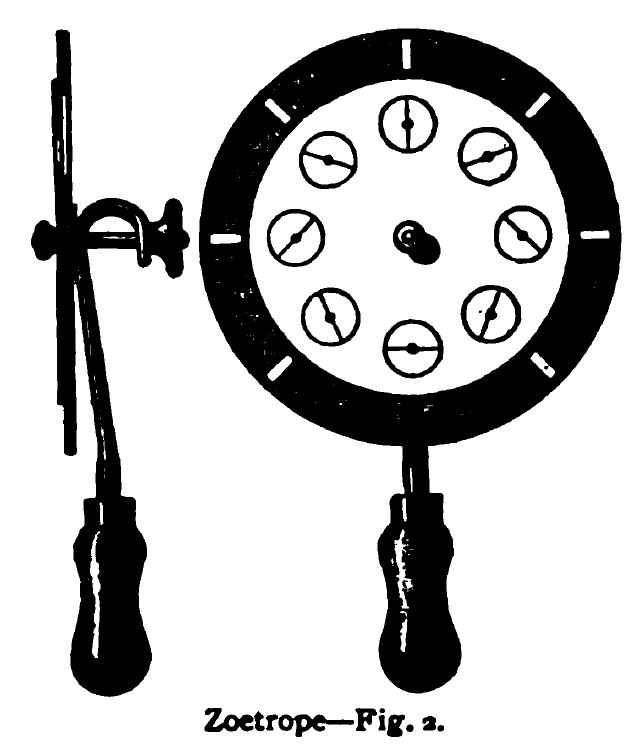
Zoetropes were harder. There are two basic types. Each has a series of drawings meant to represent phases of an action.
Scientific American / New Series, Volume 20, Issue 14, April 3, 1869
One type of Zoetrope has the images on the face of a disk. The disk may have slots or notches between the images. The disk is rotated in front of a mirror. Looking though the slots intermittently interrupts our view of the images and persistence of vision allows us to see the images as if they are moving.
This can also be done with a second disk in front of the one with the images. The front disk has the slots and it rotates in the opposite direction from the one with the images. I built one of these as a project for university class. I should have taken a photo.
The Story of the Motion Picture: 65 B.C. to 1920 A.D. By Ben Jehudah Lubschez
The other type of Zoetrope, also called a Phenakistoscope or Daedaleum (I love these names), has the images on a strip of paper lining the inside of a drum. There is a slot toward the rim of the drum above each image. Looking through the slots of the rotating drum also gives the illusion of motion.
When my daughter was young, I purchased a toy drum-type Zoetrope and we drew strips to view in it. Just recently, my wife took her class to a field trip at the Disney Family Museum in San Francisco's Presidio. They created Zoetrope strips.
Magic: Stage Illusions and Scientific Diversions, Including Trick Photography, edited by Albert Allis Hopkins
The methods above used drawing or posed photographs to recreate
motion. In 1878, San Francisco photographer Eadweard Muybridge used a
series of cameras to photograph the stages of motion as it was
happening. This took place down the Peninsula from where I lived, at the Stanford Farm, the future home of Stanford University. I found this fascinating. I wanted to reanimate Muybridge's images and I wanted to create my own, but I could never gather enough functioning cameras. Muybridge went on to do studies of many kinds of motion, and used a Zoetrope to present them.
Magic: Stage Illusions and Scientific Diversions, Including Trick Photography, edited by Albert Allis Hopkins.
German inventor Ottomar Anschutz created the Electrical Tachyscope
in 1887 and demonstrated it at the 1893 Columbian Exposition in Chicago.It used an early form of strobe light to achieve intermittent motion.
from Magic: Stage Illusions and Scientific Diversions, Including Trick Photography, edited by Albert Allis Hopkins:
"The apparatus is the invention of Ottamar Anschuetz, of Lissa, Prussia. A
special camera was used, adapted to take a number of photographs in
quick succession. The instrument for displaying the pictures is called
the "electrical tachyscope." It consists of an iron wheel of sufficient
diameter to hold an entire series of positive prints on the periphery.
The wheel is arranged upon a rigid standard, and provided with a series
of pins which register exactly with the picture. Upon the standard
behind the wheel is located a box containing a spiral Geissler tube
which is connected with the terminals of a Ruhmkorff coil. The primary
coil is provided with a contact maker and breaker adapted to be operated
by the pins projecting from the wheel, so that every time a picture
comes before the Geissler tube it is illuminated by an electrical
discharge through the tube. This discharge, being instantaneous, shows
each picture in an apparently fixed position. These pictures succeed
each other so rapidly that the retinal image of one picture is retained
until the next is superimposed upon it, thereby giving to the observer
the sense of a continuous image in constant motion."
French artist and inventor Charles-Émile Reynaud created the Praxinoscope, which improved on the Zoetrope by replacing the slots with a set of mirrors in the middle of the drum. The video was shot at the Musee Mechanique in San Francisco's Fisherman's Wharf. The Musee Mechanique is a wonderful place to visit to play with old amusement machines.
Magic: Stage Illusions and Scientific Diversions, Including Trick Photography, edited by Albert Allis Hopkins.
Reynaud went farther than the Praxinoscope or the Zoetrope with their simple strips of drawings. He created the Théâtre Optique, which used a long chain of drawings on glass, along with projected backgrounds, to create beautiful animated cartoons which could be presented to large audiences.
from Magic: Stage Illusions and Scientific Diversions, Including Trick Photography, edited by Albert Allis Hopkins:
"Up to the time of the invention of this theater, the apparatus that
produced the synthesis of the successive phases of an action were
limited to reproduction upon a very small scale, which can only be
enjoyed by a limited group. The object of the optical theater was to
provide an apparatus for the reproduction of a series of actions upon a
considerable scale. The continuity of the image obtained by the
praxinoscope, invented in 1877 by M. Reynaud, had not up to this time
been realized by any projecting apparatus. The effect is produced by
using a crystalloid band upon which the images are painted as
represented at A in our engraving. The operator can revolve it in one
direction or the other by means of two reels. The images pass before the
lantern, B, and are projected by the aid of the objective, C, upon an
inclined mirror, M, which projects them upon the transparent screen, E.
Another projection lantern, B, causes the appearance on the screen of
the scene, amid which appear the characters, which change their posture
according as the painted band, A, is revolved by the operator."
Inspired by Reynaud, I drew a couple of animated films on strips of paper. If they still exist, I should try to scan them and animate them.
Reynaud premiered the Théâtre Optique in 1892 to much acclaim. In 1893, a team working for Thomas Edison demonstrated the vertical Kinetoscope, which allowed an individual to watch a movie. In 1895, Auguste and Louis Lumière demonstrated a projector which allowed a crowd of people to watch a movie. The Théâtre Optique was quickly forgotten, In 1910, Reynaud threw his equipment and most of his animations into the Seine.
Despite sad stories like Reynaud's, I get a lot of pleasure out of looking at pre-cinema, and sometimes trying to recreate it. If you catch kids in the right mood, it can help them understand how movies work.
This post is part of the Classic Movie Ice Cream Social Blogathon, hosted by Fritzi at Movies Silently (http://moviessilently.com/2016/05/20/the-classic-movie-ice-cream-social-is-here/). Thank you to Fritzi for all the hard work. Thank you to everyone who visited and I encourage you to read and
comment on as many posts as you can. Bloggers love comments.
Coincidentally, the first day of this blogathon is the 125th anniversary of the first public demonstration of the horizontal Kinetoscope by a team of Thomas Edison's workers led by WKL Dickson. On 20-May-1891, in West Orange, New Jersey, they played this film, later called the "Dickson Greeting," to the National Federation of Women's Clubs. The Kinetoscope required further development, which came to fruition in 1893.
Charles Babbage was one of the great polymaths of the 19th Century. He is regarded as one of the fathers of computers because of his work on the Difference Engine and the Analytical Engine. Here, in a passage from this memoir Passages From the Life of a Philosopher he talks about the thaumatrope.Sir William Herschel was an astronomer.
One day Herschel, sitting with me after dinner, amusing himself by spinning a pear upon the table, suddenly asked whether I could show him the two sides of a shilling at the same moment.
I took out of my pocket a shilling, and holding it up before the looking-glass, pointed out my method. "No," said my friend, "that won't do;" then spinning my shilling upon the table, he pointed out his method of seeing both sides at once. The next day I mentioned the anecdote to the late Dr. Fitton, who a few days after brought me a beautiful illustration of the principle. It consisted of a round disc of card suspended between the two pieces of sewing-silk. These threads being held between the finger and thumb of each hand, were then made to turn quickly, when the disc of card, of course, revolved also.
Upon one side of this disc of card was painted a bird; upon the other side, an empty bird-cage. On turning the thread rapidly, the bird appeared to have got inside the cage. We soon made numerous applications, as a rat on one side and a trap upon the other, &c. It was shown to Captain Kater, Dr. Wollaston, and many of our friends, and was, after the lapse of a short time, forgotten.
Some months after, during dinner at the Royal Society Club, Sir Joseph Banks being in the chair, I heard Mr. Barrow, then Secretary to the Admiralty, talking very loudly about a wonderful invention of Dr. Paris, the object of which I could not quite understand. It was called the thaumatrope, and was said to be sold at the Royal Institution, in Albermarle-street. Suspecting that it had some connection with our unnamed toy, I went the next morning and purchased, for seven shillings and sixpence, a thaumatrope, which I afterwards sent down to Slough to the late Lady Herschel. It was precisely the thing which her son and Dr. Fitton had contributed to invent, which amused all their friends for a time and had then been forgotten. There was however one additional thaumatrope made afterwards. It consisted of the usual disc of paper. On one side was represented a thaumatrope (the design upon it being a penny-piece) with the motto, "How to turn a penny."
On the other side was a gentleman in black, with his hands held out in the act of spinning a thaumatrope, the motto being, "A new trick from Paris."
From The Young Folk's Cyclopædia of Games and Sports by John Denison Champlin and Arthur Elmore Bostwick, 1890. Several times when I was young I took a book out of the Anza Branch Library that explained how movies work. I can't remember the title. I tried to make several of the devices in the section on early moving picture devices. The Thaumatrope was easy.
THAUMATROPE. A toy consisting of a square or a disk of pasteboard having pictures on both sides. The disk has strings, by which it can be twirled so rapidly that the eye can see the pictures on both sides at once. This is possible because the image of anything seen remains in the eye about one-eighth of a second, and as it does not take so long as that for the disk to turn around, the images of both sides are in the eye at the same time. Parts of a figure may be represented on one side of the disk and the rest on the other in such a way that when the disk is twirled the figure is seen complete. Thus, the man in the illustration will appear to be riding the horse.
Drawing Thaumatrope Figures. The simplest figures to draw are those whose parts do not have to fit together very exactly. For instance, a cage may be drawn on one side and a bird on the other, and when the disk is twirled the bird will appear in the cage, but its position does not matter much. The figure on the opposite side of the disk from the spectator must be upside down, so that when it turns over to his own side it will be upright. In the case of parts of figures which must fit together exactly more care is required, as for instance when some of a man's limbs are drawn on one side of the disk and the rest on the other. The required figure should be selected from a book, or drawn entire on a sheet of paper, and then the parts to be drawn on each side of the disk must be traced on separate pieces of tracing paper.
Two straight lines, A B and C D, must be drawn across the picture, and their traces lightly penciled across both the partial drawings. One of the partial drawings is now pasted on one side of a piece of pasteboard and pinholes are pricked through it at A, B, C, and D, or
points near them on the lines ; the other partial drawing must be pasted on the other side of the pasteboard upside down, but so that the lines A B and C D join the pinholes made from the other side. Thus the two partial pictures will exactly correspond in position. The pasteboard is now cut into any convenient shape —a disk is best, but not necessary— and the figures may be painted or details added to suit the maker. It is best to put only outlines on the tracing paper, so that the work will not be wasted if a mistake is made in pasting. The middle strings must be fastened at the ends of the line A B, and the others, if there are more than one, at equal distances above and below, so that the card will twirl about this line; otherwise the figures will not blend correctly. It does not matter how the lines A B and C D are drawn in the first place so long as they cross, but their position must be traced exactly on the partial drawings.
Many comical effects can be produced by the Thaumatrope. A man may be drawn on one side and a bottle on the other so that the man will appear to be drinking when the disk is twirled. In the same way can be shown a house, and the same house in flames; a sleeping man, and the same man attacked by rats, and countless other designs. If the axis on which the card twirls is changed a little, the position of the figures changes. This can be effected by using two strings only on each side, and having one of these on one side made of stiff elastic. When the string is pulled the axis of the card will change, and with it the relation of the figures. Thus, in the case of the man drinking, the hand may appear slightly raised at first, and, on tightening the string, may be visibly lifted to the mouth.