Showing posts with label Eadweard Muybridge. Show all posts

Friday, March 30, 2018

Zoetrope -- March 30, 2018

Scientific American, 03-April-1869

from The Dictionary of Photography for Amateur and Professional Photographers By Edward John Wall, 1902.

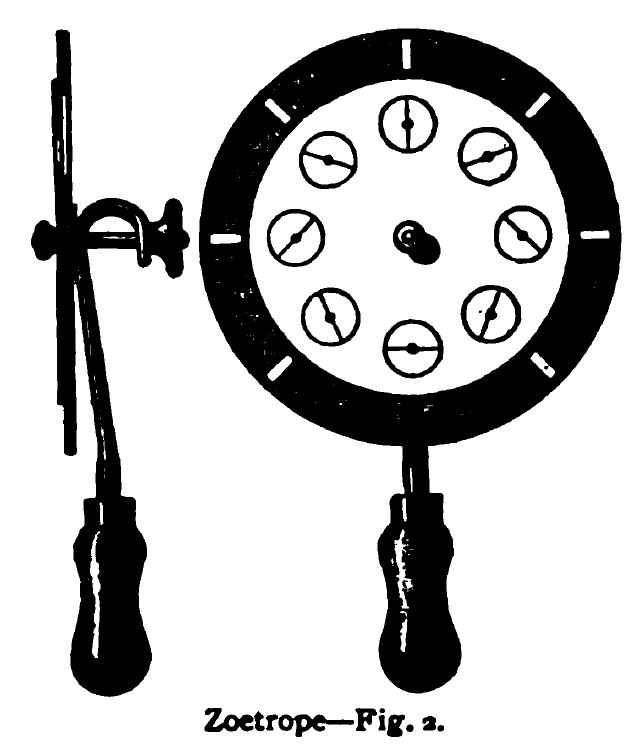
Zoetrope. The application of photography to the Zoetrope —or wheel of life—is no new thing, as over twenty years ago Mr. Baden Pritchard made a series of photographs of a steam-engine, moving it forward a little between the taking of each picture; and when the series was viewed in the zoetrope, there was produced a most realistic appearance of the steam engine in motion. We must, however, go back much farther than this for the first idea of the lantern or projection zoetrope, something of the kind having been patented by Jundzill in 1856; but we believe the first exhibition of animated photographs on the screen in London was in 1882, when Muybridge exhibited the horse in motion at the Royal Institution. About the beginning of 1896 exhibitions of animated photographs on the screen became suddenly popular, and almost every maker of apparatus for this purpose gave a new and strange name to his particular form of the lantern or projection zoetrope. In the modern forms the series of negatives is taken on a long band of celluloid at the rate of about 900 per minute. A band of positives is printed from this by rolling the negative band and a band of coated celluloid together so that they shall run in contact in front of a source of light; and the exhibition is effected by means of a lantern, which automatically unrolls the positive band, and projects each photograph in succession upon the screen. For further information on this subject, see CINEMATOGRAPH.

Tuesday, January 30, 2018

Recent Scientific Discoveries -- January 30, 2018

San Francisco Call, 08-May-1900
RECENT SCIENTIFIC DISCOVERIES.
Copyright, 1900, by Seymour Eaton.

Note— These papers on Practical Science have been prepared for The Call's Home Study Circle by Professor William J. Hopkins of Drexel Institute.

VI. MOVING PICTURES.

If we look at one of the conventional pictures of a running horse— a picture twenty years old, preferably— and compare it with some of the more recent pictures of the same subject we may see a marked difference. In the older picture the horse is stretched out in an attitude which, to the eye not specially trained, suggests speed. In the more recent one he may perhaps be seen standing like an awkward statue on one leg, with no visible means of support for the rest of him. And yet this is. in a sense, true to life, for it represents accurately the position of the horse at one instant. Except to the technically trained eye it conveys no impression of rapid motion, for the eye does not see things that way.

Persistence of Vision.

The response of the optic nerve and its connections to any action which produces the sensation of light Is not instantaneous nor does the sensation cease at once with the cessation of the cause. It persists for an appreciable time, varying from about one-thirtieth to one-tenth of a second, according to the intensity of the light. In the case of the running horse, therefore, the rapidly changing positions blend into an impression which is pretty well represented by the kind of picture that was customary before the days of instantaneous photography.

Muybridge's Pictures.

It would never have occurred to any one before Muybridge had come to this country and had shown his instantaneous pictures of moving horses that any horse ever assumed such attitudes. Even with the evidence before their eyes the first sensation of the majority his hearers was one of amusement and incredulity. His photographs were obtained by using a series of cameras so placed that the horse came before each one in succession and caused the exposure to be made at the right instant by the breaking of a thread. With the cameras at the right intervals there was thus obtained a series of pictures which showed successive instantaneous attitudes of the horse, with brief breaks between. If these pictures could be presented before the eye, one at a time, in order and rapidly enough, the impression of one would persist until the next appeared and the horse would be seen running, trotting or cantering naturally. Such an instrument, very crude and simple, existed at that time and had been in use for many years as a scientific toy. It was the zoetrope, the forerunner of the kinetoscope and all its kin.

The Zoetrope.

The zoetrope consists of an open cylinder, usually of cardboard, so mounted that it can be whirled on a vertical axis. In the upper half of this cylinder are cut equidistant vertical slits. The pictures in order showing the successive instantaneous positions In the motion to be represented are placed inside the cylinder, against the lower half, so that one picture is opposite each slit. On whirling the cylinder, therefore, keeping the eye at the row of silts, the pictures follow each other in rapid succession, only one being seen at a time. The sensation of each lasts until its image is replaced by that of the next, and the impression is that of the action of which the individual pictures show different stages.


Moving Picture Machines.

All machines for showing moving pictures by whatever name they may be called are nothing more than improvements and elaborations on the optical principle of the zoetrope. There are but few essential things which a successful machine of this sort must accomplish, but their accomplishment is not in every case altogether easy. The pictures must be presented so rapidly that there is no appreciable break between, either in light or in positions of the moving figures. The light must be admitted exactly as the picture is in place and must be cut off just before the picture Is changed. The different pictures must be shown in exact register or there will be a shifting or dancing effect which is not intended and is unpleasant.

Instead of a number of separate cameras to take the pictures, a single instrument is used, so arranged that the shutter is in practically continuous vibration at the rate of thirty or more exposures a second. In its proper place behind the shutter and lens a continuous strip of film is run in time with the shutter. Its motion is necessarily jerky, for it must be at rest for the exposure, while the shutter is open, and move ahead one space while the shutter is closed. By the development of this long strip of film there is obtained a series of negatives, from which positives are printed, in similar long strips, and these positive strips are used in the viewing or projecting instrument. If the positives are examined separately it will usually be difficult. If not impossible, to detect any difference in positions of the figures in pictures which lie near together in the strip, and when these pictures are passed through the projecting instrument at the same rate as that of the taking camera the movements of the figures upon the screen appear natural and lifelike.

The projecting instrument for moving pictures is a regular projecting lantern, with the addition of mechanism, attached to the objective, for keeping the shutter and the pictures in motion. This motion is kept up by a motor or by a hand-wheel, and the shutter or fan is run by the same mechanism that moves the film. A picture is held against the opening while the lens is uncovered, then released as the vane covers the lens, and the next one takes Its place, to be shown, in turn, the instant the vane has passed.

Practical Uses.

The chief use to which moving pictures have' been applied thus far is that of entertainment, and unfortunately the subjects which have aroused the most interest have been prize-fights. There are, however, many directions in which this instrument may prove of great value. It is proposed to make use of it in war and how far such an idea can be carried out we shall perhaps know better after the close of the present war in Africa. There are certain practical difficulties in having a kinetoscope camera at the front always ready for service, even If its use were permitted.

The value of a series of instantaneous photographs taken at short intervals in analyzing rapid motion is sufficiently obvious. By passing the pictures through the viewing instrument at a reduced speed the motion may be made as slow as we wish and its nature clearly seen. Another application of this principle which has recently been proposed is less obvious. It is proposed to take photographs at long intervals of movements which are very slow. Then, passing the series of_ pictures from these negatives through the viewing instrument at the usual speed the slow motion becomes rapid. Suppose, for example, that a photograph is taken every few hours of a sprouting seed and growing plant. When shown by the viewing or projecting instrument the sprout may be seen breaking through the ground, gaining in height and size, putting forth leaves, buds and branches and reaching its maturity, all in a few minutes. The same method may be applied to many things other than plants. To this modification of the principle of moving pictures it has been considered necessary to give a new name -- the "phantoscope."

Sunday, October 29, 2017

Synthetic Reconstruction of the Elements of an Analyzed Movement -- October 29, 2017

Étienne-Jules Marey was a French scientist who pioneered chronophotography, the capture of phases of movement in photographs.  His 1895 book Motion describes his years of work.  This chapter talks about reconstructing motion from the photographs using a phenakistoscope and a zoetrope.  

Joseph Plateau was a Beligian mathematician.  Ottomar Anschutz created the electrical tachyscope, a form of zoetrope.  Charles-Émile Reynaud created the Praxinoscope and Théâtre Optique. Georges Demenÿ used his Photophone to analyze mouth movements in speech.

I like the 3-D zoetrope. 

CHAPTER XVIII

SYNTHETIC RECONSTRUCTION OF THE ELEMENTS OF AN ANALYZED MOVEMENT

Summary.—Plateau's method; his phenakistoscope The zootrope; its applications to the study of horses' paces and their relations to one another—The use of instantaneous photography in connection with the zootrope — Muybridge, Anschütz— Scientific applications of Plateau's method—Points of a good apparatus— Improvements made by different authors—Attempts at constructing a chronophotographic projector.

Although chronophotography represents the successive attitudes of a moving object, it affords a very different picture from that which is actually seen by the eye when looking at the object itself.

In each attitude the object appears to be motionless, and movements, which are successively executed, are associated in a series of images, as if they were all being executed at the same moment.

The images, therefore, appeal rather to the imagination than to the senses. They teach us, it is true, to observe Nature more carefully, and, perhaps, to seek in a moving animal for positions hitherto unnoticed.

This education of the eye may, however, be rendered still more complete if the impression of the movement be conveyed to the eye under conditions to which it is accustomed. Such is the object of Stroboscopy, a method of immense scientific importance. The principles of this method were discovered by Plateau, and they depend on the physiological property of the retina of retaining for a brief moment the impression of an image after the object which has produced it has disappeared. The duration of this retinal picture is estimated at part of a second. So that if an image is placed before our eyes ten times in a second the idea of discontinuity is lost, and the images appear to be in continual evidence.

If the images shown to us are represented in the successive positions assumed by the object in motion, the impression conveyed to the eye is that of a continuous movement with no intermission. Now, we have seen that not only 10, but even 20, 40, or 60 images can be produced by chronophotography per second. If the 60 photographs taken during one step of a galloping horse could be passed before the eyes at the rate of 10 per second, the duration of the whole step would be spread over a period of 6 seconds, and hence we should have a considerable time in which to observe the motion of the limbs, so hard to follow under normal conditions.

In the same way a flying bird could be represented with slower wing movement, and so too with other phenomena which escape notice on account of their extreme rapidity.

Inversely, when a movement is so slow as to escape observation, photographs could be taken of it at long intervals and presented to the eyes in sufficiently rapid succession to allow of the changes being clearly perceptible. In other cases, if the photographs are presented to the eye at the same intervals as separate the successive exposures, the movement will appear as it actually took place. Such is the use of the stroboscope. We will now show the successive developments of this method.

Plateau's Phenakistoscope. — Everybody knows the ingenious toy invented by Plateau at the beginning of the present century, and to which he gave the name of "Phenakistoscope."

The original form of this instrument was a plaything which delighted us as children; it was destined, however, one day, to be used for more interesting purposes. The phenakistoscope consists of the following parts, a cardboard disc perforated at equal distances round the periphery by small slits. One side of the disc is blackened, and on the other a series of images are arranged representing men or animals in the various attitudes which correspond to the successive phases of a movement.

When the disc is spun round on its axis opposite to a mirror, and the eye applied to the blackened side on a level with the revolving slits, the reflections of the various images are seen one after another corresponding to the different attitudes assumed by the original object; this conveys an impression of actual movement. Fig. 202 represents the disc of a phenakistoscope; on it are arranged the successive photographs of a flying gull.

If this side is made to revolve in front of a mirror and the eye be applied on a level with the slits, the gull can be seen flapping its wings. The rapidity of the movement depends on the velocity of rotation.

The disc must be turned in the right direction, otherwise the images will succeed one another in the inverse order to that in which they actually occur, and the direction of movement will appear reversed.

Zootropes.—The manufacture of these articles became a commercial industry, and some of them were turned out in more convenient forms; one of them was called the "zootrope," and consisted of a cylindrical chamber revolving on a vertical axis. Narrow upright slits were made round the brim, and inside the cylindrical wall a strip of paper was pasted on which a series of images was arranged so as to represent the successive attitudes of a man or animal in motion. If these figures were observed through the slits while the zootrope was revolving, the same impression as that caused by the phenakistoscope was produced.

This contrivance, which has been adopted by many manufacturers, possesses one obvious advantage, namely, that several people arranged round the apparatus can watch the phenomenon at the same time.

Application of the Zootrope to the Study of Horses' Paces.—In the year 1867 we made use of the zootrope for the purpose of representing the various paces of a horse in motion, and also for showing how the various paces differed from one another. The latter could be shown by merely altering the sequence of the movements of the fore and hind limbs. This was the concrete demonstration of the sequence expressed by the chronographic charts.

At this time instantaneous photography had not been thought of, and so we used simple drawings to show the successive positions, our data were derived from the registered charts and from the actual foottracks.

We chose first the simplest case, namely, the paces of an ambling horse, in which the two limbs on the same side acted simultaneously. Twelve positions were drawn on a long strip of paper, six to represent the rise of the two feet on the right-hand side, the other six to represent their period of contact on the ground, the two feet on the left-hand side were of course in the opposite phases.

By arranging this strip of paper in the zootrope, the paces of an ambling horse could be easily recognized through the slits.

Now, for the purpose of showing how the other paces could be derived from those of ambling, we had recourse to the following device. Vertical lines were drawn through the middle of the horses' bodies, and square frames were constructed round the posterior halves of the figures containing the hind limbs of the animals. The squares of paper were then cut out, and the original strip of paper then remained, representing a series of positions of the fore quarters, and behind each of these mutilated images there appeared a square hole in the paper. The strip of paper was then placed on another of the same size, and the hind portions of the images which had been cut away were gummed each in its proper position upon the lower strip. When this was done, the two strips taken together presented the appearance of the original slip, namely, the successive attitudes of an ambling horse during the performance of one stride. If the lower strip is moved on one place, so that the fore feet of one image are united to the hind feet of the image immediately behind it, the fore feet will be ^ of a step in advance of the hind feet, and the whole series thus broken up will give the appearance in the zootrope of a racking pace, in which the hind limbs slightly anticipate the movements of the fore limbs.

By sliding the lower strip of paper a little further forward the appearance of a walking pace is produced. Still another move in the same direction and we have a broken trot, and then again a walk.

This is the concrete expression of the relations given by the chronographic chart Fig. 123.  (I omitted the chart from this post -- JT)

With this method persons familiar with horses' paces can recognize each example, and realize its derivation from the others. We have been most ably seconded in these researches by M. Mathias Duval, now professor at the Faculty of Medicine and at the School of Fine Arts. This savant recognized the importance of this method for teaching complicated and rapid movements such as could otherwise only be learned at the cost of much labour by specialists. M. Zecky, professor at the School of Fine Arts at Vienna, has adopted the same method for representing horses' paces. We still possess some very carefully drawn series which he sent us.

Use of Instantaneous Photography in connection with the Zootrope.—In this method the accuracy with which the paces were represented was entirely dependent on the skill of the artist, and hence it was left for photography to perfect the zootropic representation of motion.

From the time when Mr. Muybridge succeeded in taking a photographic series of the positions assumed by men and animals in motion, he invariably resorted to Plateau's method for synthesizing the movements he had analyzed.

The apparatus used by Mr. Muybridge was a sort of projection phenakistoscope, in which pictures of horses painted on glass discs, and copied from the author's photographs, were placed in the focus of the projecting lantern and made to rotate. Slits made in the discs admitted light at the required moments. A considerable audience could thus see upon the screen silhouettes of horses moving in various directions and at various paces.

Zootropes of Muybridge and Anschütz.—We have already remarked that the figures were painted. Now, one great disadvantage of Muybridge's apparatus, and, indeed, of the zootrope itself, is that the figures are out of proportion, owing to their reduction in the transverse direction, so that the painted horses on the revolving discs have to be made longer than they really are, so as to appear in their true proportions when thrown upon the screen.

M. Anschütz prepared for the ordinary zootrope strips of paper covered with photographic prints of men and animals in motion. In this case the figures were distorted; horses especially showed an appreciable diminution in length.

Solid Figures in the Zootrope.—We also made use of the zootrope in studying the movements of birds' wings, and for this purpose we resorted to a particular contrivance. Instead of a strip of paper covered with figures, we introduced into the zootrope a series of wax models painted in oils, and representing the bird in all the successive phases of its wing movement. The illusion was complete, and a flying bird could be seen flying round and round the apparatus; sometimes flying away from the observer, sometimes across, and sometimes towards him. (This zootrope with solid figures is still preserved at the Physiological Station.)


Scientific Applications of Plateau's Method.—All these applications would be simply childish if they were limited to the reproduction of phenomena which could be observed by the eye in the case of living creatures. They would be attended, in fact, by all the uncertainties and difficulties which embarrass the observation of the actual movement. In a bird, for instance, the wings could only be distinguished as an indistinct mass, just as they appear in nature. But a combination of the zootrope and chronophotography has further possibilities, for it enables the observer to follow movements, which would otherwise be impossible to examine, by slowing down the motion to any desired rate. We have already pointed out during a single stroke of the wing, which lasts 1/5 of a second, a series of twelve photographs can be taken at intervals of 1/60 of a second. Now, these twelve photographs, which correspond to a single stroke of the wing, can be made to pass before the eye in one second. This succession is sufficiently rapid to produce an impression of continuous motion. Under these conditions, the rate of movement is reduced to one-fifth of its actual velocity, and the eye can follow it in all its phases, whereas, in a living bird, only a confused flutter of the wings can be distinguished.

In the same way, by slowing down the phases of a horse's paces by means of the zootrope, they can be more easily analyzed than by observations made directly on the animal.

It is not, however, only by reason of their rapidity that some movements elude observation, sometimes their very slowness renders them inaccessible to our senses, take, for instance, the growth of animals and plants. These movements may, however, become quite visible if they are photographed at considerable intervals of time, and the corresponding series of images passed rapidly before the eyes by means of the zootrope.

Professor Mach, of Vienna, suggests a curious line of research by means of this method. His idea is to take a number of photographs of an individual at equal intervals of time, from earliest infancy until extreme old age, and then to arrange the series of images thus obtained in Plateau's phenakistoscope. If this were done, a series of changes, which had been brought about during a period of many years, would pass before the eyes of the beholder in the course of a few seconds, and thus the stages of a man's existence would pass in review before the gaze of the onlookers in the form of a strange and marvelous metamorphosis.

This method invented by Plateau seems likely to extend our knowledge as regards all kinds of phenomena. But the future of the method is dependent on the possible correction which can be effected in the distortion of the images, and on the discovery of a satisfactory means of projecting a number of moving figures on a screen, so as to be visible to a large audience. And, further, it will be necessary to augment the number of successive photographs, so as to represent a performance of considerable duration.

Improvements suggested by Different Makers.—So that the images might be projected without distortion, several object-glasses were arranged in a circle, and at the focus of each positive images were arranged representing the different phases of a movement. All the object-glasses were directed towards the same spot on the screen in such a way that by successively illuminating each of the positive images placed behind them, the corresponding attitudes were successively projected on the screen. To effect the successive illuminations of the slides, it has been suggested that a Drumont lamp should be made to revolve as a source of light.

Images projected in this way ought to be perfect; but the focusing of each, and the determination of the direction of the object-glasses, would be a most laborious operation. Moreover, the number of object-glasses is necessarily limited to five or six, and thus the extent of the movement periodically repeated, as the lamp completes its revolution, is necessarily very short.

M. Raynaud's Praxinoscope.—Under this title, M. Raynaud (Reynaud - JT) has given to the world an extremely ingenious instrument. As in the ordinary zootrope, the figures are arranged within a cylinder, and are reflected by a prismatic mirror situated at the centre of the apparatus, and thence reach the eye of the observer. The contrivance is peculiar in that the substitution of one position for another is effected without any intermediate eclipse, so that the images, owing to the constant illumination, appear exceedingly bright. By interposing a photographic object-glass in the path of the reflected images, M. Raynaud has thrown them upon a screen, and magnified them to the required dimensions. Finally, by substituting for the flat circular strip of figures a long strip which winds off one roller on to another, the writer has been able to display a performance of considerable duration. As yet, M. Raynaud has only employed figures' drawn or painted by hand; doubtless he could obtain remarkable results by substituting a series of chronophotographs. A slight defect in the apparatus is that the plane of the projected images is slightly oblique as regards the principal axis of the object-glass, this is due to the construction of the apparatus. It is thus impossible that all the parts of the images can be in focus, and hence the projection on the screen is somewhat indistinct.


M. Demeny's Photophone.—M. Demeny has employed another method for reproducing the movements of the face, the tongue, and the lips, executed during speech. My assistant at the Physiological Station has prepared on a length of film a chronophotographic series consisting of twenty-four portraits of a man articulating certain words. When this series of portraits was transferred to the circumference of a glass disc and placed in the focus of a photographic object-glass, they were brightly illuminated from behind, and rendered visible for brief intervals by an arrangement of fenestrated diaphragms, as used in chronophotography. The shortness of the exposures, and the perfect working of this apparatus, represented the images as immovable, and they appeared exactly at the same spot, in spite of the rotation of the disc upon which they were placed. (This instrument was designed by M. Demeny, and called the "Photophone" (C. R. de l'Academie des Sciences, July 27,1891).

These photographs give such a perfect representation of speech that deaf mutes accustomed to read the movements of the lips have been able to recognize the words spoken by the person photographed.

I doubt whether it is possible to make a more perfect zootrope, and yet there are a few defects that one can mention. Firstly, the number of images that can be transferred to the disc is necessarily limited, unless the apparatus is of enormous size; and, secondly, since a good definition of the movements can only be obtained by very brief exposure, it follows that the amount of light given off must be too small to produce with distinctness an enlarged projection, and this is the case even when the source of illumination is of the most powerful description.

This list of the different forms of apparatuses used in the synthesis of movement is, no doubt, incomplete; but it may serve to indicate the respective advantages and disadvantages of each system, and to serve as a guide to those who may wish to make fresh researches in the same direction.

The Points of a Good Apparatus.—In apparatuses in which the figures rotate with a continuous movement the image can only be made to appear motionless by giving such a short exposure that the movement during that time is inappreciable.

Now, the brevity of the period of illumination entails a considerable loss of light, and hence the image, when projected on a large scale, is hardly visible at all. If, on the other hand, it is necessary to produce a brilliant projection, the duration of the exposure must be as long as possible; in that case, however, the image which is for the time being under observation must be absolutely motionless. It is obviously impossible to ensure alternate periods of rest and motion with discs or other heavy pieces of revolving apparatus. The solution of this problem is the same as that which we adopted in chronophotography. The apparatus which is used for the analysis of movement is reversible, at least in principle, and might be used for their synthetic reconstruction. Let us imagine that a strip of film has imprinted on it positive images, and that this strip is placed at the focus of the object-glass, and brightly illuminated from behind. If these figures are then projected on a screen as far removed from the object-glass as were the original objects, the figures will appear to actual scale.

Every time the objective is exposed by the rotation of the diaphragm an image is thrown on the screen, the outlines of which are perfectly defined, because the film is arrested by compression at the moment of exposure. As a matter of fact, it is better to adopt a special contrivance for projecting moving figures.

The following are the reasons which induced us to construct a new instrument, to which we have given the name, "Chronophotographic projector."

The Chronophotographic Projector.—In a projecting apparatus the exposure should be as long as possible, and the transparency should be arrested during the whole period of its projection upon the screen. These conditions must be fulfilled if bright and clear images are required. In the case of the analyzing apparatus, the exposures, on the contrary, should be as brief as the illumination will allow. For an insect's wing, the exposure should be no more than 25000 part of a second. Now, with such a short exposure, an image would be almost invisible if greatly enlarged by projection; and this would still be the case even were the source of illumination very powerful. The most important point in constructing a projector is to secure as long an exposure as is possible. For instance, if ten images were taken per second, the exposure should be half or a third as long; that is to say, for 1/20 or 1/30 of a second, instead of for 1/1000 of a second, which is the usual exposure allowed by an analyzing apparatus. Instead of the small fenestrations on the circular diaphragms, long slits should be made, occupying a third of their circumference. During this long exposure, the film should be completely arrested, and for this purpose the compressor should have a particular kind of cam.

To realize the nature of a movement satisfactorily, it is as well to reproduce it several times. This may easily be done by an apparatus fitted with revolving discs; but, as in our apparatus, we have to use a length of film, it should be glued together at the ends, so as to produce an endless series of images continually rotating at the focus of the objective. Such a strip as this could not be introduced into the ordinary chronophotographic apparatus.

We have therefore constructed a special apparatus, in which an endless length of film containing forty or sixty figures, or even more, is allowed to pass without cessation under the field of the objective.

The illumination, which is from behind, and consists either of the electric light or the sun itself, projects these figures upon a screen. This instrument produces very bright images, but it is noisy, and the projected figures do not appear as absolutely motionless as one could wish.

Having arrived at this point in our researches, we learned that our mechanic had discovered an immediate solution of this problem, and by quite a different method; we shall therefore desist from our present account pending further investigations.

Thursday, September 25, 2014

Chronophotography, Part One -- September 25, 2014


An excerpt from "Chronophotography" from Magic: Stage Illusions and Scientific Diversions, Including Trick Photography, edited by Albert Allis Hopkins.  We will learn more about Étienne-Jules Marey in Part Two. 

Instantaneous photography has been of the greatest possible use to science, especially that branch of it which has been termed "chronophotography." It is to the investigations of Mr. Muybridge and M. Marey that we are indebted for the most valuable researches on the subject. Chronophotography consists in taking a number of photographs of any object at short and regular intervals of time. This is accomplished in many ways, and results obtained are useful for many purposes. The graphic method has been of great service in almost every branch of science, and laborious statistics obtained by computation have been replaced by diagrams in which the variation of a curve expresses in the most striking manner the various phases of some patiently observed phenomena. Furthermore, by the methods of modern science, a recording apparatus has been devised which, working automatically, traces the curves of such physical or physiological events which, by reason of their slowness, feebleness, or their speed, would otherwise be inaccessible to observation. The development of these methods of analyzing movement by photography have enabled the researches of physiological laboratories to become of the greatest possible value. The matter in this chapter is very largely an abstract of M. Marey's researches, which were originally published in "La Nature" and their publication in the "Scientific American Supplement" extended over a period of several years. Subsequent to this publication M. Marey wrote a book called "Le Mouvement,""which has been translated by Mr. Eric Pritchard under the title of "Movement." It is published in the International Scientific Series; and for a more extensive and scientific treatment of the subject than we are able to give here, we refer our readers to this excellent work. M. Marey describes the rudiments of chronography by supposing we take a strip of paper which is made to travel by clockwork at a uniform rate. A pen affixed above the paper marks, as it rises and falls alternately, the various periods and intervals. When the pen comes in contact with the paper it leaves a record in the form of dashes of different lengths at varying intervals. If the dashes should be equidistant it shows that the periods of contact follow one another at equal intervals of time. Now, as it is known that the speed at which the paper travels is so many inches or feet per second, it is an easy matter to obtain an accurate measurement of the duration of contact and of the intervals between. In brief, this is the principle of chronography. Chronophotography is simply an amplification of this system and has many advantages, rendering measurements possible where the moving body is inaccessible. In other words, there need be no material limit between the visible point and the sensitized plate.

Mr. Muybridge's experiments on the gaits of the horse are famous. He used a battery of cameras as shown in our first engraving. Some of the results obtained are shown in Fig. 2.

On the left is the reflecting screen against which the animal appeared en silhouette. On the right is the series of photographic apparatus, of which each one took an image.


In Mr. Muybridge's arrangement, photographic instruments faced a white screen before which passed an animal walking, trotting, or galloping. As fast as the animal advanced, the shutters of the lenses opened and permitted the taking of negatives of the animal. These were, of course, different from each other, because they were taken in succession. They therefore showed the animal in the various attitudes he assumed at different instants during his passage across the field covered by the instruments. The dazzling white light brought out en silhouette the body of the animal. Each shutter is actuated by a powerful spring; the shutter is opened as the animal advances. Threads may be observed across the road; the animal, breaking these threads one after the other, opens the shutters. Mr. Muybridge varied his experiments most successfully. He studied the gaits of different animals, and those of men in jumping, vaulting, and in the handling of various utensils. But since this time the progress of photographic chemistry has wonderfully increased the sensibility of the plates, and at the present day more than mere silhouettes of moving animals and men can be obtained. In a good light full images with all desired relief can be obtained. For example, if an athlete in motion is photographed, all of the muscles of the body are perfectly traced in relief, indicating the parts taken by each of them in the movement executed. The methods used by Mr. Muybridge would always suffice to illustrate the successive phases of the displacement of the members if they were taken at equal intervals of time, but the arrangements adapted for bringing about the formation of the successive phases cause irregularity in the extent of these intervals. The threads give more or less before breaking; moreover, the progress of the horse is not at an even rate of speed. Nevertheless, Mr. Muybridge endeavored to develop from a series of images the trajectory of each leg of a horse, but the curves obtained in these laborious attempts had not sufficient precision.

Sunday, July 27, 2014

The Zoopraxiscope -- July 27, 2014


From The British Journal of Photography, June 9 and 16, and July 28, 1882.  Miss Thompson was Elizabeth Thompson, Lady Butler.  Étienne-Jules Marey was a pioneering chronophotographer. 
I assume M Meissonier is the painter Jean-Louis-Ernest Meissonier.  Thomas Protheroe was a Bristol photographer. 


The illustration is from "The Horse in Motion" by George Waritig, Jr, in The Century; a popular quarterly / Volume 24, Issue 3, July 1882: http://bigvriotsquad.blogspot.com/2014/06/the-horse-in-motion-june-23-2014.html

June 9, 1882

Mr. MUYBRIDGE At Liverpool.—On Monday evening last, the 5th inst., at the Liverpool Art Club, in Upper Parliament-street, Mr. E. Muybridge delivered a lecture on The Attitudes of Animals in Motion. Mr. Benson Rathbone presided, and introduced the lecturer. There was a large attendance of members of the Club and their friends, and the lecture, which was similar to that recently delivered at the Royal Institution, London, and which attracted great attention at the time, was listened to throughout with the deepest attention. It was illustrated by photographic projections of the consecutive attitudes assumed by various animals in rapid motion—particularly the galloping of a horse—these being shown by the aid of the oxyhydrogen light and the zoopraxiscope, by which the most complicated movements were readily analysed. The subject is one of the highest importance and interest to artists and scientists, and, though, as the lecturer explained, the motion of fignres had been shown in the earliest pictorial art, it will be remembered that the subject received a new impetus at the time of the public controversy which originated with Miss Thompson's Roll Call, the great question of that day among the art-critics being "How a horse walks." That and other recent pictures, as well as the inquiries of scientific men, aided as they have been by the discoveries brought about by the process of instantaneous photography, have originated new ideas with regard to animal motion; but the recent lecture demonstrated some most extraordinary truths, which will be of the greatest benefit to art. On Thursday evening last Mr. Muybridge repeated his demonstration, before a large and appreciative audience interested in photography, at the private residence of Mr. John J. Atkinson, Upper Parliament street. All present expressed themselves pleased and instructed by Mr. Muybridge's treatment of his novel and most important topic. We understand an elaborate work upon the above subject is in preparation, in which Professor Marey and M. Messonier will co-operate. This is intended to be a perfect exposition of the art of illustrating the attitudes of animals in motion from the earliest period to the present time. The volume will be issued under the auspices of Mr. Robert C. Johnson, of San Francisco—a wealthy and enthusiastic patron of art.

June 16, 1882
THE ZOOPRAXISCOPE.

On Thursday evening, the 8th inst., Mr. J. J. Atkinson invited a number of artists, scientists, photographers, and others to his residence, 140, Upper Parliament-street, Liverpool, to witness Mr. Muybridge, of San Francisco, give his seance representing quadrupeds, bipeds, and birds in motion, illustrated by means of the zoopraxiscope, as briefly noticed in our last issue.

Mr. Muybridge explained that the problem of animal mechanism had long engaged the attention of mankind. In every age and in every country philosophers have found it a subject of exhaustless research. M. Marey, the eminent French savant of our own day, dissatisfied with the investigations of his predecessors, and with the object of obtaining more accurate information than their works afforded him, employed a system of flexible tubes, connected at one end with elastic air chambers which were attached to the shoes of a horse, and at the other end with some mechanism held in the hand of the animal's rider. The alternate compression and expansion of the air in the chambers caused pencils to record upon a revolving cylinder the successive or simultaneous action of each foot as it correspondingly rested upon or was raised from the ground. By this ingenious and original method much interesting and valuable information was obtained, and new light thrown upon movements until then but imperfectly understood. While the philosopher was exhausting his endeavours to expound the laws that control and the elements that effect the movements associated with animal life, the artist, with but few exceptions, seems to have been satisfied and content with the observations of his earliest predecessors in design, and to have accepted as authentic, without further inquiry, the pictorial and sculptural representations of moving animals bequeathed from the remote ages of tradition.

Yet (Mr. Muybridge argued) the action of no single limb can be availed of for artistic purposes without a knowledge of the simultaneous action of the other limbs; and to the extreme difficulty of the mind being capable of appreciating the simultaneous motion of the four limbs of an animal may be attributed the innumerable errors into which artists have been betrayed. The walk of a quadruped would seem to be a simple action, easy of observation, and presenting but little difficulty for analysis; yet it has occasioned interminable controversies among the closest and most experienced observers. The remarkable conventional attitude of the Egyptians has, with few modifications, been used by artists of nearly every age to represent the action of galloping, and prevails in all civilised countries at the present day. A few eminent artists—notable among whom is M. Meissonier—have endeavoured, in depicting the movements of animals, to invoke the aid of truth instead of imagination to direct their pencils, but with little encouragement from their critics. Until recently, artists and critics alike have necessarily had to depend upon their observation alone to justify their conceptions or to support their theories. Photography was soon recognised as a most important factor in the search for truth; and he (Mr. Muybridge), being much interested with the experiments of the French professor Marey, invented, in 1877, a method for the employment of a number of photographic cameras— twenty-four—arranged in a line parallel to a track over which the animal would be caused to move, with the object of obtaining, at regulated intervals of time or distance, several consecutive impressions of him during a single complete stride as he passed along in front of the cameras, and so of more completely investigating the successive attitudes of animals while in motion than could be accomplished by the system of M. Marey.

Mr. Muybridge illustrated the action of the horse and other animals with the zoopraxiscope, showing the walk, tlie amble, the trot, the gallop, and the leap, with the animals in motion. One of the most graceful movements was that of the deer, though the greyhound also came in for much admiration. Some of the stationary photographs of horses foreshortened were most artistic, and will teach artists and sculptors what the true motions of quadrupeds and bipeds really are, and prevent them depicting impossible positions. Among other novelties not before exhibited in Liverpool was one representing a pair of light-weight boxers, which caused so much amusement to the Prince and Princess of Wales. The foot race, representing a number of professional runners working themselves along with their elbows, created much interest, as did also the photographs of vaulters and circus riders.
 
Altogether the lecture, though much curtailed in order to give more time to using the zoopraxiscope, was a most interesting one, and several of the guests questioned the lecturer freely as to how certain results were obtained. The moral of the lecture seems to be that it will soon be definitely established that the various motions of animals trotting, cantering, galloping, &c.—are governed by laws which are as fixed as the motion of a locomotive.

July 28, 1882

ON THE ATTITUDES OF ANIMALS IN MOTION. To the Editors.
Gentlemen,—In reading the lecture by Mr. Muybridge before the Society of Arts one cannot but be struck with his refreshing assurance at the commencement, where he says that artists from all ages to the present time have been inaccurate in their notions in depicting animals in motion.
After reading the article and seeing the pictures of the animals he has photographed, I am of opinion that he is not warranted in his attempt to lecture and censure artists. An artist paints simply an impression of motion as he sees it, as it is impossible for him to see the subdivision of motion or section of a stride; and until we are endowed with further visual powers we must remain contented.
 
In some of the pictures a horse is represented motionless, the fore limbs standing still, while the hindermost are in what appears extravagant motion, such as I have never seen it in life. When a horse rises to a fence it is impossible to see his hind pasterns horizontal. Again: fancy a bird in flight painted with its wings folded under it, or a running dog with his legs gathered up as if in a knot! It may be right photographically, but is wrong artistically. To give a notion of hunters, or a pack of hounds in full cry, they must be painted as we see them— with their limbs stretched to the utmost, "tearing away like mad."
 
Another illustration: if the spokes of a wheel in motion are perfectly seen as represented by instantaneous photography, and an artist were to paint them so, we should have no idea of motion, as they always appear as a blurred circle, and must, therefore, be so painted. Instantaneous photography, in many instances, might be termed photographic juggllng or a glimpse of the unseen—a practical illustration of a line from Longfellow, that ''things are not what they seem."


The lecture and illustrations are, undoubtedly, of great interest to the scientist or the curious as studies of analyses of motion; bnt beyond that, I fear, will be of little use. Probably they may be the means of starting a new school of fanatics in painting, who will stand the chance of being laughed at for their pains, in trying to depict what is right photographically, but is never seen with the unassisted eye, and therefore incongruous.
 
Persons who are interested in this matter should study the pictures referred to—not with the aid of the zoopraxiscope, but simply as they are; and I leave them to judge whether they seem correct with their own idea of animals in motion.—I am, yours, &c, T. Protheroe,
Bristol, July 24, 1882.

Monday, June 23, 2014

The Horse in Motion - June 23, 2014


The Horse in Motion*
by George E. Waritig, Jr.

This article by George E Waritig, Jr discusses the early experiments of Eadweard Muybridge. A photo scan of this article is available from Making of America at Cornell University. An uncorrected text scan is available from the Library of Congress' American Memory site. I did some cleanup of the text scan. I made a few editorial comments in italics with my initials. Be sure to click on the images to see larger versions.  

From The Century; a popular quarterly / Volume 24, Issue 3, July 1882


THOSE CURIOUS in such matters were much interested, a few years ago, by the circulation of a few sets of photographs, taken at the private race-course of Governor Leland Stanford, of California, by Mr. Muybridge, a photographer of San Francisco. The consecutive positions of the legs in the stride of a running horse, as revealed by these photographs, seemed ludicrous and almost impossible. Indeed, it required the combination of the positions given by the reproduction of the pace in the zoetrope to convince the skeptical that the analysis of the movement was correct. The testimony of the zoetrope, and, later, of the zoepraxiscope, has silenced all skepticism, and one can no longer hesitate to concede the truth and simplicity of what, at first, seemed complicated and absurd. Since the first appearance of these photographs, the processes for securing them have been much improved, and Mr. Muybridge's public and private representations, here and abroad, have been received with the greatest favor. Meissonier, who has made a specialty of the action of the horse, is announced as an adherent of the new theory, and it is said that he has recently modified a painting in conformity with it.

While great credit is due to Mr. Muybridge for the ingenuity and skill with which he has applied his art to the production of these pictures, they would not have been taken, nor could the world have had the full benefit of them which it now receives, but for the intelligent liberality of Governor Stanford, who, at much cost and with no chance for pecuniary reward, has carried the investigation to great lengths, and who now presents its results in a large quarto volume, containing more than a hundred plates, which bear over a thousand figures of animals in motion. These illustrations are accompanied by an elaborate essay, in which Dr. Stillman explains their application to the locomotion of quadrupeds, of horses especially.
 
The method by which these photographs have been taken the result of years of experiments substantially as follows: At one side of the track is a long building arranged for photographic work, containing a battery of twenty-four cameras, all alike and standing one foot apart. On the other side of the track is a screen of white muslin and a footboard. The screen is marked with vertical and horizontal lines, and the foot-board bears numbers indicating separate intervals of one foot each. The instantaneous shutters of the cameras are operated by electricity, and their movement is governed by such powerful springs that the exposure is estimated to be about one five-thousandth of a second. The contact by which the shutters are sprung is made by the breaking of a thread drawn across the track at about the height of the horse's breast, there being one thread for each camera. In his flight through the air, therefore, he brings each of the twenty-four cameras to bear upon him at the moment when he passes in front of it, and that camera represents his position at that instant. The series of representations indicates the consecutive positions at each of the twenty-four feet covered by the instruments. In a series showing a horse trotting at speed the spokes of the sulky are shown as distinct lines quite to the felloe of the wheel, indicating an extremely short exposure. In a fast run, the tufts of the horse's tail, as it waves with his stride, are clearly marked. The distinctness of the silhouettes thus produced is well illustrated in Figures 1, 2, 3, 4, 5, 6, 7, showing a hound running with a stride of twenty-one feet. These and the other silhouettes illustrating this article are copied from heliotypes taken from the original photographs.
 
The illustrations 8 to 18, which follow, are not absolute reproductions; but in drawing them the greatest care was taken to preserve the outlines of the original. Their essential correspondence with the photographs of an animal running at speed show they may be taken as an unquestionable analysis of that gait. It is to be understood that the horse is at full speed, and that the illustrations here given represent alternate photographs of a series of twenty-four; that is, that they represent positions at intervals of two feet. The eleven cuts cover a trifle more than one stride, the supporting fore leg in the last being a little further to the rear than in the first. In Figure 8 the whole weight is borne by the left fore leg, the pastern of which is nearly horizontal, and which is nearly under the center of gravity. The hind feet are about twelve and fifteen inches from the ground, and the croup and withers are about two inches below the gauge line. Figure i8 shows this supporting foot just before leaving the ground. The extreme lengthening of the leg, by straightening the angles between the shoulder and the forearm, has raised the body about an inch nearer to the gauge line. The effect of that thrust, and of the straightening of the pastern, is continued after the foot leaves the ground, so that in Figure 9 the croup and shoulder have been thrown quite to the gauge line. In Figure 10, the horse being still off the ground, the croup has gone an inch above the line. It has hitherto been the general belief that when the horse descends from his bound he lands on one of his fore feet. Figure 11 shows that the right hind foot first reaches the ground, the other three feet being more that twelve inches above it. As this hind leg passes to the rear in Figure 12 the pastern is parallel with the ground, the left hind foot is preparing to take its position, and both fore feet are moving to the front. At the next position, Figure 13, both fore feet being still more than a foot from the ground, both hind feet are in firm contact with it. In Figure ii., the right hind foot is ten inches from the ground and far to the rear. The left hind foot is performing the functions of the right in Figure 12, and the right fore foot is on the ground. The leading fore leg is extended to its utmost in Figure 15. The two hind legs are extended, and the left fore leg is still four inches from the ground (Figure 16), when the right, the only one in contact, is nearly at the end of its stroke. In Figure 17, eighteen feet in advance of Figure 1, the left fore foot is still somewhat in advance of the position there shown. Figure 18, as above stated, finishes the stride, the leg, strongly extended to the rear, having started the upward propulsion that is to carry the horse through the air until his right hind leg reaches the ground.


The deductions from these few illustrations cannot be adequately set forth within these limits. The most curious of them, anatomically, relates to the fact that the horses withers are much further from the gauge line when one of his fore legs is almost directly under him (Figure 15) than when that leg is extended to the utmost, and when the other feet are in the air (Figure i8), the whole body being strongly thrown upward, as if by the force with which this one leg is extended. This thrust -- which shows a wonderful flexibility and strength of the whole mechanism, from the top of the shoulder to the toe -- involves the action of muscles whose relations to this movement Dr. Stillman explains in his notes. Another deduction which it seems difficult to avoid is this: Not only are the fore legs of a horse something more than mere supporters of his weight between successive thrusts of the hind-quarters: they are themselves most effective in propelling the body forward. Dr. Stillman even says:
 
 "It will be apparent * * * that each limb is required to support the body and act as a propeller in turn, and that the anterior one does more than its share of both offices." (The italics are mine.)
 
Nevertheless, it will need more than the photographs and diagrams shown in this book, and the reasoning with which the proposition is advanced, to convert to full belief in this theory one who has watched from a coach-box the tremendous action of the dorsal muscles of a pulling horse. If there is a weak point in the reasoning, it may, perhaps, lie in the fact that due consideration is not given to the effect upon the horizontal momentum of the body of the dirt-throwing movement of the fore foot as it passes over the toe -- an effect somewhat akin to that produced by a match on a billiard-table in making a ball "hop."
 
Looking at these illustrations as a series, the first impression of absurdity must be inevitable; but, as I have had occasion to learn through the perfect reproduction of a graceful and vigorous stride, on placing them in the zoetrope and there studying their combinations at low speed, they lose, in time, their extravagant appearance, and are easily associated in the mind with the natural action of a rapidly moving horse. To what extent they may be useful in modifying the pictorial representation of animals in motion it is not easy to determine. This part of the subject will have consideration further on.
 
The numerous illustrations given of walking, trotting, cantering, running, and pacing are all most instructive and suggestive, none of them more so than the series 19 to 30, showing a leaping horse. These twelve figures are selected from a series of forty-eight, which begin twenty-one feet before a hurdle three feet and six inches high, and terminate twenty-one feet beyond it. The selected figures begin sixteen feet in advance and terminate nineteen feet beyond. As the horse approaches the leap he slackens his speed, puts one fore leg far in advance, throws his weight upon that leg, and advances his hind legs (19), which pass the position of the supporting fore foot, and strike the ground about two feet in advance of it (20); as the fore leg is about leaving the ground it gives an upward thrust for the rise to the leap (21), a simultaneous spring from the hind legs carrying the animal into the air and over the hurdle (22, 23, 24, 25, 26, 27), until he lands on his fore legs differently advanced (28), and gathers himself (29), ready to begin a fresh stride (30). The distance covered by the leap shown in the illustration between the last position on the ground of the hind feet and the landing with the fore feet is about twenty-seven feet. It has been asserted that when a horse lands from a high leap he touches the ground with his fore feet, and makes another step forward, with them both, before his hind feet come to the ground. Muybridge's illustrations of leaping all show that the horse lands on one fore foot, the other taking its position immediately afterward, a little in advance. The quickness of the movement has probably misled observers to the idea that both feet take first one position and then the other. The illustrations 31 to 37 show an unpremeditated standing leap. The horse baulked at the hurdle, and was forced over it with great difficulty. It seems hard to believe that, having forced himself into the position shown in 34 he could, with his legs thus extended, spring to the position in 35. The positions of the rider in 36 and 37 indicate a general disturbance of forces which, to one who has made a standing leap for which he was unprepared, will seem very truthful.


The illustrations thus far given serve to show the method adopted to indicate the consecutive positions in the measured movements of the horse and of other animals. Their value is very much enhanced by the later series, where five views are given of each of many positions in different gaits. The cameras for this purpose were arranged so as to take one broadside view and four quartering views, looking, for example, to the right shoulder, the left shoulder, the right quarter, and the left quarter, the contact for each being made by the breaking of a single thread struck by the horse when he came into the focus. Figures 38, 39, 40, 41, and 42 show one picture of each of five series. These are not immediate reproductions of the photographs, but the drawings from which they are taken were accurately made on enlargements of the photographs. They are pictures of the same horse leaping, but are parts of five different leaps. In the approach (38), the horse is in the position next preceding that shown in Figure 19. In 39 he is in that shown in Figure 21; in 40 in the position shown in Figure 23; in 41 in the position shown in Figure 27; and in 42 in the position succeeding that shown in Figure 28. Corresponding representations of a leaping horse are not recalled as appearing in Leech's and other illustrations; that they are, however, entirely true to nature must be at once recognized by any one who, bearing them in mind, will watch the actual leaping of a well-trained horse.
 
 
The truth to nature of most of the illustrations given in the work under consideration, while it cannot be questioned, must be considered with reference to the fact that the horses under examination were nearly all highly bred animals, mainly thorough-bred race-horses. The photographs would necessarily show some modification, if representing horses in common use and of less graceful and vigorous conformation. But, modified as they may be, they can never by any ordinary process be reconciled with the conventional horse of the artist, ancient or modern. The horse in full gallop is almost invariably shown either, as in racing plates, extended to the utmost, or with an equal and uniform disposition of the limbs, as shown in Figure 43, which is a fair example of the representation of a strong and regular gallop. Not one of the series of cuts Nos. 8 to 18 gives, by itself, an idea of great speed. Figure 44, however, corresponding with Figure 18, has a strong headlong movement, and may easily be imagined to be a picture of a horse running at great speed. It becomes now a curious and not unimportant question to discuss whether or not artists should abandon their old method of representing the galloping horse, and show him always in some one of his actual positions.
 
 
Dr. Stiliman is very strongly of the opinion that they should do so. Perhaps, after all, it resolves itself into a question as to whether an artist whose purpose it is to represent things as they seem, is justified in adapting his methods to the limitations of the human vision, or whether he should show things exactly as they are, and appeal only to human reason. Dr. Stillman says: "It seems to many unaccountable that the horse, whose movements are so open, should play such a leger-de-pied as to deceive all eyes and give rise to controversies as. earnest as did the colors of the chameleon in the fable." But Dr. Stillman seems, himself, to account satisfactorily for what he suggests as unaccountable. He says:
 
"It is difficult at a glance to conceive how the eye could be so deceived; but a little consideration of the physiology of that organ will teach us that no dependence can be placed on it to interpret the motion of an object moving irregularly, even at a comparatively slow rate of speed.
 
"It has been shown that the retina of the eye is capable of receiving a distinct image of an object in almost inconceivably short space of time, as that of the flash of an electric spark or a millionth part of a second, and that the impression remains for the space of a third to a seventh of a second, according to the experiments of D'Arcy and Plateau; and the mind is incapable of distinguishing between the first impression and the last made during that space of time, and the images run together and are confused. A familiar illustration of this phenomenon is furnished by the spokes of a wheel in motion; yet these spokes will appear stationary if, revolving in the dark, they are suddenly illuminated by an electric flash; or if the end of a stick be ignited, and moved rapidly, a continuous line of fire will appear. Here there is a continuous line of impressions made upon the retina, and so conveyed to the mind ... The reader may ask why it is that the artists of all time, with the full accord of all men and our own eyes confirm the tradition -- represent the horse in galloping as extending his feet to the utmost as seen in all the pictures of horses racing. My answer is this: We now know that it is not true that a horse ever did put himself in the position portrayed by the best artists; and the explanation that I have to offer is, that in the gallop the horse always moves his feet alternately, and to the same extent; at the limit of extension there is a change of direction given to them, and their image dwells longer upon the retina, and the impressions are more lasting than of the intermediate and more rapid movements which the mind is unable to distinguish any more than the order in which they are made."
 
This looks like an unconscious undermining of the whole structure that he has labored to erect.
 
If a painting showed four horses harnessed to a coach, each of them in certain of the intermediate positions that instantaneous photography shows to be true, they would look as though they were dangling their legs at a stand-still. Whatever position might be given to a trotting horse in a picture intended to show great speed, its effect would be lost if he were shown as harnessed to a sulky of which the spokes of the wheel were visible, as we are told that they become when illuminated in the dark by an electric flash. We need the confused whirl of the wheels to complete the impression.
 
A somewhat curious illustration of the difference between what is and what seems to be, is given by the quarter-second hand on a racing time-piece. Watching this hand we see it jump to the quarters and stop, and watching its consecutive movement, we see its sweep around the center. If, however, three of the positions are covered, -- that is, if we cover a little more than the lower half of the dial, -- the effect produced on the eye is that of a needle darting straight out from the center to the top, and darting straight back again. The sweep is entirely undetected. The same principle, perhaps, holds good with a running horse, at least so far as any given position of the legs is concerned. The only position in which it is possible to see the fore feet or the hind feet is when they are extended to the utmost, that is, when they come to a stop. A painting or a statue can show only position; it cannot show movement. The fault in the artistic representation of the gallop seems to me to be inherent. The gait is not a position at all, but ceaseless motion. It is, indeed, to be questioned whether the strongest impression produced on the eye is derived from the extension of the limbs in the full strides, or from the vigor with which they are gathered after extension. On the racetrack, or in the use of the zoetrope, it is the rapid flexion of the legs which most attracts my attention, and the absence of which, from the impression given by a picture, seems to me to mark its greatest limitations. If this line of reasoning is correct, it is not so much a question whether the artist shall reproduce the positions of Muybridge's photographs, as whether he shall attempt to paint a galloping horse at all, since he cannot indicate the action, which is the essence of the gallop.
 
Dr. Stiliman thinks "there is too much capital invested in works of art all over the civilized world to permit the innovation without a protest, and ridicule is the cheapest argument that can be employed in controversy, for it does not require truth for its foundation, and but a low order of talent for its display."

The foregoing remarks as to the influence which these revelations may or may not have on the painting and sculpture of the future have been made in no spirit of protest -- the farthest possible from a spirit of ridicule. Surely, too, this question will be settled entirely without reference to the influence of invested capital. It may be that, as our ideas become trained to the analysis of quadrupedal movement, we shall accept the new light in its fullness; but let us not, in our enthusiasm over a new discovery, and in our devotion to a purely theoretical truth, lose sight of the limitations which must always surround every attempt to represent action by passive objects and lines.

George E. Waritig, Jr.

* "The Horse in Motion, as Shown by Instantaneous Photography, with a Study Of Animal Mechanics. Founded on anatomy and the revelations of the camera. In which is demonstrated the theory of quadrupedal locomotion. By J. D. B Stiliman, A. M., M. D. Executed and published under the auspices of Leland Stanford." Boston: James R. Osgood and Co. 1882.


Friday, May 23, 2014

Animal Locomotion in the Muybridge Photographs -- May 23, 2014

MULE BUCKING AND KICKING.

This article by Talcott Williams discusses the continuing experiments of Eadweard Muybridge. A photo scan of this article is available from Making of America at Cornell University. An uncorrected text scan is available from the Library of Congress' American Memory site. I did some cleanup of the text scan. I made a few editorial comments in italics with my initials. Be sure to click on the images to see larger versions. 

Animal Locomotion in the Muybridge Photographs

by Talcott Williams

From The Century; a popular quarterly / Volume 34, Issue 3, June 1887


It is now nine years since the photographs of Eadweard Muybridge, taken in California, surprised the world by challenging all received conceptions of animal motion. Their subsequent publication in The Horse in Motion, in 1882, constitutes the most considerable record on the subject hitherto accessible. In the interval since their appearance, it has become clear that what was at first presented as altering the portrayal of living movement was in reality an important addition to the instruments of scientific research, by extending observation along a path where the limits of human sense had barred advance. For the past four years the University of Pennsylvania, chiefly through the efforts of Dr. William Pepper, its Provost, has furnished Mr. Muybridge the apparatus and the scientific supervision requisite to widen the record and extend the research of instantaneous photography into the method and mechanism of animal motion. Whether animals should be drawn as they appear in the camera is still sub judice; but there is no question whatever that in no other way can they be seen for the study of their locomotion.

We see with a camera whose drop-shutter winks in a thirtieth of a second, but on whose plate impressions last for from a sixteenth to an eighth of a second, so that moving objects for any space they cover in this time appear either as blurred, like the shimmer of a turning wheel, or continuous, like the circle left by a whirling and lighted stick. To read this record takes the brain an appreciable fraction of time -- at least one five-hundredth of a second. If the four feet of a quadruped are in consideration, there is the absolute dead-wall that when a leg moves there are five points to think about together and the mind can only carry four objects at once in consciousness as more than one confused observer has found in trying to catch and carry the sequence of footfalls in the slowest walk of horse or cow. These limits of brain and eye, not in what is unseen but in what is seen, are less easy to appreciate and accept as fundamental than those with which we are more familiar. That we cannot see under a certain size or beyond a certain distance, that the retina makes no accounting of the photographic dark beyond the violet and knows naught of the heat dark this side the red, that in the world of unheard sound about us some notes we cannot hear because they are too high and some because they are too low, that we live in a world of odors of which to our grave loss we smell a bare hundredth part of what a healthy dog smells, these limitations we daily act upon, and the use of all instruments of precision rests upon them. The use of instantaneous photography in reading the secret of motion was as much the introduction of a new instrument of precision to supply the lack of sense as the use of the microscope, and had the same limitations in its application. More was claimed than was meet, and less admitted than was true, of the revelations of Mr. Muybridge. Art is one long convention which accepts the ordinary impressions of sense in interpreting nature. Flowers, like everything else that is lovely in the visible world, says Mr. John Ruskin, are only to be seen rightly with the eyes which the God who made them gave us, and neither with microscopes nor spectacles. The artist responds to science, not in her discoveries, but in their influence in changing the general and average perception of nature, Landscape art has not been altered by geological discoveries, but their collective influence has created an atmosphere in which an artist breathes uneasily if he has put slate debris at the foot of a basalt cliff.

The real discovery which Mr. Muybridge made was, therefore, the addition of a new method of research, which put before the eye what it could not see unaided.

To obtain the results of this new method through a complete and consecutive series of observations, carried on with a definite purpose under a scientific direction as proposed by the University of Pennsylvania, required in an abundant measure both time and money. The late Mr. J. B. Lippincott, of Philadelphia, whose interest in the lower animals had shown itself by his repeated gifts to the veterinary department of the university, was much interested in the investigation, and liberally advanced the preliminary expenses. Additional advances were made by a committee of five guarantors, under the stipulation that the scientific conduct of the work should rest in the hands of the university through a commission appointed from its faculties to supervise the work.

When the work, begun four years ago, was completed, $30,000 had been expended, and 100,000 plates exposed; and the final results, as reproduced by a photo-gelatine process, extend, in the completed work, through 781 folio sheets, presenting over 20,000 positions assumed by men, women, and children, draped and nude, and by birds and animals in motion. Human action is extended through all the round of work and play, for both sexes and all ages; the Zoological Garden was drawn upon for animals, the university hospital for instances of disease, and the entire field of athletic action was covered by university students, some of them record-breakers. The photographs of moving animals taken in this work nearly equal all others, while those taken by Mr. Muybridge covering a series of motions automatically timed are many fold the successive exposures ever made elsewhere.

The merest beginner can spring a drop-shutter so as to obtain a single exposure of a moving object. To secure a series of such pictures accurately divided in time and evenly distributed in space is a different matter, and can he achieved only by successively exposing different plates or exposing successive portions of the same plate. The latter has been the favorite method of Monsieur E. J. Marey, the French investigator in this field, who whirls a perforated disk over an instantaneous plate before which the object is moving. This is the principle of the zoetrope, but with the plate where the eye is in the toy and with the slit whirling, instead of the painted ring of figures. When a man turns a somersault before this apparatus, the developed plate shows him flinging himself in successive positions across it, as each successive slit in the perforated disk lets in a new image as it passes. A battery of cameras in a row, tripped in succession as the object moves before them, has been the method usually employed in this country. In the familiar illustrations taken in California, each camera was exposed by a thread which the moving horse broke as he went across the field. In the present researches, an electric circuit worked by a chronometric apparatus opened and closed each shutter. The studio through which this great defile of life-studies passed was a fenced space open to the sky. A screen, before which the object moved, reticulated in small squares of 2 inches and large ones of 19 3/4 (5 and 50 centimeters), whose net-work appears on the background of some illustrations, faced a battery of from 12 to 24 cameras. At right angles stood another row, arranged perpendicularly, and for many movements a third set was employed. Each act was therefore raked fore and aft as well as registered in passage, and was often covered from top to bottom besides. Sloping white screens threw up the under lights. Beyond all, there was above neither roof, glass, nor sky-light, nothing but the clear and open sky. For photography which has to do with the human figure, so rarely exposed to the frank, kindly, and searching light of the heavens, this is a difference, not of degree, but of kind. There is no mirror, no reflector for diffusing a perfect light like the perfect arch of the sky. To one familiar with work from the model, and knowing the chill and steady north light of the studio and the life-class, dead to changes, there was full suggestion in this long succession of studies and poses in the complete light of day, complex, intricate, but full of teaching in form, in motion, in texture, and in color. It will be a broad service to art if the study of these photographs suggests to some one the possibility of putting under the searching sky work from the life. It would change its motif, as landscape art has been transfigured by a like translation to the haven and heaven of nature.

Minute photographs were taken by the cameras in action, and were enlarged from the small representations of beast or bird to the illustrations used in this article, which picture but portions of the original plates. Full light, careful manipulation, and perfect lenses enabled these enlargements to be made without distortion, replacing the silhouettes which are the usual and familiar result of instantaneous work by prints distinct, defined, and determinate. A new device, opened and closed by the automatic action of an electric circuit, reduced the exposures to a point apparently much below any previous record. Careful calculation tends to show that the exposures of a number of plates must have been less than 1/2000 of a second, and not impossibly as low as 1/5000 In practical work, however 1/600 to 1/800 of a second proved fully short enough to catch the phase of a stride of a horse, and 1/200of a second was used for most of the slower movements. No clock can measure these brief intervals, but a tuning-fork, keyed to one hundred vibrations in the second, left its tell-tale dots on a moving cylinder where the opening circuit which tripped the cameras made their marks. It is possible that elements of error as to time exist in such a method absent from M. Marey's, but they are counterbalanced for popular exposition by better pictorial results.

The great body of records secured by these methods makes no such special revelation as Mr. Muybridge's earlier photographs. The attitudes which amazed the world then were accepted by most, as they were by Mr. George E. Waring in an article in THE CENTURY for July, 1882,* as settling the manner, method, and mechanism of progression by the horse and dog.

But, now that a broader record is presented, there is tolerably certain to be something of a reaction to the more familiar views of movement. The wet-plates of a decade ago gave simple outlines and not rounded pictures. Greater skill and care in manipulation, and more numerous examples, make it clear to any one who examines the photographs presented here, that the impression of automatism left by the earlier illustrations disappears in these later views of motion. The character of the stride, certain simple facts in the sequence of footfalls, and the alternation of support were reasonably well conveyed; but less apparent manifestations, which convey both the character of the individual animal and the characteristics of each motion, disappeared in the dense shadows of the earlier silhouettes. If, as Mr. Waring said of them five years ago, the testimony of the zoetrope, and, later, of the zoepraxiscope, has silenced all skepticism, and one can no longer hesitate to concede the truth and simplicity of what at first seemed complicated and absurd, still, I take it that no one who had ridden a horse or loved a dog but felt a certain outraged sensibility in being assured that creatures whose footfalls, the slip and swell of whose shoulders, and the gathering arch and spring of whose back had an individuality all their own, as distinct as the pressure of a friends hand or the tone of his voice, were four-legged machines chiefly occupied in balancing on one toe, straining a pastern to breaking, or gathering their legs in a disorderly bundle on their stomachs. These photographs, taken under more favorable conditions, give each of the remarkable positions which repetition has made familiar and to which even repetition can scarcely reconcile us; but they are given with subtle variations, with change and alteration, with departures from the automatic sequence first suggested, which show how individual is the movement, not merely of each species, but of each animal.

The University Commission intrusted to Dr. Harrison Allen, emeritus professor of physiology in the university and a comparative anatomist of high rank, the work of studying the entire series, with the view of eliciting and illustrating the laws of animal motion and muscular action shown by it. Dr. Allen has published his conclusions as a preface to the memoir on the series, in which will also appear the results reached by other investigators. These conclusions somewhat redeem the unaided human eye from failure to catch the principle of animal locomotion. The apparent spring from the fore foot, which was the most conspicuous revelation of the photographs of the Horse in Motion, led its author to assert that in the work of propulsion and support the fore limb does more than its share of both offices. Dr. Allen offers a different theory. These rounded photographs of the play and action of muscle suggest that the history of animal movement is the development of the rear limbs for use as a spring and source of energy and of the fore limbs as a basis of support. For the race-horses, the fore limbs are vaulting poles. To them, when the hind-quarters have given their powerful impulse, he passes; on them he balances; and from them he moves on to the next gathering launch of his haunches. Through generations of adaptation, the slender, clean fore leg has become a straight but springy column of support. The great muscular system of the shoulder is, in Dr. Allen's view, little able to give the leg impulse, and is arranged for support about the firm shoulder-bones which hug the spine the horse has no collar-bone to smash like a bow bent beyond its limits, as his riders does when both go headlong in an ugly cropper. These muscles catch and diffuse the shock with which a horse in his forward stride lands on his fore legs. Each joint, which rolls so simply with smooth surfaces in animals less highly organized for speed, has become in the horse tongued and grooved at elbow, wrist, and knuckle, to apply to shoulder, knee, and pastern joints their human analogues, the fore hoof has widened to a larger support than the hind, largest of all in draught-horses, where the fore feet are the fulcrum on which the push of the hind-quarters turns, until the straight elastic column is equal to its task, breaking, if at all, at the springy joint whose flex carries off the shock of impact even in the rushing descent in the figure on page 367.

RUNNING STRAIGHT HIGH JUMP.

The breathless instant which every child knows on a rocking-horse, and which any one of vivid memory for childhood will recall, when doubt comes whether this time rocker and rider are not going to pitch forward on their noses, and the settling back in safety on the hind rockers, illustrate very fairly the swing by which a horse passes from stride to stride with the advantage in the horse that he swings his hind rockers forward as his body launches on past the perpendicular support of the fore leg, until this too has passed from under the center of gravity and the hind legs are ready in place to offer support for the next stride. For this impulse, the hind-quarter rivets into the back-hone, whose lumbar vertebrae can double like a curving spring under the pull of the great system of muscles whose sheathing swell is so plainly apparent in the figure on page 367 as the horse flings his weight over the hurdle. How far this spring of the loins can go stands graphically forth in the figure on page 367. The buck, first with one foot and then with both, the return to the ground, and the vicious lash behind, fall well short of half a second; but there is time in this to show at once how rigid and how flexible is this mechanism. Or, as Dr. Allen says, with a scientific elegance and accuracy no layman can hope to equal in touching at a safe remove upon this frequent object of the paragrapher's pen, The excursus of the hind legs is dependent upon the flexibility of the lumbar vertebrae.

So, too, as an elastic bow suddenly and strongly bent has a tendency to spring to one side and another, the horses rear limbs, taken as a whole, tend to spring out; and it is this spread outward of the stifle or upper joint and bend inward of the back or knee which gives the stifle action whose presence is accepted as the sign of speed present or to be transmitted. In a dog moving at full speed, the back, in furnishing these impulses, doubles like a bent bow, giving those curious foreshortened curves which at swift intervals turn a coursing hound in all appearance, to a rolling ball as one rides hard behind; and in more than one instance these photographs show that the impulse of the hind legs is strong enough to keep the fore legs busy through two or three steps as the dog goes balancing forward, shot on by the curving spring of back-bone, haunch, and hind leg.

BACK SOMERSAULT.
 Such a view of animal movement has its support, Dr. Allen urges, to summarize his views, in the circumstance that the earliest progression was by the hind legs alone, still apparent in the kangaroo, and yet more striking in the earliest animals. If the path by which vertebral movement has developed be followed, a regular sequence appears. beginning with lizards like the salamander, whose legs are spread straight out on each side and move independently. By degrees and by pairs, first back and then fore, the legs of quadrupeds turn downwards until they have gone through all the successive angles, and reach in man the possibility of fore and aft extension. Just as a series of angles can be drawn beginning with the reptile prone and moving up by a growing angle until man stands at a right angle with the ground, so the legs spread flat in lizards of an early type slowly crook down until they are bent under the crocodile, extend straight down, bent a quarter circle around, below higher quadrupeds, and can at last be placed in a direct line with the trunk in man. Per contra, the bird, which is a slip backwards, a no thoroughfare in the ascending series of creation, bends its wings upward to the reverse angle of the quadruped. All the progress of specialized motion, as it grows from the simplicity of the hop, through the leap, the canter, the run, the trot, an artificial gait, and reaches in the walk the most intricate of all natural motions, preserves lift and impulse from hind-quarters and the spring-balance and moving support of fore.

PIGEON, FLYING.

AMERICAN EAGLE, FLYING.

THROWING A TWENTY-POUND ROCK.
This theory of animal motion being a reaction from the first position assumed on the subject, it is not impossible that the ultimate decision will rest somewhere between. Without assuming to pass upon an issue whose decision requires special training, I question whether any one who has felt, under the edges of his saddle-leathers, the powerful action of a horses fore-quarters at high speed will be ready to admit that these surging muscles merely stiffen and hold in place the bending fore leg. An observant eye will catch also, in the figure on page 366, such a swing of the rider as suggests that the fore leg as it left the ground has given an impulse of its own. May it not be that while the hindquarters in a sense overcome inertia, and start the stride, the muscular office of the forequarters is to preserve it?

But apart from scientific results whose full measure can be known only after the careful study by many investigators of these plates, they have an interest of their own in the light they give the ordinary observer, and still more the artist, upon the usual facts of nature. Flight is a daily puzzle, and the instantaneous photographs of the pigeon and the American eagle (pp. 362, 363) tell more of the secrets of flight than any group of illustrations accessible outside of a special paper or two in transactions. The sharp stroke and long recover which has revolutionized college boating because it used speed and a sharp catch where force was exerted, and wasted none of the energy of action in hasty preparation, is apparent in the oarage through the air of each of these birds. In every flying-machine, the recover is all the battle. The lifting stroke is easily dealt, but to get the wing back has over-taxed the invention of two centuries devoted to the problem. In the bird, through all the period in which the pinion is brought forward for recovery,and this occupies three-fifths of the time eniployed in the acts, the wing slides along tail-end down, front edge raised, and the bird passes up kite-fashion on the impulse which the stroke has given. The real recover only begins when the head has been almost hidden by the arched and hooding wing, and then every feather whirled about like the slats of a Venetian blind by a single pull of the muscle lying at the quill-pits the wing is thrown over the head by a single twist of wrist and elbow: feathers are only finger-nails, ready for the next stroke. Up to this point the bird has been rising. Here for an instant it drops, to begin rising again with the next stroke, giving the wavy line of progression, apparent in the series, but lost to the eve in the straight path a pigeon usually seems to follow.

BASEBALL-THROWING.

The flight in these photographs is nowhere swift. As it is, moving slowly, the downward rush of the pigeons wing, catching the air in a curving line like a propeller flange, has outstripped the speed of an instantaneous plate. The bird in this flight is moving through the twelve views only a yard or so (one meter) in 231/1000 of a second, about thirteen feet a second, or a mile in a little over seven minutes. A pigeon under favorable circumstances is equal not to ten but to sixty and eighty miles an hour. The constant habit in drawing a wing is to present it as a plane of simple form and curve, which a wing never is, and to overlook the separate action of the long quill-feathers. The Japanese do neither. The rudest sketch of bird-flight made in Japan by an artisan rather than an artist, which can be picked up for a few cents, gives the wing its double screw curve and opens the moving feathers, which, at every stroke, turn backwards and forwards. To find an eagle whose ragged and opening feathers give the impression of life and action apparent in the figure on page 363, we must turn back to the vigorous eagle whose spreading wings fill the space on the coins of an early Ptolemy. Ragged, unkempt, and weak as the great bird was from long confinement when he winged his brief flight across this field with neither the pride nor ample pinion that the Theban eagle bears, there is still about the stretch and sweep of these great vans, their easy curve and sharp recover, such suggestion of free flight as it would be hard to match in any drawing, familiar though the subject be and tried of scores of pencils.

BASEBALL-BATTING.

JUMPING A HURDLE-BARE-BACK.
The lesson of this extended series illustrating animal motion is in the lower animals one of mechanism rather than form; in man it is one rather of form than of mechanism. There is no one of the plates given in this article, for instance, if the figure on page 360 be excepted, in which a new attitude is presented. There, the sharp ingathering of all four limbs, in a manner which suggests the cramped legs of a racer between strides, varies widely from the conventional type of a running jump, which represents the jumper as shooting over the bar, bent, but with arms and legs straight. The others, vigorous as they are in their speaking attitudes, give no new positions; but they emphasize the difficulty of exactly catching and fixing, without the memoranda offered by photographs like these, the successive changes of pose and muscle which the simplest physical act brings about or the new posture in whicb it leaves the body. The series on page 364 cover in time a half second from first to last, and the alterations in posture, which modify so wholly the profile of the figure, are separated from each other by a tenth of a second each. The trained eye misses much of the rapid swell and subsidence of muscle and flex of trunk in these brief intervals; the untrained eye misses both altogether. All are recorded in this accurate portraiture. The complete transformation of figure which takes place in batting, from Figs.1 to 8 on page 365, is worked in three-quarters of a second. When we speak of nervous energy transmitted at a speed of 90 feet (30 meters) a second or a muscle contracting in from 8/100 to 9/100 of a second, the statement furnishes a shallow conception of the rapidity with which the trained and coordinated muscles of the human trunk and arms go through the myriad changes which are needed in some act which familiarity has brought to the edge of automatism. Yet in these swiftly changing relations are hidden the secret and revelation of living action as it is. It were bald error, open to ridicule, to suggest that the notation of the photograph can compare with the study of these changes in the living figure; but the data furnished by these series of photographs give material for the study of the altering positions of action akin to, and, within just limit and in its proper place and station, comparable with the familiar knowledge obtained by the study of artistic anatomy carried on in the only method in which its lessons can be adequately acquired.

It is well to be mindful of the value of the records here presented and provided on a still larger scale by these researches of the University of Pennsylvania, because a sense of surface and of the precise forces at work beneath it is one of the broad marks of difference which separate modern sculpture, if a few examples be excepted, from ancient. The eye grows accustomed to what it sees fully, frequently, and in freedom. Its capacity for appreciation -- turning aside from the point of view involved in production to a more general and generous attitude towards art -- grows by what it feeds upon. Limited as is the teaching and narrow the lesson given by these sharply defined shadows of action caught and crystallized by the camera, they are still broad enough to suggest, I venture to say, a somewhat new measure and method of criticism for much hitherto overlooked and little understood by receptive but untrained laymen; and art, if it is to succeed at all, must be built up on a broad foundation of lay appreciation. Its plant withers or grows to distorted shapes, if it is denied this soil in deep and well-cultivated measure. The resemblance between the last figure on page 363 and the familiar Mercury of John of Bologna is a trite matter, interesting, but not important of itself. But I question greatly if~ in this most suggestive series, anyone will follow from the start in putting the stone the changes which finally launch the twenty-pound weight, without a new sense, not merely of the light, airy, and splendid figure so long admired, which the sculptor of the Renaissance poised on the breath of the west wind, but of the truth and vigor with which that masterpiece suggests and expresses swift, continuous, and powerful motion. In that appreciative anxiety to admire the right thing at all pain and hazard to past predilection which is at once the curse, characteristic, and, in due season, let one hope, promise, of the present average American attitude towards most art, the training of perception in such matters as these is indispensable to progress in public taste.

Suggestions of this order, although nowhere else linked to so remarkable and typical an example, run through the instances of more swift and violent and therefore less familiar action in the photographs of the running, straight high jump (page 360), and of the back somersault (page 361). In the jump, as in putting the heavy weight, the models in each case were university students whose success in contests was the best test of their fit proficiency, a circumstance of which the reader can scarcely fail to be sensible, even before he is informed of the fact. The running high jump, involving a high lift rather than a far throw of the body, is less rapid than most violent exertions. From first to last one second elapses for all the illustrations. With this time the subject is often enough attempted by clever English draughtsmen; but even here where the camera has least relatively to tell, there is fresh suggestion in the fashion, already touched upon, in which the gathering of the legs and arms follows the same act in the mid-stride of four-footed animals; and the straight line in which the body shoots towards the ground, tense as a crucifix, gives sense of movement not easily surpassed. But if the jump is slow, the somersault is not. The span of time, from the instant the ground is left until the feet touch the ground again, is less than half a second; and in this space the body has been whirled around in air through the moving arc of a ball shot forward, twisting as it goes.

JUMPING A HURDLE -- SADDLE.
The advance of instantaneous photography in recent years, not less than the excellence of the method employed in this inquiry, has its best measure in the figures of a gray mare taking a hurdle in a single easy flight, smooth and straight as a swallow's (page 366). The impulse for this leap has already been given before this series opens. Its character, the swelling strain of the hind-quarters, is better caught in another leap (page 367). The seven exposures which carry the mare from the time her hind feet leave the ground until her forelegs catch it again cover a bare third of a second (60/1000 each interval). The twenty-one feet of the leap from hind hoof to hind hoof are passed in half a second. So far as mere position and outline go, this is an old story, but the modeling, the balance, and the action are all new, and all dependent for interest on evanescent phases only apparent to the cameras supersensitive plate. The rigid swell of the powerful muscles which sheathe the thigh and give the lift to both leaps lasts, at longest, less than one-tenth of a second, and yet on the proper portrayal of this rests the vraisemblance of the flight, the ocular persuasion of a force exerted equal to its successful doing (page 367). M. Tame has somewhere said that human progression lost the possibility of grace when the yielding arch of the foot was shod with the stiff-soled and heeled boot of modern life. Something akin to this will occur at the contrast between the flexile changing grace of the leap bare-back and the same spring in a saddle. The rigid pad of leather and wood, light as it may be, is a bar to free and common action by horse and rider. The full meaning of this shines in each figuring of the horse and his nude bare-back rider on this page. The slender youthful rider and his horse give us again the Greek seat of the frieze of the Parthenon, with its drooping hand and swaying motion, its simplicity of outline, of treatment, and of poise. Nor can I better emphasize and express the value and worth of these photographs of living motion in directing criticism and stimulating appreciation, than by saying that so well trained an observer and conscientious a critic as the late Mr. Charles C. Perkins, in his Historical Hand-book of Italian Sculpture, did not hesitate to say of Donatello's equestrian statue, at Padua, of Eramos di Narni, that it shows the closest study of nature in all but one particular; namely, that the horse moves by lifting his two right legs simultaneously from the ground. This error, common to other sculptors, both ancient and modern, as Mr. Perkins writes, is the position caught above; and it is the position selected by keener and better-trained eyes than Mr. Perkinss, the position of Verocchios colossal bronze of Colleoni at Venice; of more than one of the figures in the Panathenaic procession; of the statue of Balbus found at Pompeii; and of that matchless semblance of a matchless man, the equestrian statue of Marcus Aurelius.

CANTER-BARE-BACK.
 Talcott Williams

* The Horse in Motion, by George E. Waring,

[The illustrations in this article are taken by permission from Animal Locomotion, an electro-photographic investigation of consecutive phases of animal movements, by Eadweard Muybridge, published under the auspices of the University of Pennsylvania.]