 |
| Film Fun, January, 1916 |
This post is part of the Classic Movie History Project Blogathon hosted by Fritzi at Movies Silently, Ruth at Silver Screenings and Aurora at Once Upon a Screen. Each participant is posting about a year from 1915 to 1950. Be sure to click on most images to see larger versions.
1916 was not a funny year for the 300,000 men killed at the Battle of Verdun or the one million killed at the Battle of the Somme. 1916 was not a funny year for the 8500 men killed at the naval Battle of Jutland. 1916 was not a funny year for the 12 members of the IWW killed at the Everett Massacre. 1916 was not a funny year for the 64 men killed during the Easter Rising in Dublin and the 16 later executed by the British. 1916 was not a funny year for the 16 people killed in San Francisco by the Preparedness Day Bombing, nor for Tom Mooney and Warren Billings, who were convicted of the bombing and sent to prison for 23 years even though neither was guilty. 1916 was not a funny year for Mary the circus elephant, who was hanged in Tennessee for killing her handler, nor was 1916 a funny year for her handler.
So why do I call this post "1916, A Funny Year"? I call it that because among the important cinema events of 1916, which included the premiere of DW Griffith's
Intolerance and the rising popularity of movie serials, was a great deal of growth in the genre of slapstick film comedy.
The 03-September-1949 issue of
Life Magazine carried an article by James Agee, "Comedy's Greatest Era." He looked back at the era of silent comedy, which had been dead for about 20 years, if one doesn't count Charlie Chaplin's
City Lights from 1931 and
Modern Times from 1936. Agee said that he was trying to "suggest what it was like in its glory in the years from 1912 to 1930, as practiced by the employees of Mack Sennett, the father of American screen comedy, and by the four most eminent masters: Charlie Chaplin, Harold Lloyd, the late Harry Langdon and Buster Keaton." Note that Mack Sennett and three of the "four most eminent masters" were still alive when Agee wrote the article.
 |
| Motion Picture Studio Directory and Trade Annual, 1916. |
Back in 1916, Mack Sennett was going strong, even though he had lost some of his independence in joining the Triangle Film Corporation. Triangle was founded in 1915 by Harry and Roy Aitken. The three points of the Triangle represented its three prestigious producers, DW Griffith, Thomas Ince and Mack Sennett.
 |
| Moving Picture World, October, 1916. |
The advertisement, from the 14-October-1916
Moving Picture World, features several current Keystone stars like Roscoe Arbuckle, who might have been a member of Agee's Pantheon if not for a scandal in 1921 that unjustly ruined his career. Gloria Swanson and Bobby Vernon often worked together as a team. Miss Swanson went on to become one of the biggest stars in the movies and Vernon had a long career as an actor and writer in comedies. Louise Fazenda and Harry McCoy worked in comedy into the sound era. I don't remember much about Ora Carew or Harry Booker. Arbuckle left Sennett in 1917, as Chaplin, Ford Sterling and others had already gone because Sennett would not or could not pay them what they were worth.
 |
| Moving Picture World, January 1, 1916. |
At the end of 1914, Charlie Chaplin had left Sennett to go to Essanay. At the end of 1915, Chaplin left Essanay to make a wonderful series of shorts for Mutual release. Essanay took his penultimate production for the studio, "Burlesque on Carmen," and expanded it from two to four reels by adding outtakes and a whole subplot featuring Ben Turpin, who wasn't in the original movie. Chaplin sued but lost.
 |
| Moving Picture World, May 20, 1916 |
Chaplin's last production for Essanay, "Police," is commonly called his best for that studio. I like the design of the ad.
 |
| Moving Picture World, May 27, 1916 |
Mutual knew it had a hot property in "The Floor Walker," Chaplin's first two-reeler under his new contract. They were paying Chaplin $650,000 a year, and they wanted to get their money's worth.
 |
| Moving Picture World, June 10, 1916 |
Essanay knew it had a hot property in the second to last film Chaplin made under his old contract.
Chaplin's second Mutual release, "The Fireman," played at 14 theaters on Broadway during its first run.
 |
| Moving Picture World, July 8, 1916 |
I like the image in this ad for Chaplin's third Mutual, "The Vagabond."
 |
| Moving Picture World, July 15, 1916 |
This Mutual ad touted Chaplin as "the greatest laugh maker that ever lived." It also says, for some reason, that "This year under the Mutual environment he has acquired UNCTION -- that indefinable something which marks the difference between the bread worker and the true artist."
 |
| Moving Picture World, August 19, 1916 |
I remember seeing "One A.M," which is a solo performance by Charley, except for the appearance of a cabbie, on television. Note the warning about "Chaplin Fakirs!! Ancient films are being dug out of the grave, duped and retitled to be sold to exhibitors as parasites on the fame of Charles Chaplin." Keep in mind that Chaplin had been making movies for just over two years.
 |
| Moving Picture World, September 9, 1916 |
Essanay contined to tout its last two Chaplin movies. Note that they were released through two different companies, General Film Service and V.L.S.E. (Vitagraph-Lubin-Selig-Essanay).
 |
| Moving Picture World, September 23, 1916 |
I remember seeing a version of "The Count" with sound effects on television when I was young.
 |
| Moving Picture World, September 23, 1916 |
The same issue of
Moving Picture World carried an ad for Essanay's next attempt to squeeze all it could out of Chaplin's legacy, the five reel
Essanay-Chaplin-Revue. "Especially arranged by the Essanay Company from the Essanay-Chaplin comedy successes 'The Tramp,' 'His New Job,' 'A Night Out.'" It warns infringers that all the Essanay-Chaplins were protected by copyright. Note that this is listed as the "FIRST
Essanay-Chaplin-Revue." Essanay would do this again in 1918 with
Triple Trouble.
 |
| Moving Picture World, October 7, 1916 |
In his wonderful book
The Silent Clowns, Walter Kerr gives a loving description of the scene where Charlie, as the pawnbroker's assistant, evaluates an alarm clock, treating like a succession of different objects.
 |
| Moving Picture World, November 11, 1916 |
The image shows Chaplin's regular nemesis, Eric Campbell, Charlie, and his regular leading lady, Edna Purviance.
 |
| Moving Picture World, December 16, 1916 |
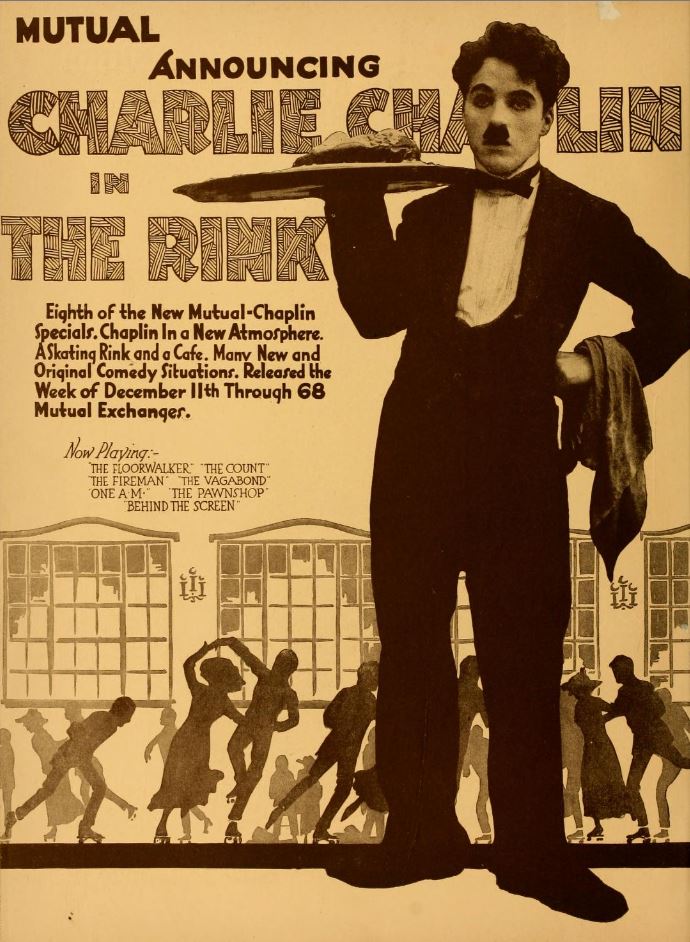
I remember a television station showing "The Rink" in the 1970s when roller skating became popular.
 |
| Motography, April 1, 1916 |
By 1916, Chaplin may have been the most popular man not only in film but in the whole world. Everyone wanted to see his movies, especially the soldiers in the trenches.
 |
| Film Fun, April, 1916 |
Lots of people wanted to be Charlie Chaplin. Kids could be Charlie by sending ten cents to the NUIDEA Company of Brooklyn. They would receive a "Chas. Chaplin Mustache," an imitation gold tooth, a $1000 bank roll of stage money an "Ish Ka Bibble" lapel button and the "Great Chaplain Coin Vanisher." I wonder why it includes a gold tooth. The "Ish Ka Bibble" button is interesting. I remember Ish Kabibble, Mervyn Bogue, who performed with Kay Kyser. According to Wikipedia, "Ish Ka Bibble" is a fake Yiddish expression that is said to mean "I should worry?" I'd love to own a Great Chaplain Coin Vanisher.
 |
| Film Fun, January, 1916 |
Adults often participated in Charlie Chaplin look alike contests. The
Film Fun images are from such a contest in Dublin. There is a popular story that Chaplin himself entered a look alike contest and came in second. This is probably not true, but it is a good story.
 |
| Moving Picture World, December 9, 1916 |
Other people who wanted to be Charlie Chaplin did it professionally. Billy West used the tramp costume in a long series of comedies for different studios. Note the large top photo. The round insert shows West out of makeup.
 |
| Moving Picture World, June 3, 1916 |
The Juvenile Film Corporation presented Joseph Monahan imitating Charlie Chaplin in a burlesque on Charlie Chaplin's "Burlesque on Carmen."
 |
| Moving Picture World, November 11, 1916 |
Billie Ritchie was a special case. He dressed in a tramp costume and wore a small moustache, but Ritchie claimed he was wearing the tramp costume two or three years before Chaplin was born in 1889, and that Chaplin was imitating his act. Chaplin and Ritchie are seen in the
Film Fun cover at the top of this post.
 |
| Moving Picture World, April 8, 1916 |
Harold Lloyd, another of James Agee's "four most eminent masters," starred in a series of Lonesome Luke comedies. Lonesome Luke resembled Chaplin with some variations, like a thin moustache instead of a toothbrush, and tight pants instead of baggy. The Rolin Film Company was founded by Hal Roach and Dan Linthicum. Note that Lloyd's name does not appear in this April ad.
 |
| Moving Picture World, August 5, 1916 |
Harold Lloyd's name is featured prominently in this August ad for "Luke Crystal Gazer."
 |
| Moving Picture World, September 9, 1916 |
This ad for "Luke Joins the Navy" includes photos of Lloyd's two frequent co-stars, Bebe Daniels and Snub Pollard. Bebe Daniels left Lloyd in 1920 to star for Cecil B DeMille. She became a major star. Australian Snub Pollard had a long career in comedy.
 |
| Moving Picture World, September 23, 1916 |
This ad for "Luke and the Mermaids" mentions Luke, Snub and Bebe by name. It does not use Harold Lloyd's real name. Lloyd got tired of imitating Chaplin. In 1917, he got the idea for the "glasses character" that he used to become a member of the comedy pantheon.
 |
| Moving Picture World, December 16, 1916 |
Meanwhile, back at Essanay, partner George Spoor was looking for a comedian to take Charley Chaplin's place. He signed international star Max Linder. Linder had appeared in early Pathé slapstick comedies in France. He became a major star before World War One. There is some confusion about what he did in the war, but he was wounded or became seriously ill and newspapers reported that he had died. This was not true, but the French film industry, the most powerful in the world before the war, had mostly shut down. Max took the offer from Essanay and came to America, signing a deal to make six short films. The first two did poorly and the third did only a little better, so that was the end of the series.
 |
| Tacoma Times, December 2, 1916 |
James Agee's "four most eminent masters" included my personal favorite, Buster Keaton. In 1916, Keaton was still appearing in vaudeville with his father Joe and his mother Myra. This ad for the Pantages Theater in Tacoma bills the Three Keatons as "Fun's Family." I like way Ricker and Winifred are billed as "Riotous Funsters." Keaton made his film debut the following year with Roscoe Arbuckle.
 |
| New York Tribune, November 12, 1916 |
The last of James Agee's "four most eminent masters" was Harry Langdon, who didn't make his film debut until 1923. In 1916, he was appearing at the apex of the vaudeville world, New York's Palace Theater, with his wife in "Johnny's New Car." Irene Bordoni was an important actress and singer. George Whiting wrote the lyrics for "My Blue Heaven."
 |
| Moving Picture World, June 24, 1916 |
Walter Kerr argues in
The Silent Clowns that James Agee's list of four was limiting. He said that Laurel and Hardy need to be considered among the great silent comics, although he allows that their sound career was more important. Oliver "Babe" Hardy was a veteran of silent comedy in 1916. He appeared in a series of Vim comedies partnered with little Billy Ruge as Plump and Runt. Vim's other comic team was cleverly named Pokes and Jabs (Bobby Burns and Walter Stull).
 |
| Variety, April 14, 1916 |
Hardy's future partner, Stan Laurel, would make his film debut the next year, using his original name, Stan Jefferson. In 1916, Stan was appearing in vaudeville with his wife, Mae, and another person, billed as the Keystone Trio or the Stan Jefferson Trio. Stan Jefferson imitated Charlie Chaplin in the act, which was appropriate because he had been Chaplin's understudy with the Fred Karno pantomime troupe.
 |
| Bryan Daily Eagle and Pilot, 18-July-1916 |
Walter Kerr suggested that another candidate for the pantheon might be Lloyd Hamilton, who starred in short comedies into the sound era. In 1916, we was usually teamed with little Bud Duncan as Ham and Bud. These were some roughneck comedies. Sadly, many of the solo movies Hamilton made for Educational during the 1920s are lost. The Dixie Theater featured Ham and Bud in "The Great Detective." Harry Myers, who would appear on the next day's bill with his regular partner Rosemary Theby, later played the drunken millionaire in Chaplin's City Lights.
 |
| Daily Capital Journal., 24-March-1916 |
Walter Kerr said that women did not have the same opportunities as men to star in slapstick comedies. Mabel Normand made many wonderful comedies, but her career was cut short by scandal and ill health. "Fatty and Mabel Adrift" was one of several movies she made with Roscoe Arbuckle.
 |
| Moving Picture World, August 19, 1916 |
Another person who did not get the same opportunities as some men was the Bahamian-American comedian Bert Williams, who made two short films for the Biograph in 1916, "A Natural Born Gambler" and "Fish." Williams appeared in vaudeville and the Ziegfeld Follies. He died tragically young in 1922.
 |
| Moving Picture World, October 14, 1916 |
Henry Lehrman got his nickname, "Pathé," when he showed up at the Biograph studio and claimed to have had lots of experience with the Pathé company in France. Director DW Griffith, amused by his audacity, gave him work as an extra and a stuntman. Lehrman worked his way up to directing comedies before Mack Sennett left to form Keystone. Lehrman came along, and wound up directing Charlie Chaplin's first movie, "Making a Living." Lehrman left Sennett along with Ford Sterling to make movies for Universal. Lehrman broke up with Sterling to form the L-KO (Lehrman Knock-Out) Komedy Kompany. Lehrman was also nicknamed "Suicide" because he was known for risking the lives and limbs of his performers. L-KOs had a reputation for being rough and ready comedies. I assume that this L-KO ad includes an image from "The Surgeon's Revenge." I include a detail view below.
 |
| Moving Picture World, October 14, 1916 |
 |
| Moving Picture World, October 28, 1916 |
Cross-eyed Ben Turpin will never make it into the pantheon of slapstick comedians, but he had a very long career and made a lot of people laugh. "He Died and He Didn't" is an interesting title. Notice the Vogue motto: "Slapstick with a Reason."
 |
| Moving Picture World, October 14, 1916 |
I don't remember reading much about Marcel Perez, who played a character called Tweedledum or Dweedledum or Tweedie in slapstick comedies for various companies. He started out in pre-World War One French comedies, then moved to Italy, then came to America because of the war. He worked for various companies, performing and directing. I learned about his career from a chapter in Steve Massa's book
Lame Brains and Lunatics.
 |
| Moving Picture World, October 21, 1916 |
Comedy producer and director Al Christie left Nestor in 1916 to form the Christie Film Company with his brother Charles. The Christie Brothers produced comedies in competition with Mack Sennett and Hal Roach until 1933. "Christie Comedies set a high mark in clean wholesome fun -- not slapstick but funny."
 |
| Moving Picture World, January 1, 1916 |
Sammy Burns was an obscure slapstick comedian. I don't know why Vogue chose to omit his last name from this ad and call him "Sammy???" Notice that Vogue's motto is stated as "Slapsticks with a Reason." His previous release, "Sammy's Scandalous Scheme," involved Sammy's character imitating Charlie Chaplin.
 |
| Moving Picture World, April 8, 1916 |
Handsome Harry Watson, Jr played Musty Suffer in a series for George Kleine.
 |
| Moving Picture Magazine, November 1915 |
And finally, I thought I would end with a surprise. It is from 1915, but I couldn't resist. I think I know what it is. Would anyone else care to offer an opinion? Nice drawing of Charlie.
This post was part of the Classic Movie History Project Blogathon hosted by Fritzi at Movies Silently, Ruth at Silver Screenings and Aurora at Once Upon a Screen. Thank you to all three of them for all the hard work. Thank you to everyone who visited and I encourage you to read and comment on as many posts as you can.
I participated in several movie blogathons at my other blog,
The Pneumatic Rolling-Sphere Carrier Delusion.
You can visit them here.


