 |
| New York Clipper, 01-February-1908 |
Showing posts with label American Mutoscope and Biograph Company. Show all posts
Showing posts with label American Mutoscope and Biograph Company. Show all posts
Thursday, April 4, 2024
Lively Times in a Quiet Place While Waiting for a Train -- April 4, 2024

Sunday, September 3, 2023
Biograph -- All Films 12 Cents -- September 3, 2023
 |
| New York Clipper, 11-April-1903 |
The American Mutoscope and Biograph Company was an early American producer and manufacturer. Biograph offered its own productions, many made at the famous studio at 11 East 14th Street in Manhattan. They also carried Star Films produced by Georges Méliès in France and British films made by Charles Urban's Warwick Trading Company.
This ad also has a "Special -- Just Received, Launching of Shamrock III, With Sir Thos. Lipton and His Guests." British yachtsman Sir Thomas Lipton, founder of the tea company, tried to win the America's Cup five times between 1899 and 1930, always with a boat named Shamrock. He never won, but he was widely respected for his sportsmanship. Perhaps this was film of the launching of the Shamrock III in 1903:
Friday, August 4, 2023
Films 12 Cents (A Foot) -- August 4, 2023
 |
| New York Clipper, 18-April-1903 |
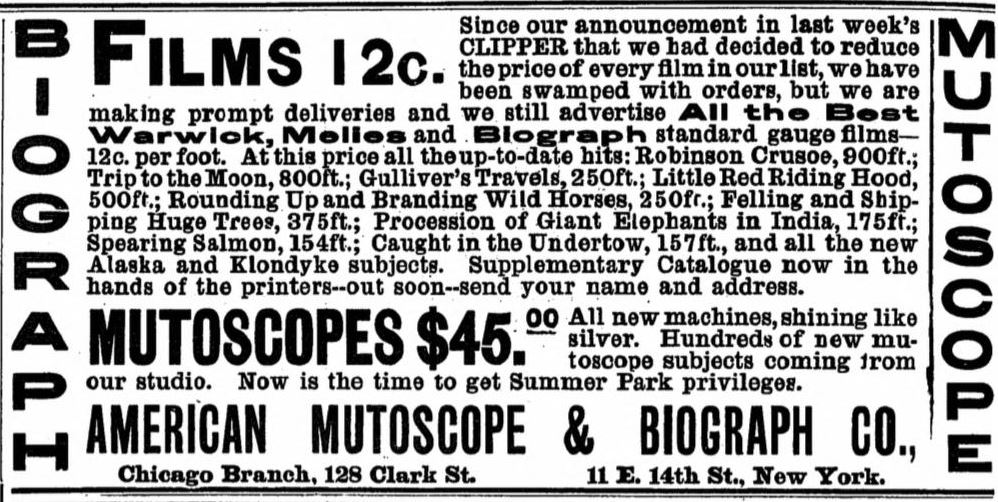
The American Mutoscope and Biograph Company was an early American producer and manufacturer. You could by a new Mutoscope, a coin-in-the-slot machine, for $45, "new machines, shining like silver."
Biograph offered its own productions, many made at the famous studio at 11 East 14th Street in Manhattan. They also carried Star Films produced by Georges Méliès in France and British films made by Charles Urban's Warwick Trading Company.
 |
| Motion Picture News, 11-August-1923 |
Sunday, June 25, 2023
Biograph Plant as Memorial -- June 25, 2023
 |
| Film Daily, 06-June-1923 |
Sigmund Schlager of the Luxor Company proposed that "a committee of stars and producers" could take up the task of collecting money to purchase the old American Mutoscope and Biograph Companystudio at 11 East 14th Street in Manhattan and "maintain it as a memorial to the pioneers of the industry." That would have been neat.
DW Griffith directed his first movies in the brownstone building. In large part because of Griffith's success, Biograph moved to a new, larger location in 1913. The building was torn down in the 1960s.
Wednesday, May 3, 2023
Biograph -- New Films From Icy Alaska and the Golden Northwest -- May 3, 2023
 |
| New York Clipper, 28-March-1903 |
The American Mutoscope and Biograph Company was doing well in 1903. You could have bought a Mutoscope, "the king of all slot machines," for $45. Most of the films listed were taken during the Yukon Gold Rush.
Friday, February 3, 2023
We Now Have in Stock Méliès' Greatest Triumph -- February 3, 2023
 |
| New York Clipper, 14-March-1903 |
The American Mutoscope and Biograph Company released "Robinson Crusoe," Star Film's production number 430–443. This was made by French producer, director, writer, set designer and actor, Georges Méliès. I do not know if Biograph held rights to the movie, or they were engaging in piracy.
Thursday, October 6, 2022
Marion Davies -- When Knighthood Was in Flower -- October 6, 2022
 |
| Motion Picture News, 28-October-1922 |
When Knighthood Was in Flower was an 1898 novel written by Edwin Caskoden. His real name was Charles Major. The story was inspired by the life of Mary Tudor, Henry VIII's sister. The book sold well. In 1901, Paul Kester adapted the story into a play which was also successful.
In 1907, the Biograph Company produced a one-reel adaption called When Knights Were Bold. DW Griffith, who had not yet become a director, played a role, as did his secret wife Linda Arvidson. The film is probably lost.
In 1922, William Randolph Hearst was looking for a suitably ostentatious project for his inamorata, Marion Davies. His production company, Cosmopolitan, hit upon When Knighthood Was in Flower. Director Robert Vignola used a virtually unlimited budget to create a huge movie.
 |
| Moving Picture World, 07-October-1922 |
I have never seen it, but Criterion has released a restored version with a score by Ben Model.
I have never seen it, but Undercrank Productions has released a restored version with a score by Ben Model. It is on my queue.
In 1953, Disney decided to make another adaption of the story, directed by Ken Annakin. It was released in the US as The Sword and the Rose If I have seen it, I don't remember it.
 |
| listal.com |
 |
| listal.com |
In 1953, Disney decided to make another adaption of the story, directed by Ken Annakin. It was released in the US as The Sword and the Rose If I have seen it, I don't remember it.
Monday, October 3, 2022
Wanted, 10 Mutoscopes of the Mutoscope and Biograph Co.'s Make -- October 3, 2022
 |
| New York Clipper, 28-March-1903 |
Mr CW Parker of Abilene, Kansas was looking for ten Mutoscopes, one railroad sleeping car and "one ten cent in the slot tin type photograph machine." I wonder if he found everything he wanted.
Tuesday, August 2, 2022
Melie's Latest Triumph -- August 2, 2022
 |
| New York Clipper, 07-March-1903 |
The American Mutoscope and Biograph Company released "Robinson Crusoe," Star Film's production number 430–443. This was one of French producer, director, writer, set designer and actor, Georges Méliès. I do not know if Biograph held rights to the movie, or they were engaging in piracy.
Thursday, December 2, 2021
Biograph Business Booming -- December 2, 2021
 |
| New York Clipper, 28-February-1903 |
The American Mutoscope and Biograph Company was doing well in 1903. You could buy a new Mutoscope for $45. Films of the Durbar Pageant in Delhi allowed American audiences to see the great festival honoring the crowning of Edward VII, King and Emperor. Lord Curzon, the Viceroy of India, represented the monarch.
Saturday, October 2, 2021
Mutoscopes and Films -- October 2, 2021
 |
| New York Clipper, 05-September-1903 |
The American Mutoscope and Biograph Company offered Mutoscope devices and also standard films, including some produced in Britain by Charles Urban and Cecil Hepworth. Anna Held, shown viewing a Mutoscope, was a musical performer who was heavily promoted by her common-law husband Flo Ziegfeld.
Thursday, June 3, 2021
Zane Grey Week -- Fighting Blood -- June 3, 2021
 |
| Motion Picture News, 21-May-1921 |
Zane Grey was a popular Western novelist in the first half of the Twentieth Century. I had read about movies made from his stories, so I took a few novels out from the Anza Branch Library. It turns out that he was not a very good writer, but he did produce interesting characters and descriptions.
I thought I might join with producer Benjamin B Hampton and have a Zane Grey Week.
I thought I might join with producer Benjamin B Hampton and have a Zane Grey Week.
As far as I can tell, the first movie made from a story or novel by Zane Grey was "Fighting Blood." The one reel movie was directed by DW Griffith and is often praised for its building intensity. Biograph released it in 1911.
 |
| Moving Picture World, 08-July-1911 |
This article does not mention Zane Grey, who was already a popular author. I have read about the movie for many years in books and articles about DW Griffith and I don't remember reading that it was based on a Zane Grey story.
 |
| St Landy Clarion, 04-June-1922 |
Tomorrow: Zane Grey's most popular novel, Riders of the Purple Sage.
Zane Grey Week -- June 2-9, 2021
June 02, 2021: Zane Grey Week
June 03, 2021: Zane Grey Week -- Fighting Blood
June 04, 2021: Zane Grey Week -- Riders of the Purple Sage and Others
June 05, 2021: Zane Grey Week -- Tom Mix Takes Over
June 06, 2021: Zane Grey Week -- Riders as a Talkie
June 07, 2021: Zane Grey Week -- Another George Plays Lassiter
June 08, 2021: Zane Grey Week -- Riders on Television
June 09, 2021: Zane Grey Week -- The Man of the Forest
Saturday, June 9, 2018
The Adventures of Dollie (1908) -- June 9, 2018

This post is part of the Springtime Silent Movie Challenge: In the Beginning..., hosted by Fritzi at Movies Silently. "Here’s the challenge. Before June 21, 2018, you will:
"Watch 5 movies made between 1906 and 1914
"Watch 5 movies made in 1905 or before
"Share your experience on your blog, on social media or here in the comments (I will set up a special post for the purpose to publish on June 21)"
For my five movies made between 1906 and 1914, I thought I would continue to look at some pioneering efforts.
My ninth film, my fourth from 1906-1914, is Biograph's "The Adventures of Dollie," the first film directed by DW Griffith.
 |
| www.listal.com |
In 1907, Griffith visited the Edison company in New York and tried to sell them a script. They didn't want the script, but they gave Griffith a leading role in Edwin S Porter's "Rescued From an Eagle's Nest." Griffith and his wife, Linda Arvidson, continued acting in films for Edison and Biograph. They kept their marriage a secret.
In 1908, Biograph's primary director Wallace McCutcheon fell ill. His son, Wallace, Jr took over but didn't do a very good job. Biograph offered the job to Griffith, but he worried that if he failed as a director, he wouldn't get work as an actor. Biograph assured him he could go back to acting.
One of the first film books I read at the Anza Branch Library was Linda Arvidson's When the Movies Were Young. She spoke disparagingly of "The Adventures of Dollie," and I assumed she was right, since there was no chance I would ever get to see it. But then, years later, I took a film class at San Francisco State. We saw a beautiful print of "The Adventures of Dollie" and I found that it held the attention of the whole class.
This is not as nice a print as the one I saw in film class.
I should mention that this movie is steeped in anti-Gypsy prejudice. The word "Gypsy" is a slur used to refer to people who generally call themselves Romani. The Roma are scattered over Europe and the Americas. The Romani are known for living transient lives, usually on the fringes of society. Stereotypes accuse them of being thieves, con artists and kidnapers of children. I remember when we visited Italy in the 1970s that the relatives were upset when a band of zingari set up camp by the river. I will use the word "Gypsy" here because we are talking about a stereotyped depiction.

On bright, sunny day we see a family of three, played by Arthur Johnson as the father, Linda Arvidson as the mother and Gladys Egan as Dollie. They are all well-dressed. Dollie is excited. Father leaves them for some reason that is not clear from the action.

We see two boys dressed like Tom Sawyer and Huckleberry Finn walking down a rough road along a river, on their way to go fishing.

In the same shot, Dollie and Mother approach and sit by the river.

Still in the same shot, a strangely dressed man approaches. He is a Gypsy basket-seller, played by Charles Inslee.

Mother greets him politely, but isn't interested in buying a basket. The Gypsy starts to walk away, but he comes back and snatches her purse. Mother grabs his arm.

The Gypsy shoves Mother to the ground and is pushing Dollie away when Father enters in the background, sees what is happening, and rushes to the rescue.

Father thrashes the Gypsy, who begs for mercy. He picks up his baskets and runs away. He has pulled out a knife sometime during the action, but no one seems to be concerned. This shot lasted for about 1 minute and 44 seconds.

We see a Gypsy camp. A sleeping woman wakes up and tends some items on a fire. Note the barrel by the rear of the wagon. The Gypsy enters and shows her how he has been injured. Mrs Gypsy ties a bandage around his arm. The Gypsy decides to get vengeance. He pantomimes kidnapping Dollie and putting her in the wagon. Mrs Gypsy tries to stop him, but he knocks her down and leaves the scene.

Dollie and Father are playing with rackets and a ball. Mother enters and says something. Father and Dollie go to follow as she leaves, but Dollie wants to stay and play.

Almost immediately, the Gypsy enters and grabs Dollie. After he carries her away, Mother reenters and looks for Dollie. Mother becomes upset and calls for Father, who enters and looks around. Father calls for help.

A woman enters and leads Mother away. A man enters and runs off with Father.

We see the Gypsy run down a hillside, holding Dollie, In the background, a man cuts weeds.

Soon we see Father and the other man. The man cutting weeds shows them where the Gypsy went and joins them. He didn't notice that the Gypsy was running with a little girl?

Back at the Gypsy camp, Mrs Gypsy is throwing things into the back of the wagon. The Gypsy enters, carrying Dollie. Mrs Gypsy holds Dollie while the Gypsy throws more stuff in the back of the wagon.

The Gypsy senses someone coming and drops Dollie into the barrel and puts on the cover.

Father and the other men enter. The Gypsy, leaning casually on the barrel, denies knowing anything about Dollie.

Father searches the wagon, throwing out a bunch of junk. He expresses his frustration and leaves with the other men. The Gypsies celebrate, and then the Gypsy reloads the wagon. He finishes by placing the barrel on the tailgate. They drive away in the wagon.

We see the Gypsy wagon race along a dusty country road towards the camera.

The wagon fords a wide body of water and the barrel falls in.

The barrel floats on a stream towards the camera. We see the water begin to quicken.

We see the water flow over a weir, a low dam.

The shot holds for a long time. We see the barrel go over the weir.

In a nice shot, we see the barrel float towards the camera.

We see another shot of the floating barrel.

We see a boy fishing. He may be one of the boys we saw earlier, but it is impossible to tell. He sits at the spot where Dollie and Mother had sat by the river. The boy spots something in the water. The camera does not move and there is no cut to what he sees.

The boy hooks the barrel and pulls it in with his fishing rod.

Something startles the boy, who jumps back. It was probably Dollie making a noise. He waves his arm and Father runs out from the woods and helps the boy lift the barrel to the riverbank.

They both lean down to listen to the barrel. Father picks up a rock, breaks the lid, and lifts up Dollie.

Father hugs Dollie and calls to Mother, who runs in from the bushes. The family is reunited.

And the film ends.
"The Adventures of Dollie" was a success, selling more prints than the average Biograph film.
 |
| Variety, 11-July-1908 |
 |
| Moving Picture World, 18-July-1908 |
"The Adventures of Dollie" does not include any of the techniques for which Griffith soon became famous. There are no closeups. There is no intercutting. The performances are not impressive. On the other hand, it compares well to other 1908 movies. I was impressed when I saw it in film class and we all cheered at the end.
Coming Next Saturday: The first Keystone comedy.
Subscribe to:
Posts (Atom)