![]() |
| Moving Picture World, 05-April-1919 |
Sunday, April 7, 2019
Bolshevism on Trial -- April 7, 2019
Friday, April 5, 2019
U.S. Prize Fight Ban Off, RKO Takes Over -- April 5, 2019
![]() |
| Motion Picture Herald, 20-July-1940 |
Many cities and states, fearing racial unrest, banned films of the 04-July-1910 fight between heavyweight champ Jack Johnson, who was African-American and former champ James Jeffries, who was white. In 1912, Congress banned interstate transportation of fight films. The ban remained in place until 1940.
U. S. PRIZE FIGHT BAN OFF, RKO TAKES OVER
RKO Will Distribute Jenkins-Armstrong Bout Pictures for Pathe; First Since July, 1912
National distribution of prize fight films, outlawed by Federal legislation for 28 years, was to resume as a legitimate practice this week with Pathe News filming and RKO Radio Pictures handling the pictures of the bout of Lew Jenkins, world's lightweight champion, vs. Henry Armstrong, world's welterweight champion, scheduled for Wednesday night at the Polo Grounds in New York City.
Banned in 1912
From July 31, 1912 when the Sims act forbidding interstate commerce in fight films was passed until July 1, 1940 when it was repealed through the efforts of Senator William Warren Barbour, the regular motion picture industry had no interstate distribution of such films and during the 28 years the so-called "sports crowd" had a monopoly on the business, despite the law.
In the early days of the industry prize fight films contributed to the development of new picture making techniques in addition to being popular screen entertainment. In July, 1894 the first prize fight films were made at Edison's "Black Maria" studio in West Orange, N. J. The principals were Michael Leonard, "Beau Brummel of the prize ring" and Jack Cushing, contender for the lightweight crown. Six of the ten rounds were recorded by the Kinetograph and nearly 1,000 feet of film was used, a record.
James Corbett, heavyweight titleholder was signed in August, 1894, to the first exclusive star contract in film history, Corbett fought six one-minute rounds for the camera and gave the pre-arranged knock-out blow at the end of the sixth. The Corbett-Fitzsimmon fight in Carson City was filmed there and faked in Philadelphia and both versions did good business. Biograph introduced photography under lights at the Jeffries-Sharkey fight in 1899. The fight film business continued until adverse reaction followed the Jack Johnson-Jim Jeffries fight at Reno on July 4, 1910.
The Johnson-Jeffries film grossed, according to reports, $300,000 for the old General Film Company. But in some places exhibition of the film occasioned race-riots and Johnson's activities after the fight were not such to quiet public protest. On July 31, 1912 Congress passed the Sims bill which made interstate traffic in fight films unlawful.
A negro and a white man were the contenders in the last legal fight for film purposes in 1912 and in the first since the law was repealed this year.
RKO promised prints for the metropolitan New York area the day following the Jenkins-Armstrong fight and on the second day for theatres throughout the country. Exclusive film rights to fight were obtained in a deal with the Madison Square Garden Corporation and Mike Jacobs, fight promoter and head of the Twentieth Century Sporting Club. Stanton Griffis, chairman of the executive committee of Paramount, is chairman of the board of directors of Madison Square Garden. Ned E. Depinet, vice-president, concluded the arrangement for RKO.
During the 28 years that the law against the interstate traffic in prize fight films was on the books it was openly violated, in many instances. When independent distributors were caught crossing state lines with fight films they were often compelled to pay a $1,000 fine but usually went right on with the distribution of the picture.
The "sports crowd" which controlled the fight films made' during the 28 years of the Sims act sold some pictures widely but complete national distribution was not possible. Many exhibitors did not wish to violate the law ; others became discouraged when motion picture practices were violated, as when prints were sold simultaneously to competing theatres.
Major distributors were never barred from handling fight pictures in other countries. Universal handled the distribution of the Joe Louis-Arturo Godoy fight of February IS, 1940 for all foreign countries except possessions of the U. S. The promoter of that film was Jack Dietz' Sports Attractions which specialized in the filming of such events. The film rights were bought from Mr. Jacobs.
The future of the fight film business is uncertain at present. The fact that RKO Pathe obtained the films rights to the first big bout after the Sims law was repealed indicated, it was said, that a major picture company is willing to pay more than formerly paid by the "sports crowd" for such rights. It was reported that RKO and Paramount might bid for the film rights to the next big fight ; a joint distribution set-up was said to be possible.
RKO expects that the Jenkins-Armstrong films will be widely received because there is no longer the legal difficulty for exhibitors out of the state and because a regular production crew might be expected to obtain better films and better sound than in former fight pictures. It was said that the rentals would probably be about the same.
![]() |
| Motion Picture Daily, 15-July-1940 |
![]() |
| www.listal.com |
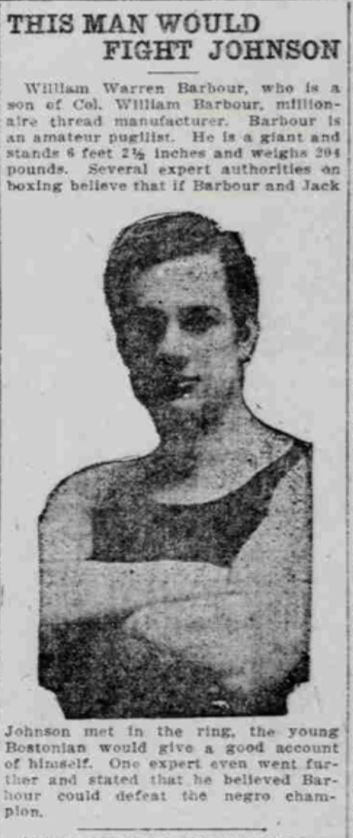
"MILLIONAIRE KID'S" FIGHT FILM REPEALER
Senator William Warren Barbour's (Rep., N. J.) interest in sponsoring the Congressional repeal of the Federal ban on interstate transportation of fight films, enacted over the last weekend in June with almost unprecedented lack of opposition and attention, goes back some 29 years, when the Senator was then reigning national amateur heavyweight boxing champion.
Warren Barbour, billed as "The Millionaire Kid," was generally conceded to be the chief "white hope" to end the conquests of big, black Champion Jack Johnson. Boxer Barbour, son of a wealthy Jersey manufacturer, was all for the match, but his parents were adverse to his turning professional. He took his gloves off for his parents.
Shortly afterward, the Federal fight film ban was enacted, in 1912, because of Johnson's mauling of white fighters and because of some spectacular personal behaviour in Chicago.
Senator Barbour, in Congress, long felt that the ban was an archaic handicap to the sport, got his friend, Jack Dempsey, to so testify before a Congressional committee. The repeal resulted.
![]() |
| El Paso Herald, 12-July-1910 |
Wednesday, April 3, 2019
Larry Spent 93% of What Was in the Till On This One -- April 3, 2019
![]() |
| Moving Picture World, 12-April-1919 |
"Larry Spent 93% of What Was in the Till On This One." This could be a foreshadowing of troubles to come for Larry Semon.
![]() |
| Moving Picture World, 12-April-1919 |
![]() |
| Moving Picture World, 05-April-1919 |
![]() |
| Moving Picture World, 05-April-1919 |
![]() |
| Exhibitors' Herald, 19-April-1919 |
Monday, April 1, 2019
Hula Hula Island -- April 1, 2019
Sunday, March 31, 2019
Love-Joy Scenes -- March 31, 2019
![]() |
| Moving Picture World, 01-March-1919 |
![]() |
| Moving Picture World, 22-March-1919 |
![]() |
| Moving Picture World, 08-March-1919 |
Saturday, March 30, 2019
Agnès Varda, RIP -- March 30, 2019
Friday, March 29, 2019
How Fatty Arbuckle Makes "Love" -- March 29, 2019
![]() |
| Moving Picture World, 08-March-1919 |
"HOW FATTY ARBUCKLE MAKES 'LOVE'
"Roscoe of the Movies in New York for a Week-End After Signing a New Paramount- Arbuckle Contract — Tells of Latest Comedv With the Romantic Title
"By Edward Weitzel
"IN one way Roscoe of the Movies is a disappointment. He keeps all of his comedy for his pictures. During an hour's interview with him he did nothing to uphold his reputation as one of the leading funny men of the screen. He leaned against a desk in a corner office at the Paramount and talked as soberly and sensibly of his plans and his work as might the head of a steel corporation. Before many minutes his listeners began to understand why it took more time and money to make one of his two-reel comedies than are required to complete the average five-part serious drama.
"Hard mental application and days of preparation are necessary to produce a piece of business that may not run a minute. The story is written as Scenarist-Director-Actor Arbuckle thinks up a new bit of the comic-continuity and tries it this way and that and starts all over again and tries it another way and four or five other ways and then throws them all away and thinks up something new.
"Such a steady course of close brain-work doesn't leave a man much time to be funny in a casual off-hand way for the amusement of chance callers. That is why he is glad to relax occasionally and have other persons do funny things to make him laugh. So he has run on from Kansas City for a week end in Times Square and a visit to as many smart shows along Broadway as can be taken in before he starts back for the Coast on Sunday.
"Arbuckle Renews Contract.
"'How did you come to make your start from Kansas City instead of Los Angeles?' Roscoe Arbuckle was asked.
"'It was an after thought,' was the reply. 'My old contract with the Paramount was about up and Joseph M. Schenck, my manager, and Lou Anger, my personal representative, met Adolph Zukor at the Mouhlbach Hotel, in Kansas City, last Saturday, and signed a new contract and I was taken along to keep me out of mischief. The business was completed in short order and everyone was so pleased with the terms of the contract that the New York members of the deal insisted upon dragging me back with them for a play spell.'
"'He didn't need much urging,' put in Personal Manager Anger. "And I don't mind saying for Mr. Arbuckle, who is a painfully modest man, that the new contract is the largest one ever signed by Mr. Zukor for an individual artist. It covers a period of three years and involves over three million dollars."
Comedian Pays Tribute to Associate.
"A large American flag floating from a tall flagpole in front of the Public Library changed the conversation to the wonderful parades that have passed up Fifth Avenue during the war and since the boys have started to come home.
"'Where's 'Buster' Keaton?' the stout comedian was asked.
"'Still over in France, waiting to be sent back. We are making every effort to get him started. It is utterly impossible to replace him. To my mind, 'Buster' is the coming comedian of the movies and will be a very successful star.'
"'I'll wager he is a great favorite with his company.
"'He can entertain them, all right. By the way, he had a funny experience, or rather his drill squad did, when 'Buster' first joined the army. He was eager and anxious to learn but knew just as little about handling a gun and about military tactics as the rest of the rookies. In going through the drill he unconsciously put in some of the funny steps and movements with which he was accustomed to burlesque military exercises. Everyone knew who he was and nothing but military discipline kept him from breaking up the show. When off duly he was the best entertainer in camp, with his ukelele solos and his stock of natural comedy. We'll all be glad to get him back again.
Yes, Luke Is a Regular Actor.
"'How about the four-footed member of your company — you must pay him an enormous salary to make him such a willing worker.
"'My dog! Oh, he's a true artist and works for pure love of his art.'
"'What part of his art does he love best?
"'Biting Al St. John and 'Buster' Keaton.'
"'Do you have any trouble teaching him his share of the business?'
"'Very little. The only thing is to prevent him from overdoing it. Both boys wear stout leather union suits when there is to be a mix-up with the dog, and the instant they start to run he darts after them without being told. In the picture where he jumps off the pier we didn't bother about rehearsing him. It was a thirty-foot drop, but the instant one of the actors jumped he was right after him. It must have hurt when the dog struck the water, but he was always game for the next jump.'
"'That must have been a difficult scene to photograph,' remarked Publicity Promoter Peter Smith.
Is Careful About Risks.
"'Well,' explained the comedian, 'it took us two days to get the camera rigged so that we could shoot the jumps, and you know how many minutes the scene lasts. One reason why it takes so much time and expense is because we are obliged to guard against accident. We cannot afford to take any unnecessary chances of the actors getting hurt. There is enough risk that cannot be avoided, as it is.'
"The next question asked the comedian sounded like an attempt to pry into his private affairs :
"'Do you mind telling, Mr. Arbuckle, how you made 'Love'?'
The expected blush did not appear on the face of the man who has shown how Bill Hart was a maiden when he burlesqued him in "The Sheriff."
"'You mean my new picture? — some subject, isn't it?'
"'To tell in two reels ! — it certainly is. You're the hero, of course?'
Admits He Is There With Strong Arm Stuff.
"'Oh, yes ! I may not be as handsome as some of the other screen lady-killers, but I can be just as brave and hold the heroine in my arms just as long as the best of them.'
"'What kind of a hero are you? A cowboy hero?'
"'No, a farmhand hero who is in love with the farmer's daughter on the next farm. I have a rival, a rich young chap played by Al St. John, and he almost beats me to it in the tying of the wedding knot. But true love conquers in screen comedies — when the hero writes his own scenario — and I put one over on the wealthy youth by a trick, and marry the bride five minutes before he expects to make her his own wife. I'll not explain how the trick is worked, but it contains a lightning change act that I'm rather proud of.'
"'One more personal question, Mr. Arbuckle. Has your past experience made you competent to do justice to the subject? In other words, what do you know about making love?'
"'Everything. I've been making it all my life.'"
![]() |
| Moving Picture World, 01-March-1919 |
![]() |
| Moving Picture World, 15-March-1919 |
Subscribe to:
Posts (Atom)