Wednesday, April 30, 2014
Clara Bow #15 -- April 30, 2014
Red haired Clara Bow was probably the most popular silent actress after Mary Pickford. In this item from the 11-May-1927 Film Daily, she is called "The 'It' Girl" because of her appearance in the 1927 movie It.
Tuesday, April 29, 2014
Mechanical Toys as a Means of Practical Instruction -- April 29, 2014
From Scientific American / New Series, Volume 20, Issue 14, April 3, 1869
He who will introduce toys with the double object of amusing and instructing will be a benefactor to the race. We are aware that many of the popular toys now in use, are based upon mechanical laws, and, in a degree, illustrate mechanical facts; but this elucidation is not a primary or principal object in their construction, and can be found generally, only by a close study or a partial dissection of the toy. It is not apparent to the casual observer; indeed, the object seems to be to conceal the mechanism and exhibit only the result, tempting the inquiring mind -- one that likes to understand the why and wherefore, "that seeks to know where faith should trust" -- to copy the example of the boy who burst the head of his drum to see where the sound came from, or ripped the bellows to find the source of the wind. From the great steam man to the flying top, from Maelzel's automaton chess player to the pasteboard acrobats and dancers, the source of power and its modes of transmission are concealed as much as may be. Yet this is the best, most valuable, most interesting exhibition of the device. Concealment is not knowledge; mystery is not wisdom.
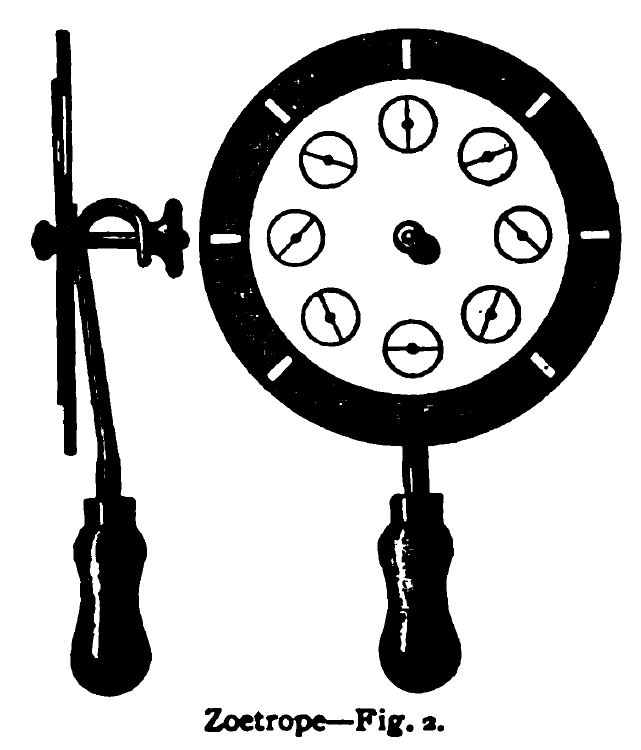
The zoetrope or "wheel of life" is a play upon the organ's vision, a valuable exemplification of the science of optics. As such it is amusing, and bewildering. But how valuable it would be to show the action of machinery, to illustrate mechanical movements. A machine or its parts might, by its use, be presented in actual, or rather apparent motion, showing not only the parts of the machine and their relations, but also their action. Why could not the principle of the zoetrope be extended to exhibit, simultaneously to every individual of a large audience, the movements of machinery? Certainly here is room for invention, or, at least, improvement. This toy might be made a valuable aid to impart scientific and mechanical knowledge. The lecturer who first succeeds in introducing the zoetrope to his class, or audience, to illustrate mechanical movements will inaugurate a profitable and valuable means of imparting knowledge. These suggestions are worthy the attention of our inventors.
The image is from The Young Folk's Cyclopædia of Games and Sports by John Denison Champlin and Arthur Elmore Bostwick, 1890. http://bigvriotsquad.blogspot.com/2014/02/zoetrope-27-february-2014.html
Monday, April 28, 2014
Educational -- Inspiring -- Clean -- Thrilling -- Historical -- April 28, 2014
On 25-March-1916, heavyweight champion Jess Willard, the Pottawatomie Giant, defended his title against Frank Moran, the Fighting Dentist at Madison Square Garden. Willard won in 10 lifeless rounds. This ad is from the 08-April 1916 Moving Picture World.
Willard, a cowboy who didn't start boxing until he was 27, was, at the time he won the title from Jack Johnson in 1915, the oldest (33), tallest (6' 6 1/2") and heaviest (235 pounds) heavyweight champ. There was some suspicion that Johnson might have thrown the fight, but no firm evidence.
Willard lost the title to Jack Dempsey in 1919. After a short retirement, Willard returned to the ring and fought well until 1923.
After Moran left the ring, he became an actor. He was a member of Preston Sturges' stock company, appearing in most of his movies.
From the New York Evening World, 27-March-1916.
Sunday, April 27, 2014
Mutoscope #2 -- April 27, 2014
A Mutoscope at San Francisco's Musee Mechanique (http://www.museemechanique.org/) . The sign ("This is an authentic, turn of the century Zoetrope!") is wrong. The Mutoscope is a hand-cranked entertainment machine that works like a giant flipbook. I took the photo on 20-September-2008.
Saturday, April 26, 2014
Grauman's Chinese #37 -- April 26, 2014
In July, 2012 we paid a return visit to Hollywood and Grauman's Chinese Theater. Sid Grauman was a San Francisco showman who came to Los Angeles and built three major houses, the Million Dollar, the Egyptian, and the Chinese. The theater has hosted many film premieres, but is most famous for the hand and footprints (and hoofprints and nose prints and other types of prints) in the forecourt.
Charles Laughton left his hand and footprints in the forecourt on July 24, but he didn't include the year. He was a great actor, but I think the first movie I remember him in was The Hunchback of Notre Dame. (31/DSC_0052.JPG)
Thursday, April 24, 2014
If You Have Not Yet Booked Oz Features Do So at Once -- April 24, 2014
The Oz Film Manufacturing Company, located in Los Angeles, was formed in 1914 to produce movies based on stories by L Frank Baum, the creator of The Wizard of Oz. The company made some movies, but was not a financial success. This ad is from the 10-October-1914 edition of Moving Picture World. It refers to their first two movies, The Patchwork Girl of Oz and The Magic Cloak of Oz. It claims that The Patchwork Girl had "Crowded Houses -- Playing to Standing Room Only -- At the Strand Theatre, New York City."
I know The Last Egyptian, a non-Oz Baum story got produced. I'm not sure about His Majesty, the Scarecrow of Oz.
Tuesday, April 22, 2014
America's Leading Photoplay Artist -- April 22, 2014
Actress Pearl White was the first serial queen, starring in The Perils of Pauline in 1914. Before the serials, she appeared in many comedies, such as the Crystals, released through Universal. The ad is from the 05-October-1912 Moving Picture World. "Split Reel Every Sunday. Consisting of Two Rip-Roaring Comedies."
Subscribe to:
Posts (Atom)